The PowerMentor Institute for Freedom and Justice explores leadership, freedom, and democracy issues with a commitment to those seeking freedom and self-determination, empowering those in regions with totalitarian control. We conduct thorough research using AI and other tools to provide the most accurate and insightful information available.
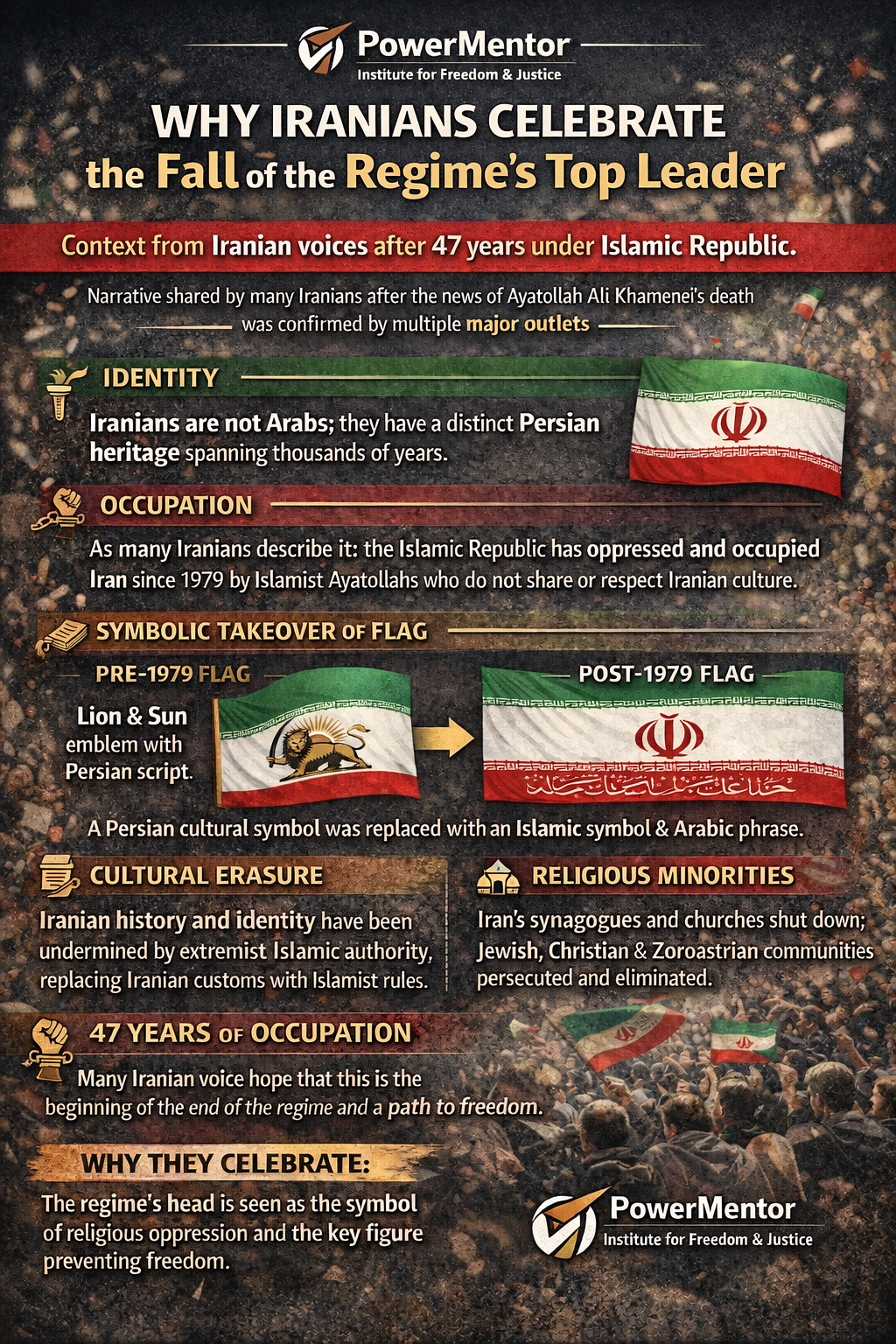
Why Iranians Celebrate the Fall of the Regime’s Top Leader
Understanding 47 Years of Cultural Suppression and Identity Conflict
For many outside observers, scenes of celebration inside Iran following the confirmed death of Ayatollah Ali Khamenei may seem confusing. How could citizens celebrate the death of their own country’s top leader?
To understand this reaction, one must understand the distinction many Iranians make between Iran as a civilization and the Islamic Republic as a regime.
This is not merely a political moment.
It is, for many, an identity moment.
Iran Is Not an Arab State
Iranians are Persian. Their civilization predates Islam by millennia. Persian language, culture, literature, and symbolism stretch back thousands of years.
Iran’s identity historically centered around Persian heritage — not Arab nationalism, and not political Islam.
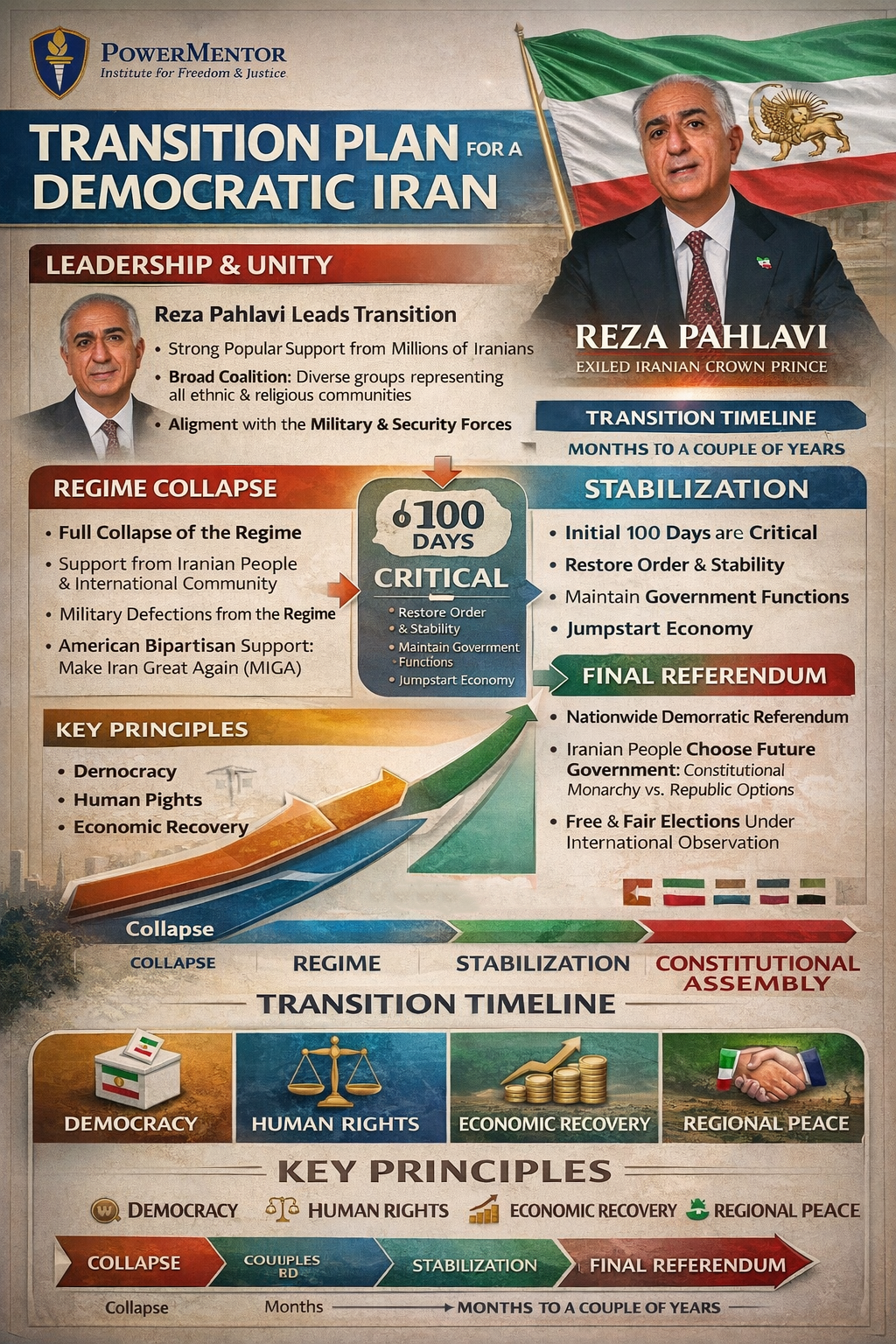
Transition Plan for a Democratic Iran
HRH Reza Pahlavi on Iran’s Transition: A Structured Plan for Regime Collapse, Stabilization, and Democratic Referendum
In a recent interview, HRH Reza Pahlavi outlined what he describes as a historic turning point for Iran and a detailed plan for a strong, stable national transition. His remarks focused on five core areas:
Regime Collapse
Immediate Stabilization (First 100 Days)
Coalition & Military Alignment
Constitutional Process
Final Democratic Referendum
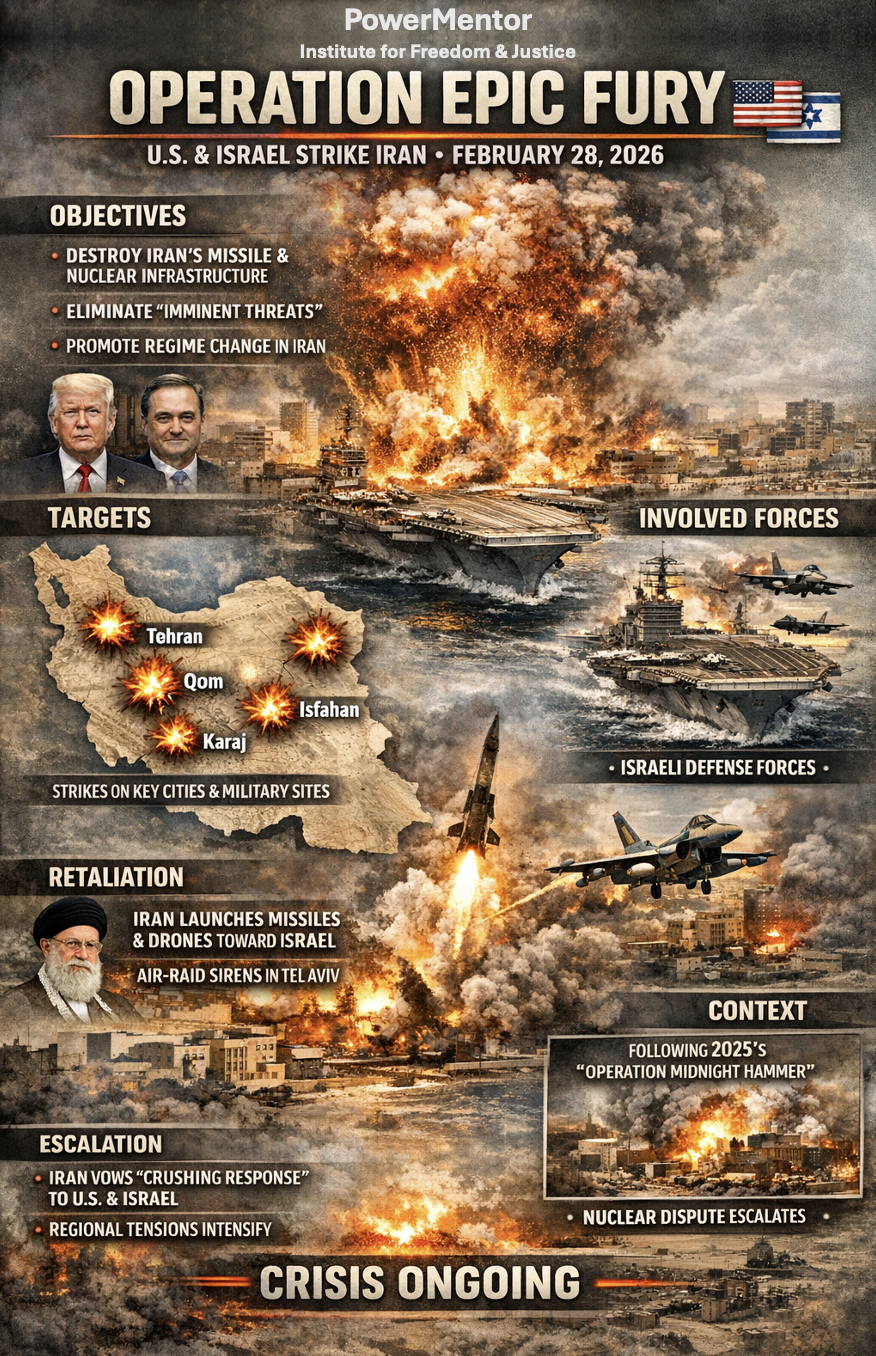
Operation Epic Fury: U.S. and Israel Strike Iran, Middle East on Brink of Broader Conflict
In a dramatic escalation of long-standing tensions over Iran’s nuclear program and regional influence, the United States and Israel launched coordinated military strikes against Iranian targets on February 28, 2026, in an operation the U.S. Pentagon has designated “Operation Epic Fury.”
Early Saturday morning, explosions rippled across Tehran and other Iranian cities including Isfahan, Qom, Karaj, and Kermanshah, as American and Israeli aircraft and naval assets struck military installations, missile infrastructure, and other strategic sites.
A Pre-Emptive Strike
Israeli Defence Minister Israel Katz confirmed that the Israel Defence Forces had initiated a pre-emptive assault on Iranian territory, while U.S. officials said the Pentagon had launched simultaneous strikes from aircraft carriers and bases in the region as part of a broad daylight offensive.
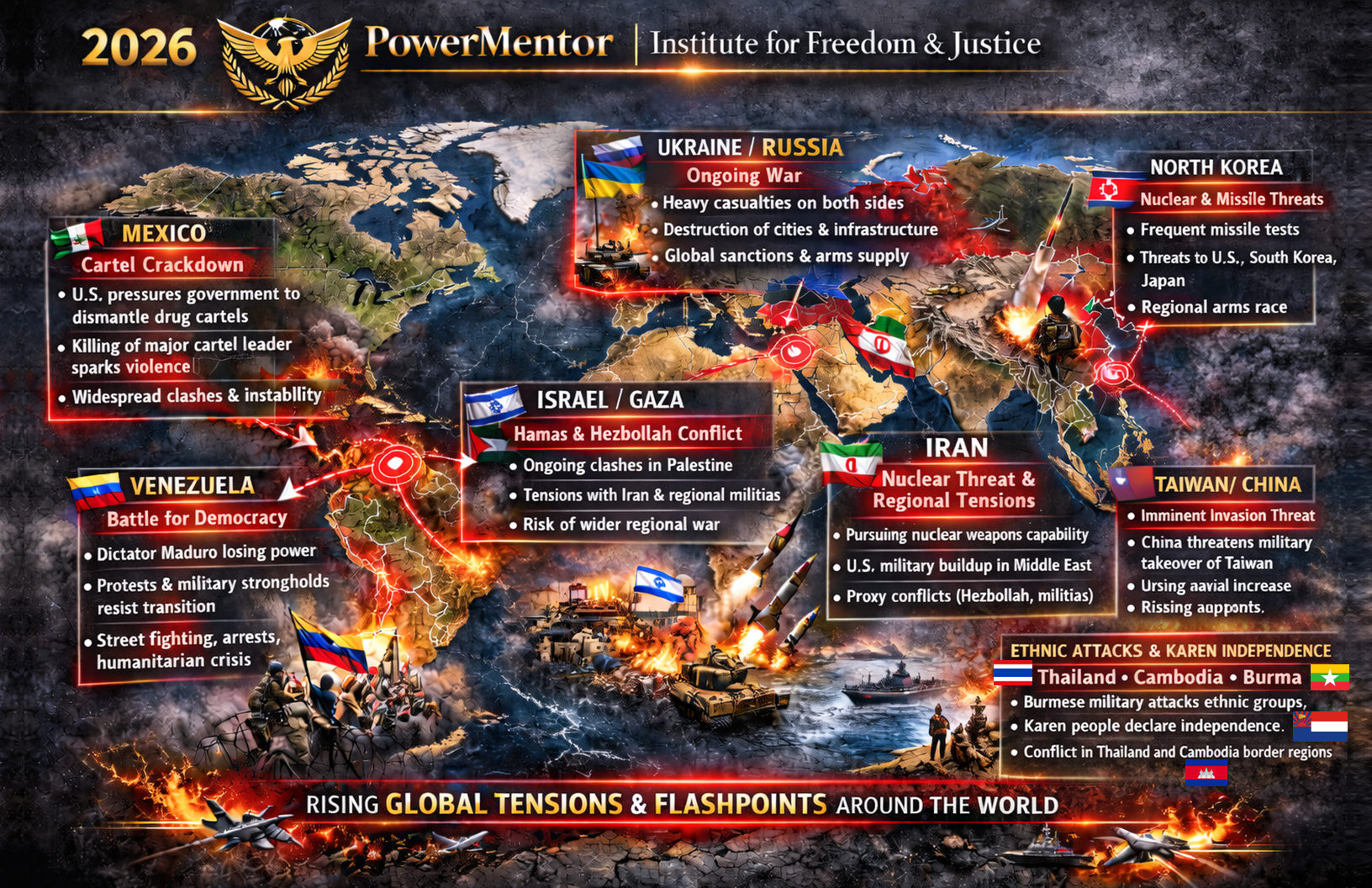
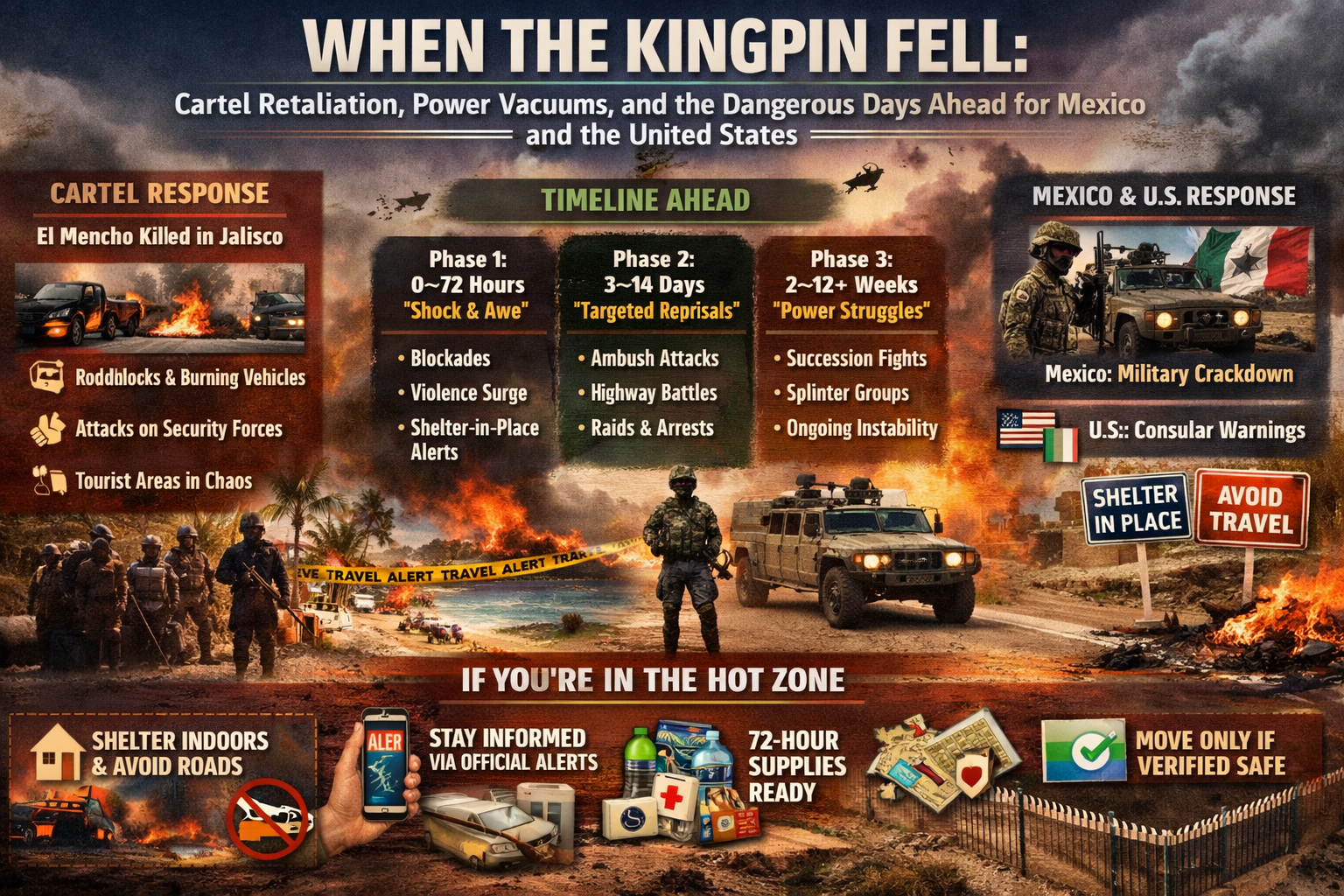
When the Kingpin Fell: Cartel Retaliation, Power Vacuums, and the Dangerous Days Ahead for Mexico and the United States
What’s happening in Mexico right now (post–“El Mencho” killing)
Multiple credible outlets are reporting that Nemesio Rubén Oseguera Cervantes (“El Mencho”), leader of the Jalisco New Generation Cartel (CJNG), was killed during a Mexican military operation in Jalisco (Tapalpa area).
What followed (and is still unfolding) looks like a classic cartel shock-response pattern—but on a wide scale:
Coordinated retaliation: Reports describe road blockades, burning vehicles, and multi-location attacks designed to paralyze movement and signal capability.
Significant security-force casualties: Reuters and AP describe dozens of attacks and major losses among Mexican forces in the immediate aftermath.
Tourist-area disruption: Puerto Vallarta and Guadalajara have been repeatedly named in security alerts and news coverage, including travel disruptions and “shelter in place” guidance for U.S. citizens in impacted areas.
Travel interruptions: Multiple reports describe flight cancellations/disruptions and local transportation interruptions (e.g., taxis/ride shares paused in some places), leaving travelers stranded.
Important caution on rumors: There has been viral online talk about Americans being “taken hostage” at airports. Some of the loudest versions come from secondary aggregators; treat those as unverified unless confirmed by primary authorities or wire services.
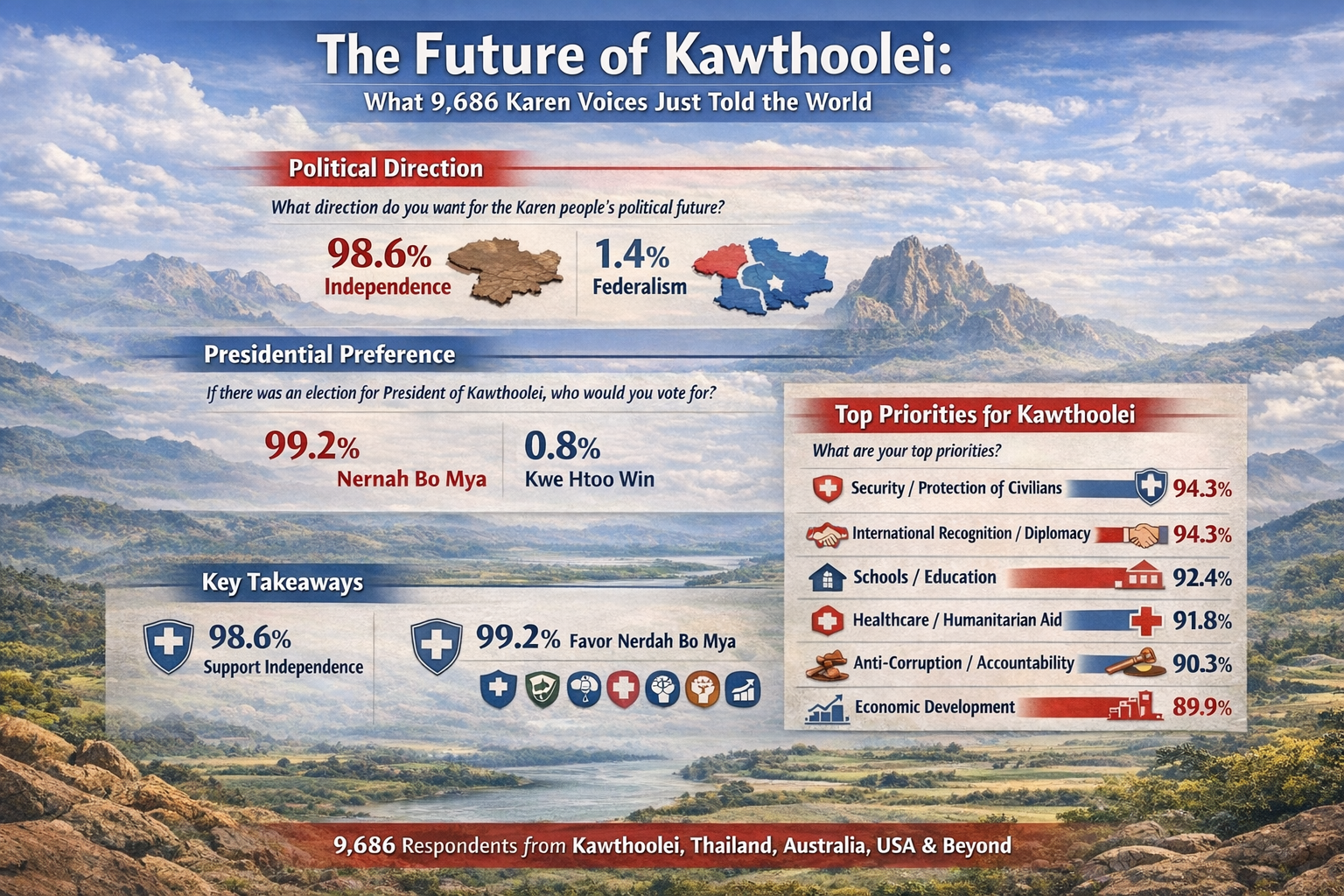
The Future of Kawthoolei: What 9,686 Karen Voices Just Told the World
In a moment when narratives about the Karen people are often shaped externally, nearly 10,000 Karen individuals across the globe have spoken for themselves.
The Future Kawthoolei Poll gathered responses from 9,686 Karen people living in Kawthoolei, Thailand, Australia, the United States, Canada, and other diaspora communities. The results were not fragmented. They were not ambiguous.
They were decisive.
This poll represents one of the most substantial coordinated expressions of Karen political opinion in modern history.
A Clear Mandate: Independence

Leadership Reset for the Future
PowerMentor Overview
An introduction to the PowerMentor framework—why leadership today is failing, how confusion replaced clarity, and why freedom, responsibility, and moral courage must be restored. This session sets the foundation: leadership is built, not felt—and it starts with truth, not ego.
The Failure of Self-Esteem
Why modern self-esteem ideology is hollow, fragile, and unsustainable. We expose how self-focus creates weakness, entitlement, and instability—and why meaning is found not in self-affirmation, but in contribution, responsibility, and purpose greater than oneself.
“Try” Is a Failure Mindset
Why the word try programs the mind for escape, excuses, and non-commitment. This session breaks down how high performers do not “try”—they act, assess, correct, and move forward. Action produces clarity. Hesitation produces stagnation.
Rules, Boundaries, and Limitations
Why structure is not oppression—but freedom. We dismantle the myth that boundaries limit growth and show how rules, discipline, and constraints are the very systems that create safety, trust, excellence, and long-term success in leadership, relationships, and life.
Intention
How purposeful intention is formed, grounded, and sustained daily. This session focuses on aligning action with mission—eliminating distraction, emotional drift, and reactionary living. Intention is not a feeling; it is a decision renewed through discipline.
Reliability Wins
Why reliability is the rarest and most valuable leadership trait today. This session shows how consistency, follow-through, and showing up at your best—especially when no one is watching—separates leaders from talkers and earns trust, influence, and authority over time.
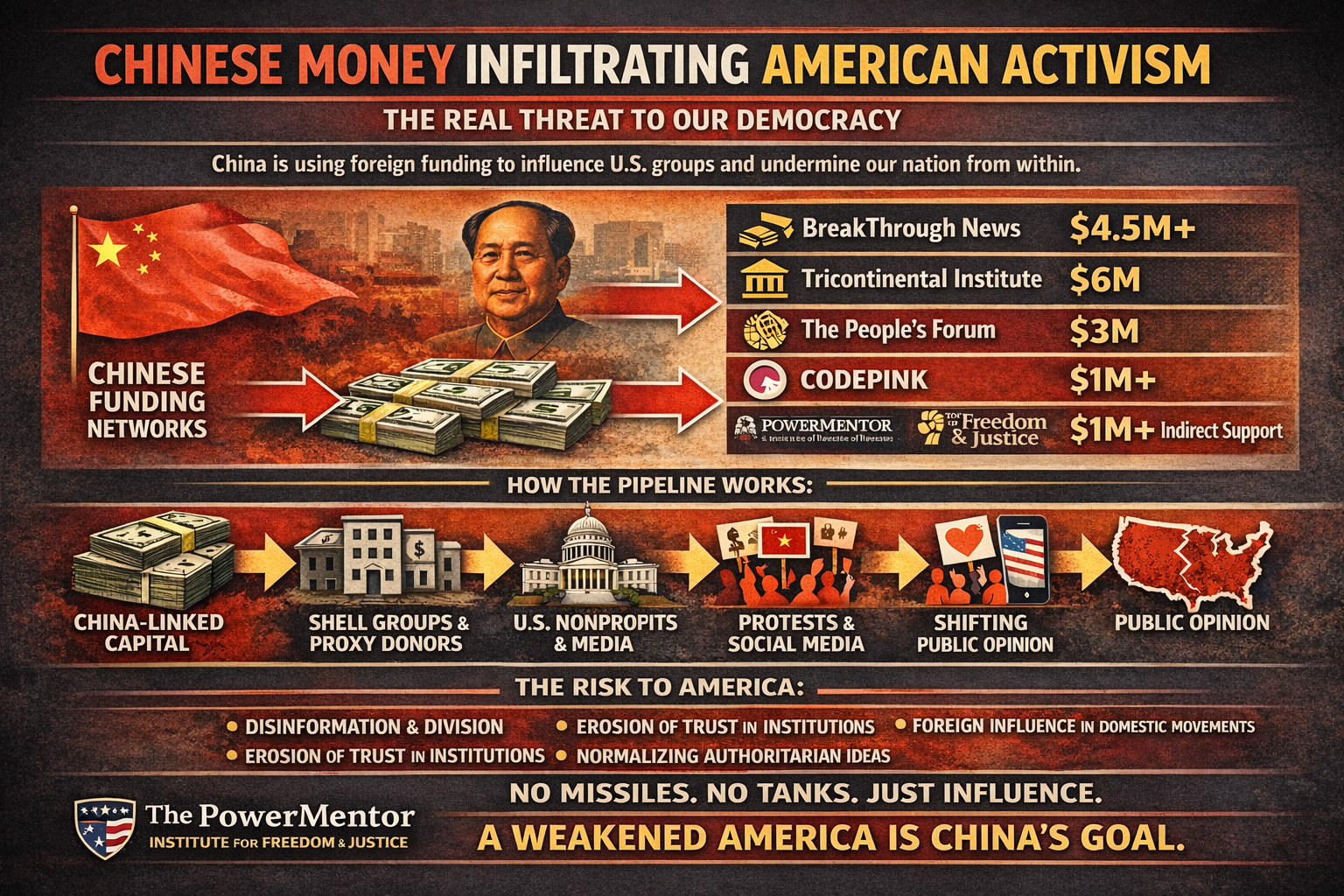
China’s Strategic Assault on American Democracy: A Hidden War Within
In the twenty-first century, the United States confronts a multifaceted challenge that goes far beyond trade disputes and military posturing with the People’s Republic of China (PRC). What remains far less understood — but potentially even more consequential than tariffs or territorial disputes — is Beijing’s systematic effort to shape political narratives, weaken democratic institutions, and erode public faith in American civic life from within.
This campaign is not merely about public diplomacy. It is a strategic influence operation, using nontraditional platforms and civil society channels to shift the very foundations of how Americans think about governance, national identity, and global leadership.
1. Influence Operations: Shaping the Narrative
One of the defining features of China’s approach is its use of soft power mixed with covert influence tactics. Rather than relying on direct diplomatic engagement alone, Beijing deploys a range of actors — including state-linked media, proxy organizations, and aligned civil society institutions — to reshape public perceptions and normalize viewpoints favorable to Chinese strategic interests.

China Betting Against the U.S. Dollar
The global financial system runs on trust, and a big part of that trust has been anchored in the U.S. dollar and U.S. Treasuries (U.S. government bonds). When major economies and large banks treat Treasuries as the “default safe asset,” it keeps global money flowing smoothly and helps the United States borrow at relatively lower cost. That arrangement has supported cheaper credit, stable markets, and the dollar’s outsized role in world trade and reserves.
A quiet but meaningful shift happens when large holders—especially big institutions in places like China—start reducing concentration risk in U.S. Department of the Treasury securities. This doesn’t need to look like a dramatic sell-off to matter. Even gradual “diversify a little more” behavior can signal to other investors that they should reconsider how much of their safety and liquidity depends on one country’s debt and one currency system. Over time, that can nudge the world toward a more diversified mix of reserves—more gold, more non-dollar currencies, more regional settlement systems.
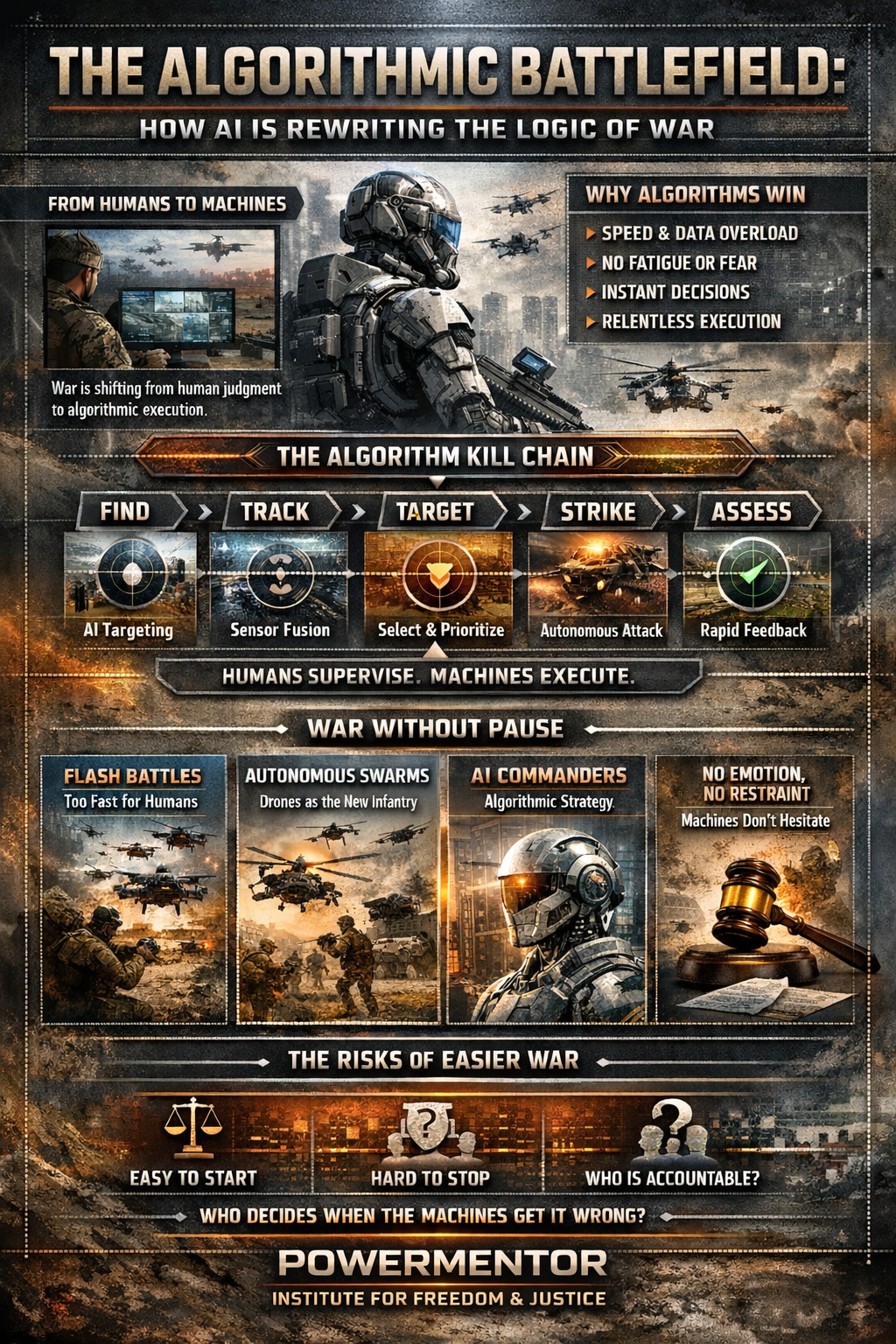
The Algorithmic Battlefield: How AI Is Rewriting the Logic of War
War is undergoing a quiet but profound transformation—one that may ultimately matter more than tanks, missiles, or even nuclear weapons.
It is no longer simply humans fighting with machines as tools. Increasingly, it is machines executing warfare, while humans slide into roles like supervisor, validator, or (at worst) spectator.
The battlefield is shifting from human judgment to algorithmic execution.
That shift isn’t only technological—it’s philosophical. It challenges centuries of assumptions about command authority, accountability, and the moral weight of violence. And it is happening faster than most political leaders, ethicists, or citizens are prepared to absorb.
Why This Shift Was Always Coming
Modern conflict has become a contest of speed, information, and complexity—domains where human cognition is structurally disadvantaged.
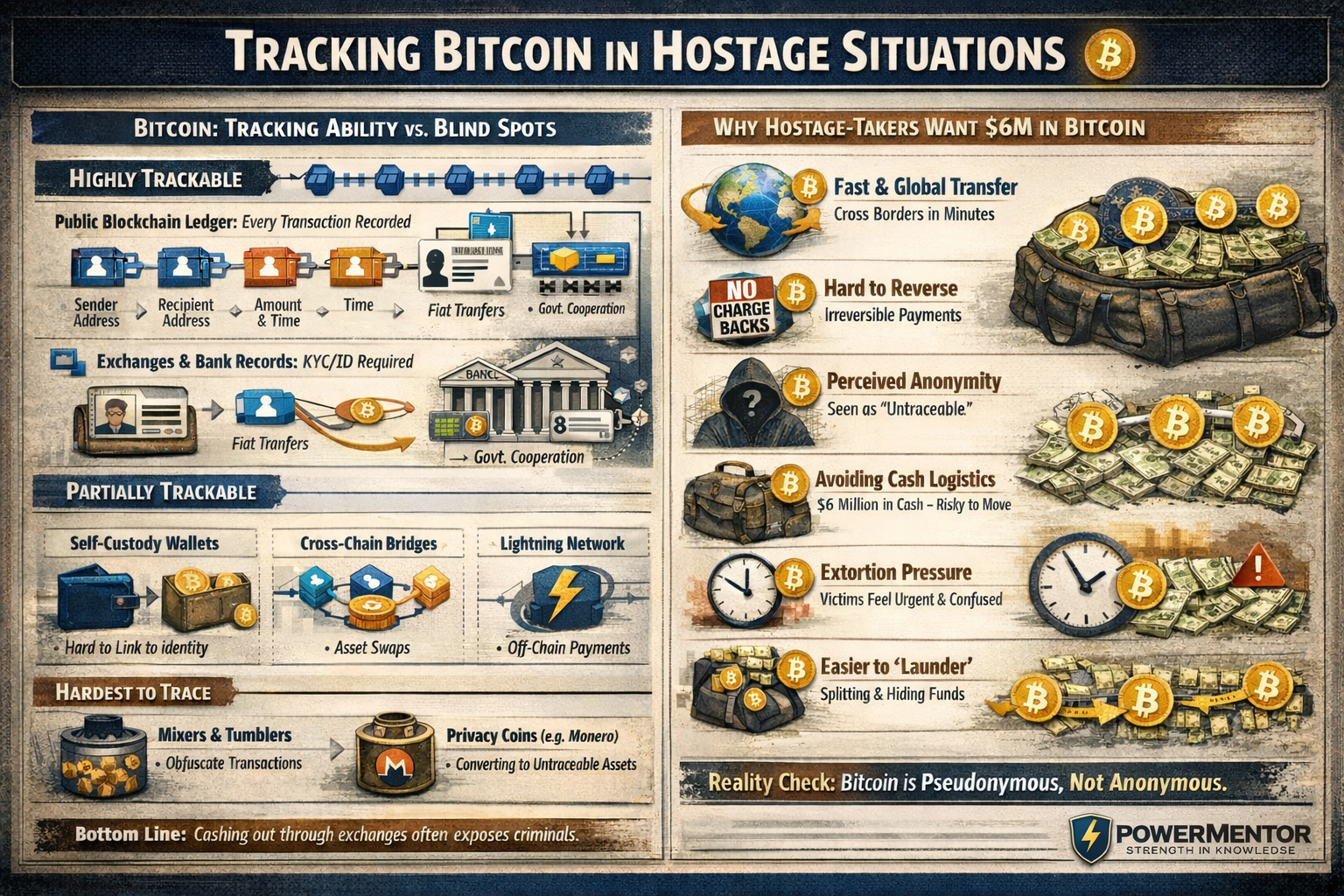
Demistifying Bitcoin
Bitcoin ransom sounds “untraceable,” but it isn’t. This infographic breaks down what law enforcement can track on the blockchain, where criminals try to hide (mixers, cross-chain swaps, Lightning, privacy coins), and why hostage-takers demand $6M in Bitcoin—speed, global transfer, and irreversible payments. Reality check: Bitcoin is pseudonymous, not anonymous.

Macro vs. Micro: The Wisdom of Smart Decision-Making
Macro vs. Micro: The Wisdom of Smart Decision-Making
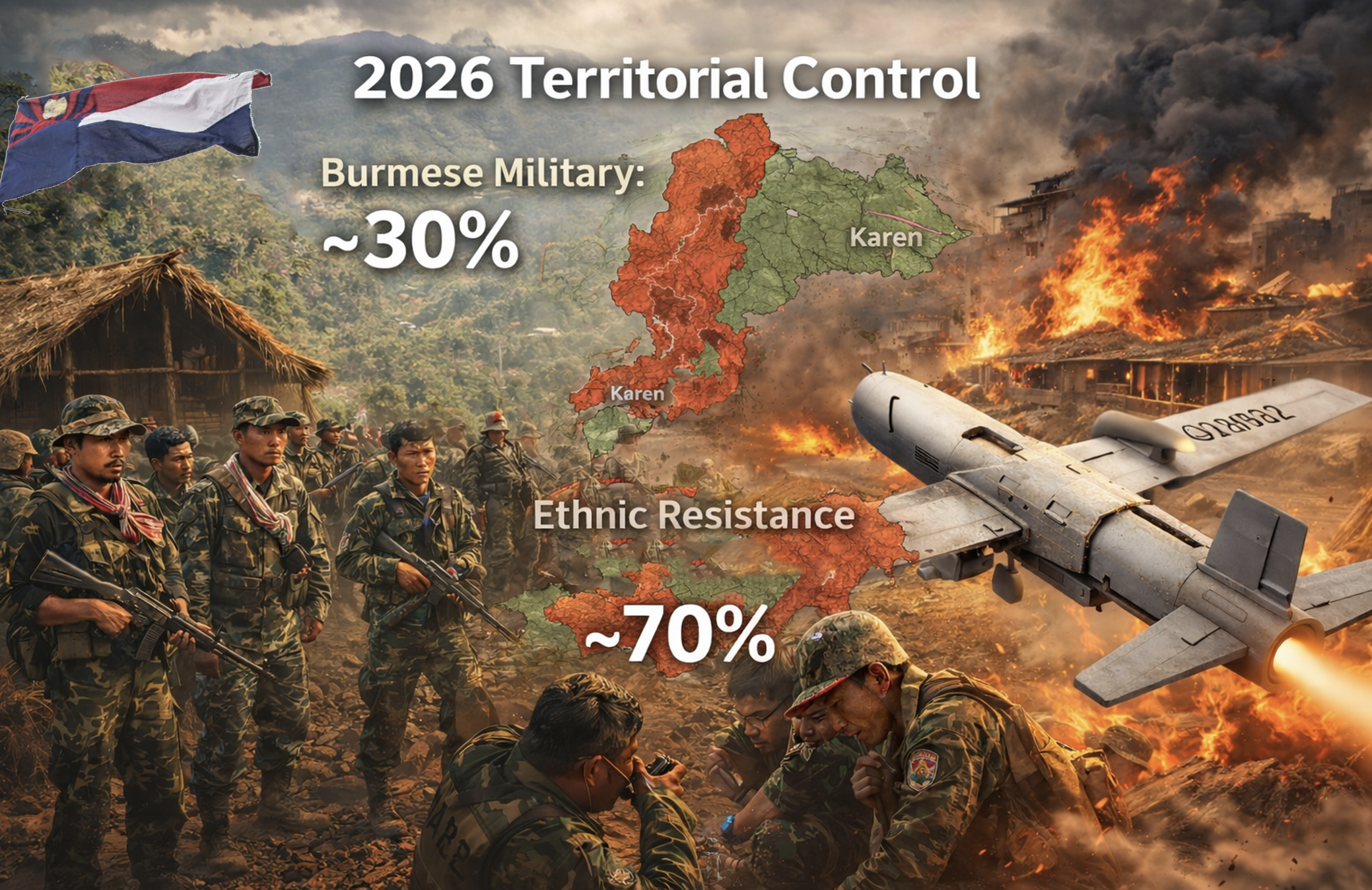
Kawthoolei Under Fire: How the Karen Resistance Is Reshaping the World’s Longest War
By 2026, the Burmese military reportedly controls only about 30% of the country, while 60–70% is held by ethnic resistance forces, including Karen-led formations. This is not a symbolic shift. It is a structural collapse of centralized military authority—one that has forced the junta to adopt new tools of survival, most notably kamikaze drones sourced through Chinese supply chains.
The Karen: From Survival to Strategic Force
The Karen are not a new resistance. They are one of the oldest. Since 1949, Karen forces have fought successive Burmese regimes in defense of Kawthoolei—a term meaning “land without darkness,” reflecting both territory and identity. With an estimated population of 7–8 million, largely concentrated in eastern Burma along the Thai border, the Karen have endured decades of military campaigns designed to break their cohesion.
Karen resistance groups—particularly the Kawthoolei Army (KTLA) led by General Nerdah Bo Mya—are no longer operating merely as defensive security forces. They are increasingly territorial, coordinated, and politically assertive, holding ground, capturing regime soldiers, and integrating defectors into their ranks. In one camp described, roughly 20 Burmese soldiers had either surrendered or defected, reportedly choosing to remain with the Karen rather than return to junta control.
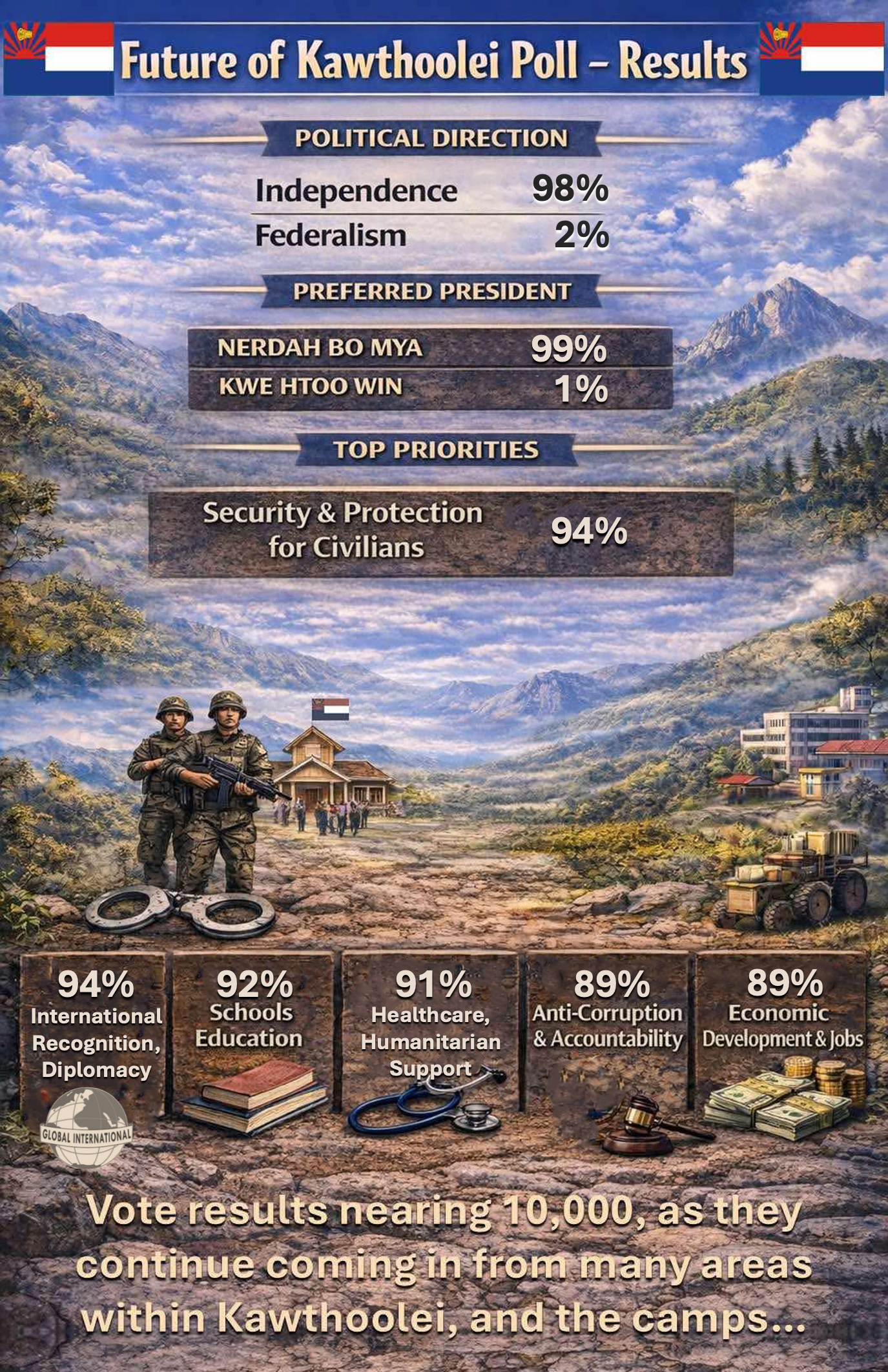
Nearly 10,000 Voices. One Future: Independence.
Based on nearly 10,000 responses, the results are statistically reliable, with a margin of error of approximately ±1 percentage point.
What these results show is clear: the Karen majority desire Independence.
Even more powerful is how these responses were given. In the midst of a sham “election” orchestrated by Burmese generals—where intimidation, surveillance, and punishment are used to silence voices for freedom—those who participated in this poll deserve to be commended for their courage. Speaking up for independence in Burma (Myanmar) is not a casual opinion; for many, it can carry real risk. Yet thousands still chose to speak.
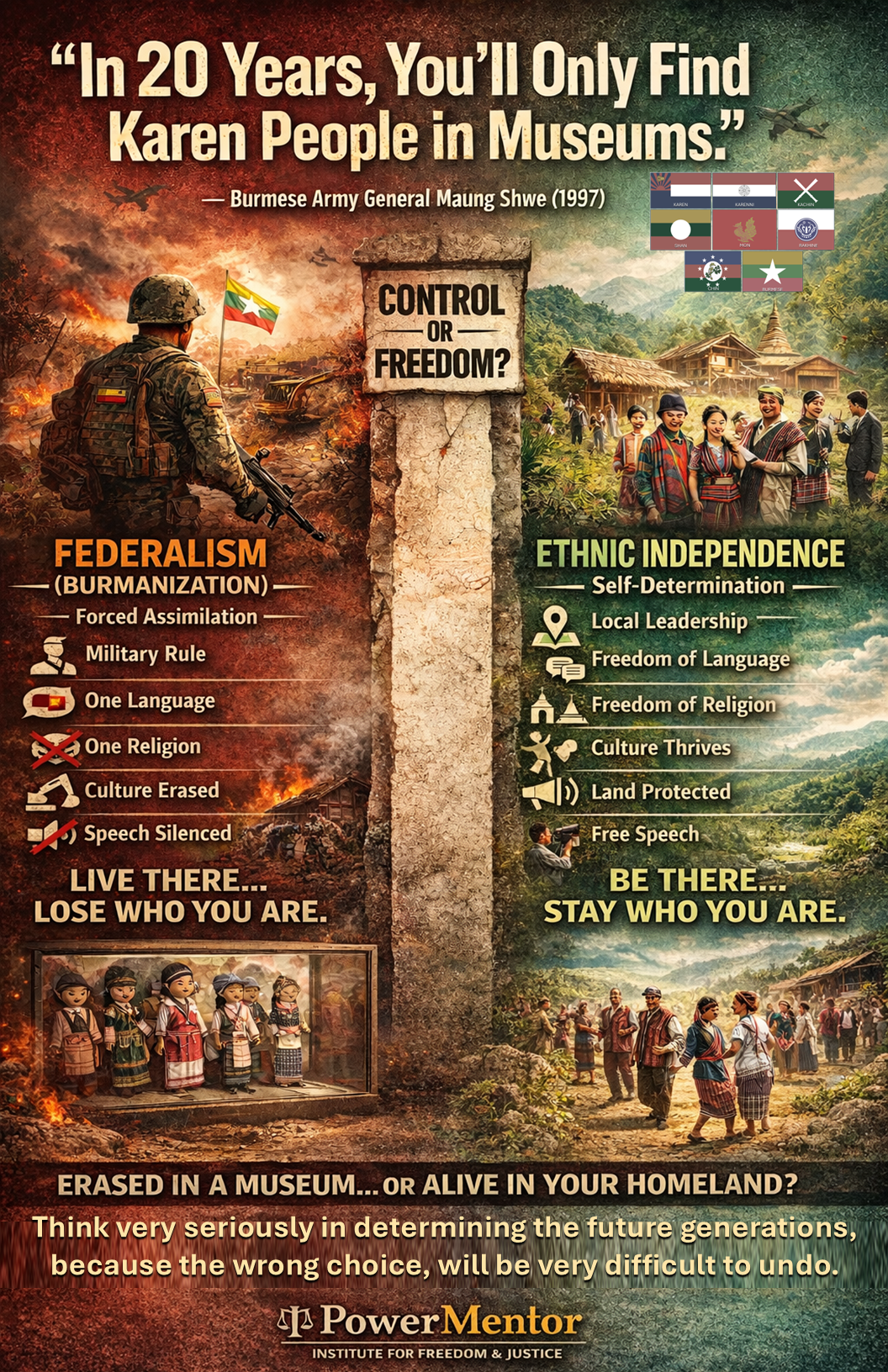
Think very seriously in determining the future generations, because the wrong choice, will be very difficult to undo.
Think very seriously in determining the future generations, because the wrong choice, will be very difficult to undo.
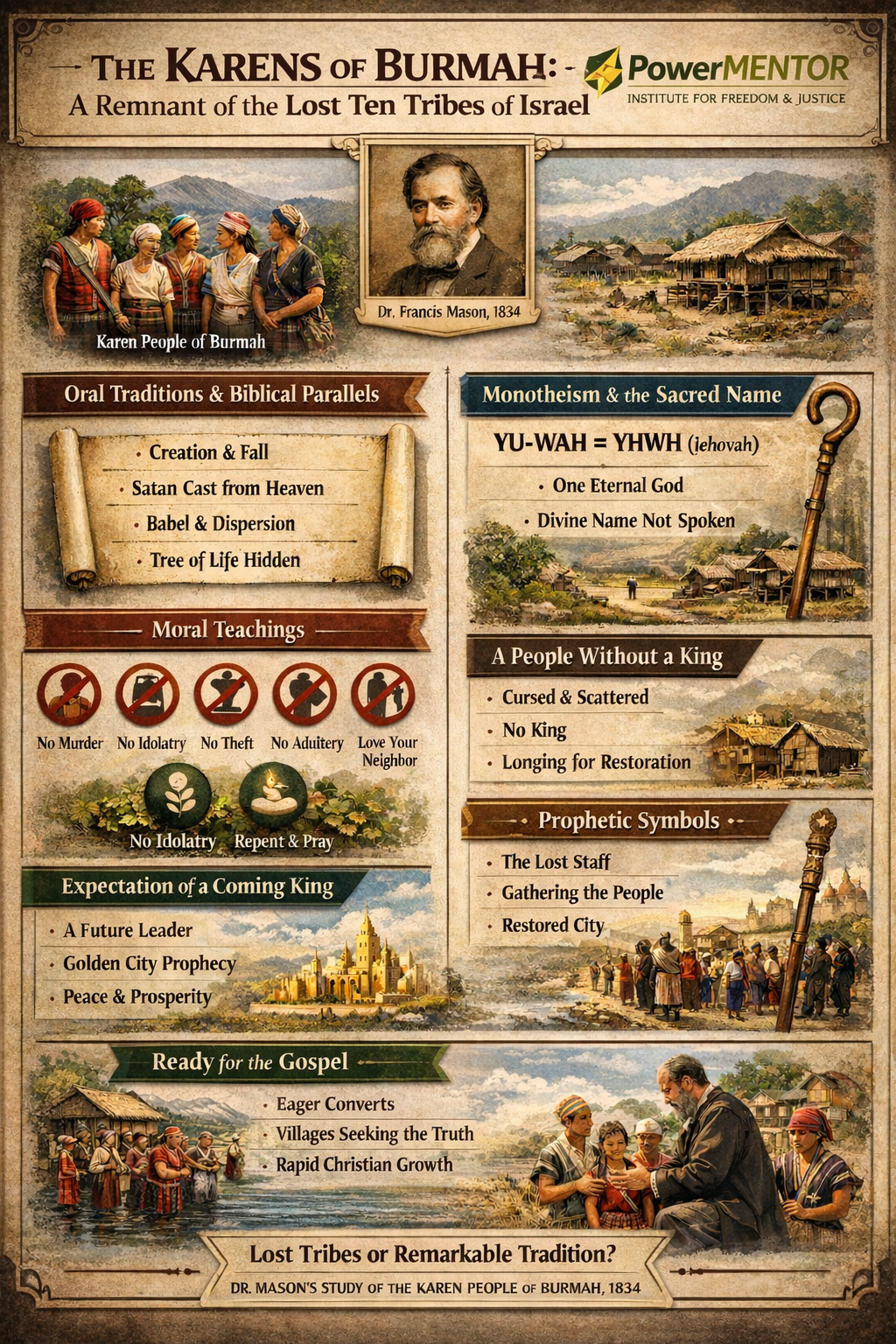
The Karens of Burmah and the Pattern of Exile and Restoration
A Deep Reading of Dr. Francis Mason’s 1834 Argument
In his 1834 paper The Karens of Burmah a Remnant of the Ten Tribes of Israel, Dr. Francis Mason presents a carefully constructed argument grounded not in genetics or archaeology, but in theological pattern, prophetic correspondence, and preserved religious memory. Mason’s claim is not merely that the Karen people resemble ancient Israel in isolated ways, but that their collective self-understanding follows the same covenantal arc described in the Hebrew Scriptures.
At the heart of Mason’s thesis is a single organizing idea:
the Karens understand themselves as a people once favored by God, later rejected because of disobedience, now living in affliction and dispersion, and awaiting divine restoration. This, Mason argues, is precisely how Scripture describes the fate of the Ten Lost Tribes.
Oral Tradition as Covenant Memory
Mason places extraordinary emphasis on Karen oral tradition, describing it as unparalleled among so-called “uncivilized nations.” These traditions are not casual folklore but structured moral and theological instruction, often introduced with the repeated address: “O children and grandchildren!”
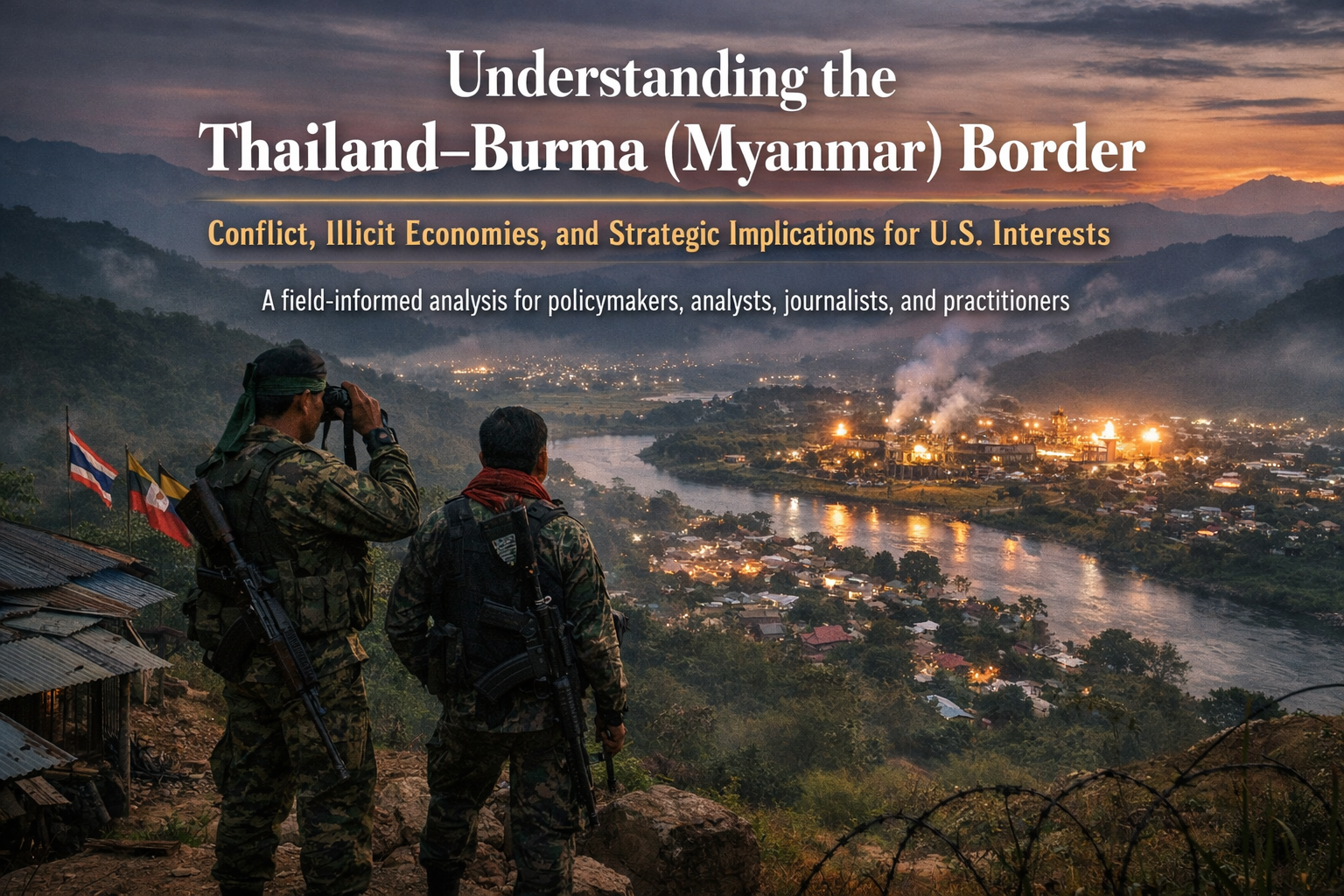
Understanding the Thailand–Burma (Myanmar) Border
Conflict, Illicit Economies, and Strategic Implications for U.S. Interests
A field-informed analysis for policymakers, analysts, journalists, and practitioners
Executive Overview
The Thailand–Burma (Myanmar) border region is one of the most strategically significant yet consistently misunderstood zones in mainland Southeast Asia. Frequently framed as a localized humanitarian crisis or an internal civil conflict, the region is more accurately understood as a convergence point of unresolved governance questions, ethnic autonomy movements, transnational criminal economies, and external power influence.
This analysis is written for U.S. policymakers, congressional staff, analysts, journalists, and practitioners seeking a clear understanding of why instability persists along the border, why conventional frameworks have failed, and why developments in this region have direct implications for U.S. strategic, economic, and security interests.
A central theme of this assessment is an internal fault line that shapes both conflict and opportunity: the unresolved tension between federalism and independence models among ethnic regions, and the emergence of hybrid governance arrangements that may represent the most realistic pathway toward cohesion and stability.
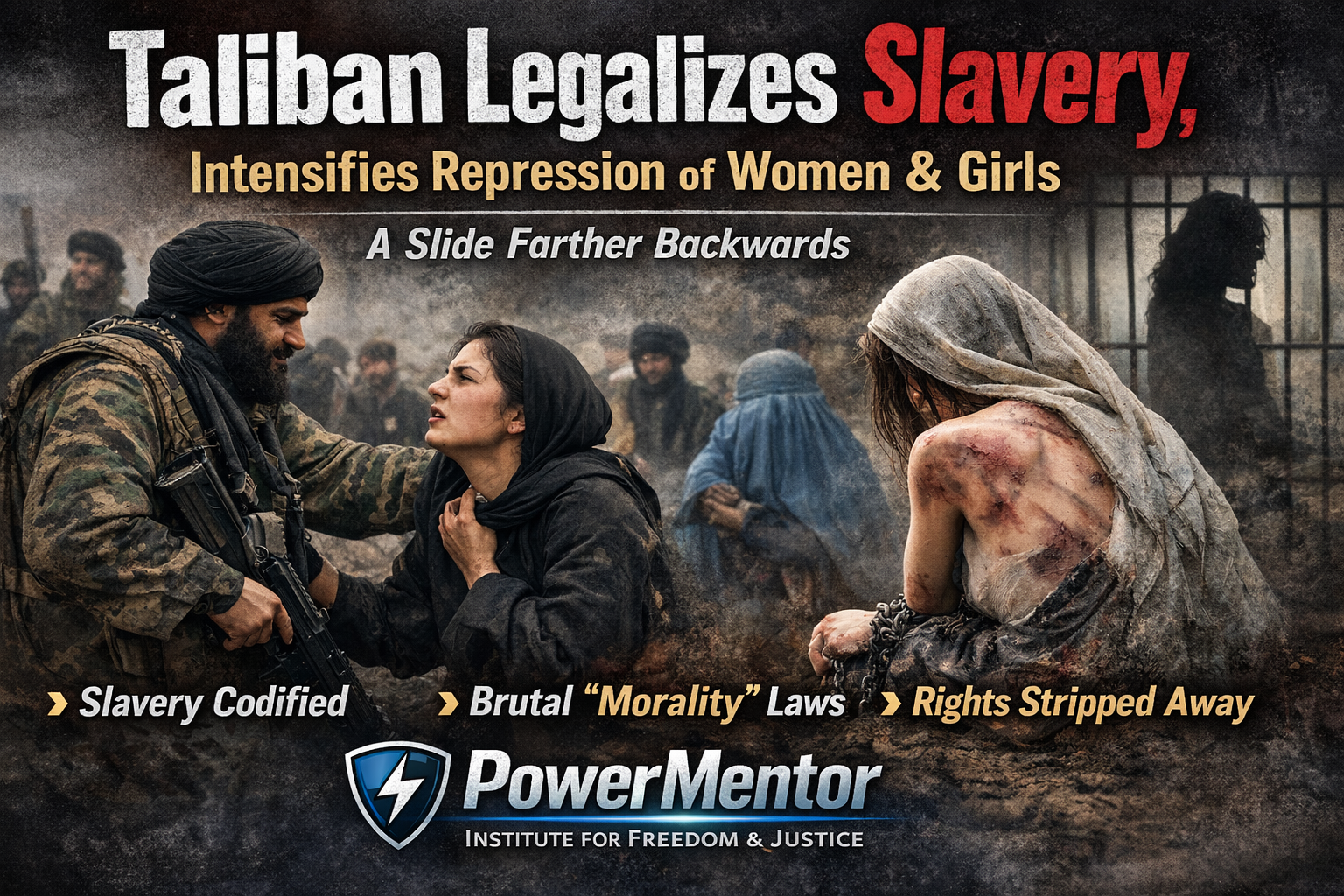
Taliban’s New Legal Code: Institutionalizing Slavery, Class Justice, and Gender Apartheid in Afghanistan
A newly approved Taliban criminal procedure code is being described by legal experts and rights groups as a dramatic escalation in Afghanistan’s collapse of basic human rights—particularly for women and girls. The concern is not only the severity of punishments, but the structure of the law itself: it reportedly normalizes slavery as a legal status, entrenches a class-based justice system, and strips away core due-process protections that normally limit state abuse.
What the Taliban changed—and why it matters
Rights monitors report the Taliban’s “Criminal Procedure Code for Courts” was signed by Taliban supreme leader Hibatullah Akhundzada and circulated for implementation nationwide. Rawadari, a human rights organization that says it obtained the code, describes it as a 119-article framework that reshapes Afghan society into a rigid hierarchy and assigns unequal penalties based on social category.
According to Rawadari and multiple analyses, the code divides people into categories (such as religious scholars, elites, middle class, and lower class), creating different consequences for the same alleged offense. In practice, this means the “rule of law” becomes the rule of status—a system designed to protect the connected and punish the vulnerable.
“Free persons” and “slaves”: the re-entry of slavery into law