
China’s Strategic Assault on American Democracy: A Hidden War Within
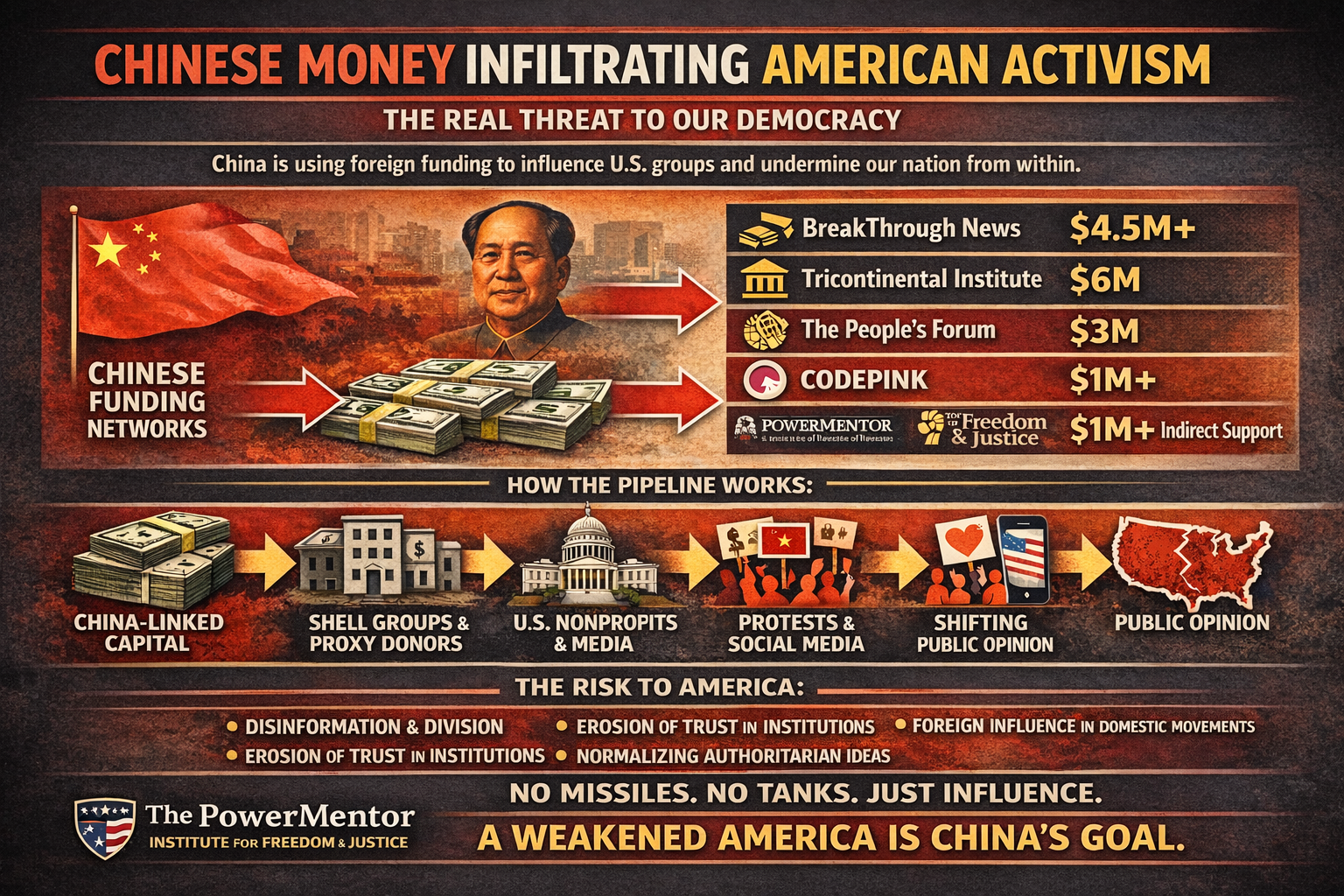
In the twenty-first century, the United States confronts a multifaceted challenge that goes far beyond trade disputes and military posturing with the People’s Republic of China (PRC). What remains far less understood — but potentially even more consequential than tariffs or territorial disputes — is Beijing’s systematic effort to shape political narratives, weaken democratic institutions, and erode public faith in American civic life from within.
This campaign is not merely about public diplomacy. It is a strategic influence operation, using nontraditional platforms and civil society channels to shift the very foundations of how Americans think about governance, national identity, and global leadership.
1. Influence Operations: Shaping the Narrative
One of the defining features of China’s approach is its use of soft power mixed with covert influence tactics. Rather than relying on direct diplomatic engagement alone, Beijing deploys a range of actors — including state-linked media, proxy organizations, and aligned civil society institutions — to reshape public perceptions and normalize viewpoints favorable to Chinese strategic interests.
For decades, analysis has shown that the Chinese Communist Party (CCP) leverages a wide array of actors beyond state media, including academic visits, cultural exchanges, and ostensibly independent organizations, to advance its political agenda globally (Diamond & Schell, 2018). These channels often operate under the radar of standard public scrutiny, making them highly effective at quietly setting agendas.
In the U.S., analysts have identified hundreds of groups that regularly coordinate with or promote narratives aligned with Chinese objectives — from academic collaborations to civic organizations that echo Beijing’s talking points on issues such as foreign policy, human rights, and social reform.
2. Targeting the U.S. Information Environment
A core element of China’s strategy is transforming the information landscape in ways that degrade trust in objective truth and civic institutions. Contemporary research into digital influence shows authoritarian state actors — including those aligned with Beijing — actively cultivate online networks and content creators to sway public opinion and undermine democratic discourse.
This method harnesses social media platforms, influencer ecosystems, and charismatic online voices to normalize geopolitical narratives that serve Chinese interests. Particularly concerning is research demonstrating how foreign influencer operations can reshape perceptions without the overt presence of state media — blurring the lines between authentic civic discourse and engineered persuasion.
3. Civil Society: Not Immune to Geopolitics
At their best, nonprofit organizations and civil society groups are the lifeblood of democratic engagement — empowering citizens, holding power to account, and fostering grassroots advocacy. Yet malign foreign influence can exploit this very openness as a vector to weaken democracies, leveraging legal structures and civic legitimacy to disseminate ideas that erode societal cohesion.
China’s influence is not confined to elite diplomatic circles. It reaches into the spaces Americans trust — universities, advocacy groups, research institutes, and cultural organizations — shaping debate and subtly aligning discourse with Beijing’s strategic narratives (Institute for China-America Studies, 2015).
This approach echoes the CCP’s broader “United Front Work” strategy, which emphasizes co-opting nonparty actors to expand influence and marginalize opposition — a tactic Mao Zedong famously termed a “magic weapon” for political warfare abroad.
4. Undermining Democratic Resilience
Why does this matter?
Democracy depends on:
An informed citizenry capable of distinguishing fact from manipulation
Public confidence in institutions and processes
Robust civil society that can resist external coercion or co-optation
Open debate that reflects domestic priorities, not foreign interests
When foreign influence operations exploit legal openings, media ecosystems, or associative networks with politically charged messages, they blur where civic advocacy ends and geopolitical interference begins. This is not an imagined threat — it is a documented interplay between domestic civic institutions and foreign strategic goals that can distort public discourse and erode democratic norms.
Attempts to introduce foreign narratives into American public life — whether through digital channels, academic partnerships, or civic networks — risk normalizing policy preferences that are counter to U.S. interests and societal values. Such influence campaigns are designed not just to persuade but to confuse, divide, and weaken collective trust in democratic frameworks, making societies more susceptible to authoritarian alternatives.
Conclusion: A Call to Awareness and Action
The challenge today is not simply countering bad actors in cyberspace or tightening campaign finance laws. It is a deeper fight to preserve the intellectual and cultural foundations of American democracy.
Recognizing that information — not just military force or economic leverage — is now a battleground is essential. If democracies do not actively defend the integrity of their political discourse, legal structures, and civic institutions, they may find themselves contested not only abroad but within their own hearts and minds.
References
Diamond, L., & Schell, O. (2018). China’s Influence and American Interests: Promoting Constructive Vigilance. Hoover Institution Press.
Incerti, T., Elkobi, J., & Mattingly, D. (2026). Foreign influencer operations: How TikTok shapes American perceptions of China. ArXiv.
Institute for China-America Studies. (2015). Institute for China-America Studies overview.
Newsweek Investigation. (2020). 600 U.S. groups linked to Chinese Communist Party influence effort.
U.S. – China Influence Working Papers. (2019). China’s Growing Influence in Asia and the United States. U.S. Congress.
