

Understanding the Thailand–Burma (Myanmar) Border
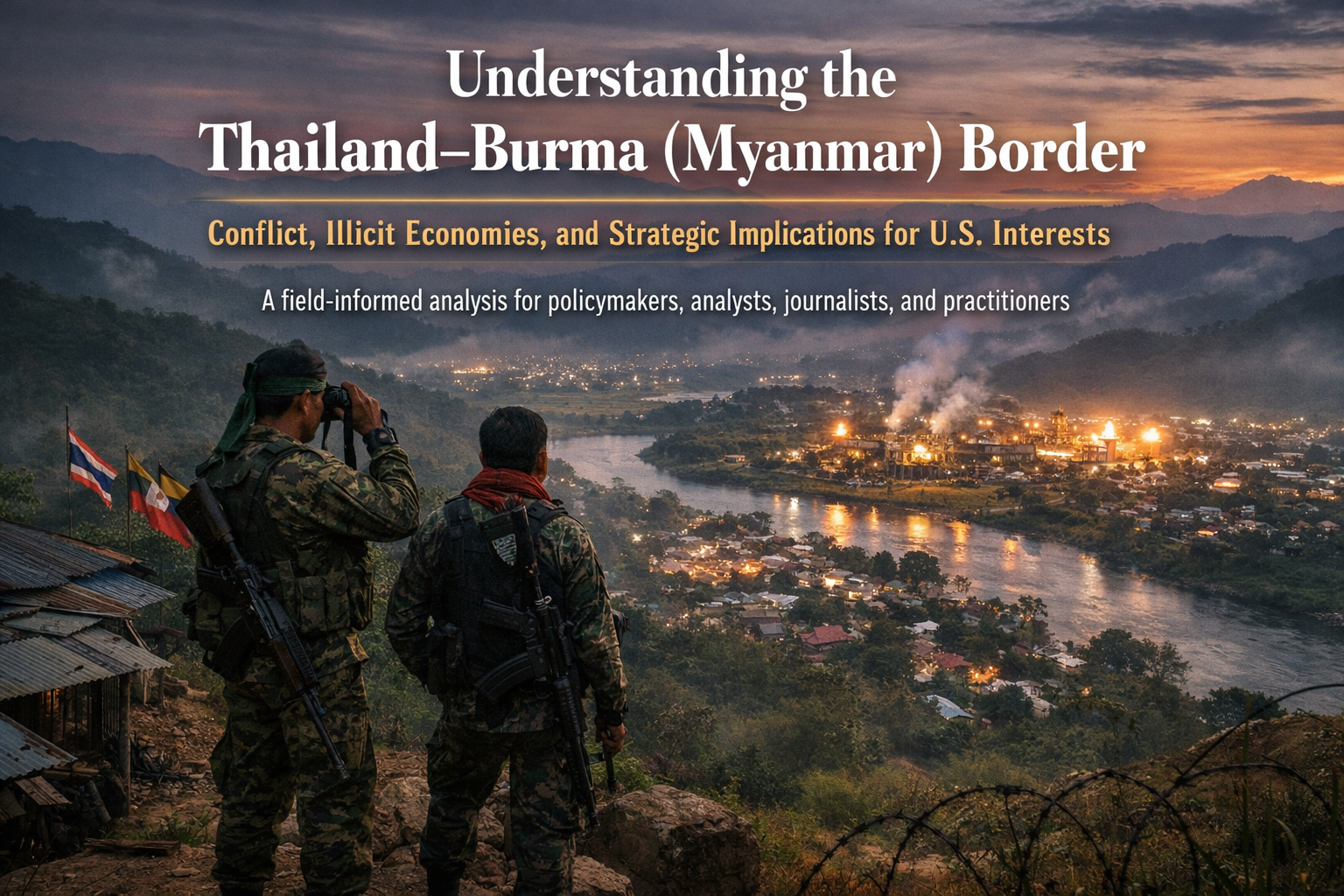
Conflict, Illicit Economies, and Strategic Implications for U.S. Interests
A field-informed analysis for policymakers, analysts, journalists, and practitioners
Executive Overview
The Thailand–Burma (Myanmar) border region is one of the most strategically significant yet consistently misunderstood zones in mainland Southeast Asia. Frequently framed as a localized humanitarian crisis or an internal civil conflict, the region is more accurately understood as a convergence point of unresolved governance questions, ethnic autonomy movements, transnational criminal economies, and external power influence.
This analysis is written for U.S. policymakers, congressional staff, analysts, journalists, and practitioners seeking a clear understanding of why instability persists along the border, why conventional frameworks have failed, and why developments in this region have direct implications for U.S. strategic, economic, and security interests.
A central theme of this assessment is an internal fault line that shapes both conflict and opportunity: the unresolved tension between federalism and independence models among ethnic regions, and the emergence of hybrid governance arrangements that may represent the most realistic pathway toward cohesion and stability.
Geographic and Strategic Context
The Thailand–Burma border runs through rugged terrain that has historically resisted centralized authority. Mountain ranges, forest corridors, and river systems have long enabled cross-border movement of people, armed groups, and commerce—both licit and illicit.
Rather than a clearly governed boundary, the border functions as a fluid governance zone, where authority is layered, negotiated, or contested. State presence varies dramatically by location, and non-state actors often perform governance functions in practice, regardless of formal recognition.
Strategically, the region links South Asia, Southeast Asia, and southern China. Instability here affects migration patterns, illicit trade routes, and regional security dynamics well beyond Burma (Myanmar) itself.

Ethnic Armed Organizations and Parallel Governance
Ethnic armed organizations operating along the border are frequently described only as insurgent forces. In reality, many function as hybrid political-military structures, providing security, dispute resolution, taxation, and limited social services within their areas of control.
For local populations, legitimacy often derives not from ideology but from continuity, protection, and survival. These systems emerged not in opposition to governance, but in response to prolonged governance absence or coercion.
However, these organizations are not unified actors. Internal divisions—particularly regarding long-term political outcomes—have intensified, especially around competing visions of federalism versus independence.
The Federalism–Independence Divide and Hybrid Models
One of the most underexamined drivers of fragmentation within ethnic regions is the unresolved debate over political end-states:
Federalist approaches envision meaningful autonomy within a restructured national framework.
Independence-oriented approaches argue that historical patterns of broken agreements and military dominance render federal arrangements unreliable.
In practice, many regions already operate under hybrid governance models, combining elements of de facto autonomy, negotiated coexistence, and parallel institutions. These arrangements are rarely acknowledged formally but often reflect on-the-ground realities more accurately than rigid constitutional frameworks.
From a policy perspective, recognizing this spectrum—rather than forcing binary classifications—matters. Ignoring it risks reinforcing internal divisions, undermining cohesion, and misaligning external engagement.
Related analysis:
– Article on Hybrid Federalism Models in Ethnic Regions
– Article on Internal Divisions and Governance Tradeoffs
Illicit Economies: Scam Compounds, Trafficking, and Finance
Governance gaps along the border have enabled the growth of transnational criminal ecosystems, including large-scale online scam operations, forced labor trafficking, and illicit financial flows.
These systems persist not merely due to instability, but because:
Jurisdictional ambiguity complicates enforcement
Corruption distorts accountability
Criminal networks adapt faster than institutions
These activities increasingly intersect with global cybercrime and financial systems, directly impacting U.S. citizens and international markets.
Related analysis:
– Article on Scam Compounds and Forced Labor Networks
– Article on Illicit Financial Flows in Southeast Asia
External Actors and Regional Power Dynamics
Regional engagement with the border is driven largely by containment rather than resolution. Neighboring states prioritize stability sufficient to manage spillover risks, while external actors calibrate involvement based on strategic interests rather than governance outcomes.
China’s engagement is pragmatic and security-oriented, focused on protecting economic corridors and regional leverage. Western influence is constrained but remains relevant in areas such as financial transparency, information exposure, and coordinated responses to transnational crime.
Why This Matters to U.S. Interests
The Thailand–Burma border is not a peripheral humanitarian issue. It is a systems-level strategic zone with implications for:
Transnational fraud and cyber-enabled crime
Human trafficking and forced labor
Illicit financial flows
Regional stability in mainland Southeast Asia
Strategic competition and influence
Understanding internal governance dynamics—including the federalism-independence spectrum—is essential for any effective policy engagement.
Policy Pathways: Options, Not Prescriptions
Rather than prescribing outcomes, this analysis highlights policy-relevant considerations:
Recognizing hybrid governance realities rather than imposing binary models
Targeting illicit economies without penalizing civilian populations
Engaging diverse regional actors without legitimizing criminal systems
Supporting political architectures that reduce fragmentation and incentivize cohesion
Bridging internal divisions may depend less on choosing between federalism or independence, and more on stabilizing hybrid arrangements that already function in practice.
About This Analysis
PowerMentor publishes long-form, field-informed analysis intended to support policymakers, congressional staff, analysts, journalists, and humanitarian practitioners seeking to understand complex geopolitical and human security environments. The focus is on systems, incentives, and long-term implications rather than advocacy.
