
Taliban’s New Legal Code: Institutionalizing Slavery, Class Justice, and Gender Apartheid in Afghanistan
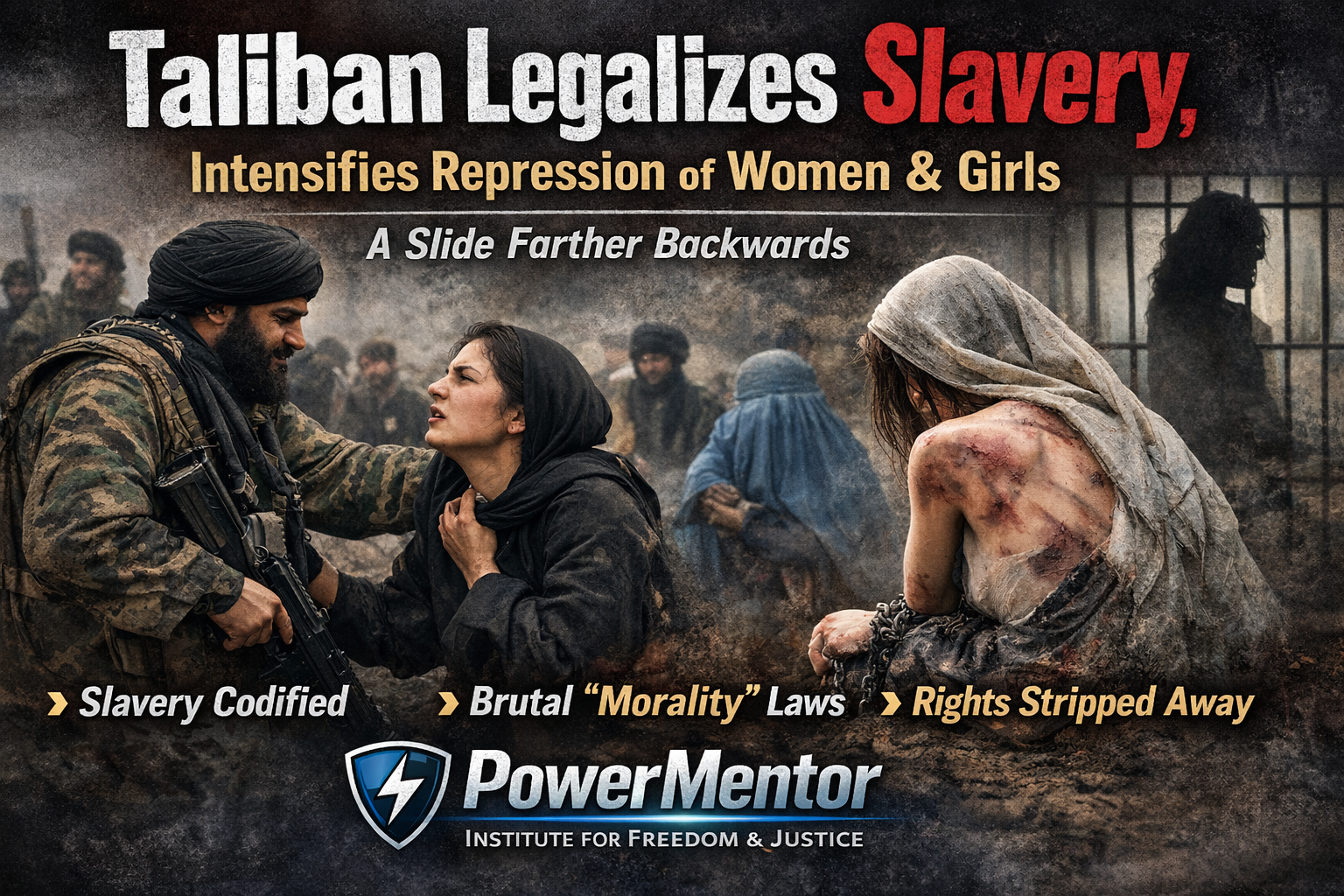
A newly approved Taliban criminal procedure code is being described by legal experts and rights groups as a dramatic escalation in Afghanistan’s collapse of basic human rights—particularly for women and girls. The concern is not only the severity of punishments, but the structure of the law itself: it reportedly normalizes slavery as a legal status, entrenches a class-based justice system, and strips away core due-process protections that normally limit state abuse.
What the Taliban changed—and why it matters
Rights monitors report the Taliban’s “Criminal Procedure Code for Courts” was signed by Taliban supreme leader Hibatullah Akhundzada and circulated for implementation nationwide. Rawadari, a human rights organization that says it obtained the code, describes it as a 119-article framework that reshapes Afghan society into a rigid hierarchy and assigns unequal penalties based on social category.
According to Rawadari and multiple analyses, the code divides people into categories (such as religious scholars, elites, middle class, and lower class), creating different consequences for the same alleged offense. In practice, this means the “rule of law” becomes the rule of status—a system designed to protect the connected and punish the vulnerable.
“Free persons” and “slaves”: the re-entry of slavery into law
One of the most alarming elements is the repeated legal distinction between “free persons” and “slaves.” Legal observers argue that this language treats slavery not as a crime, but as a legitimate social category—something a legal system can reference, accommodate, and regulate.
That matters because international human rights law prohibits slavery in all forms. When a governing authority writes slavery into legal categories—especially inside criminal procedure—it signals acceptance and normalization, not prohibition.
A justice system designed without due process
Multiple reports warn the code removes or omits basic legal protections commonly found in fair judicial systems—protections that exist precisely because confessions can be coerced and accusations can be weaponized. Analysts highlight the absence (or effective removal) of safeguards such as meaningful access to defense counsel, protections against self-incrimination, and requirements for independent investigation.
When courts operate without strong due process, the law becomes less a tool of justice and more a tool of control. In authoritarian systems, that typically produces predictable outcomes: arbitrary detention, coercion, torture risk, and punishment used to intimidate entire communities.
Women and girls: legalizing discrimination, expanding impunity
The Taliban’s legal direction is also intensifying the already severe repression of women and girls since 2021. International reporting and UN statements have repeatedly described Taliban governance as moving toward “gender apartheid,” meaning systematic, institutionalized domination and exclusion of women and girls across public life.
Specific provisions highlighted by Afghan and international outlets include punishments that are harsher for women who are accused of leaving Islam (and especially for returning), and comparatively light penalties for men who commit violence against their wives—even when serious injury is documented.
If these provisions are implemented as reported, the signal is unmistakable: women’s autonomy is criminalized, while male violence can be treated as a minor offense. That is not merely “conservative social policy”—it is a legal architecture that enforces domination.
Vague “morality crimes” and the expansion of corporal punishment
Another recurring warning involves vague offenses—terms such as “dancing” or participation in “gatherings of corruption”—that can be interpreted however authorities wish. In systems without due process, vague crimes are especially dangerous, because they allow selective enforcement: punish enemies, silence critics, and intimidate anyone who refuses to comply.
Reports also describe expanded corporal punishment and wider discretion for authorities, increasing concerns about torture, humiliating punishments, and public spectacles of violence used to discipline society through fear.
International response: condemnation, ICC warrants—and growing normalization
There is growing international recognition that Taliban policies may rise to crimes against humanity. In July 2025, the International Criminal Court (ICC) issued arrest warrants for Taliban leader Hibatullah Akhundzada and Taliban chief justice Abdul Hakim Haqqani for alleged persecution on gender grounds (and related grounds).
At the same time, multiple reports note a troubling global contradiction: while human rights bodies condemn Taliban rule, some states have expanded diplomatic engagement, and certain forms of cooperation (including deportation arrangements) can indirectly legitimize Taliban authority.
This is how repression becomes permanent: not only through internal force, but through external normalization.
What continues in the shadows: resistance through education
Even under escalating repression, Afghans are still resisting—especially through underground education efforts. Reporting describes home schools, quiet community networks, and alternative learning channels aimed at girls and mothers, as families do whatever they can to keep education alive despite bans and intimidation.
That underground resilience is a reminder that authoritarian control is never total. But it is also a reminder that survival should never be mistaken for freedom.
What should the world do now?
If the new code is implemented as reported, it represents a clear step toward a legalized system of stratification: slavery recognized, class privilege enforced, women’s rights erased, and due process dismantled.
Here are global-community action items that logically follow from a criminal procedure framework that (as reported) recognizes slavery as a legal category, expands corporal punishment, removes due-process safeguards, and intensifies gender-based persecution:
1) Accountability and legal pressure
Publicly support ICC action (including cooperation with investigations, evidence-sharing, and enforcement support where possible).
Expand targeted sanctions (travel bans, asset freezes) on individuals and entities directly responsible for drafting, approving, and enforcing the code.
Create a coordinated evidence pipeline: fund documentation groups, protect witnesses, and standardize secure chain-of-custody for future prosecutions.
2) Recognition and naming of the crime
Adopt a formal international stance describing the system as gender apartheid / gender-based persecution (where legally applicable), and push for consistent language across UN bodies and major governments.
Trigger formal UN processes: emergency briefings, special sessions, and strengthened mandates for monitoring and reporting.
3) Conditional diplomacy, not normalization
Freeze “normalization” steps (upgrades in diplomatic status, formal recognition, ceremonial engagements).
Condition any engagement on measurable benchmarks (e.g., girls’ secondary education restored, women’s mobility restored, end to corporal punishment, due-process guarantees, abolition language removed).
Coordinate a unified diplomatic line so individual states don’t undercut pressure through unilateral legitimacy.
4) Aid redesign to prevent regime capture
Ring-fence humanitarian funding with strict anti-diversion controls: third-party monitoring, independent audits, transparent vendor lists, and cash-transfer safeguards.
Shift delivery to community-based channels where feasible (women-led NGOs, trusted local networks, cross-border delivery) while minimizing Taliban gatekeeping.
Prioritize protection services: safe houses, trauma care, legal aid, and emergency relocation support.
5) Protection pathways for at-risk Afghans
Expand humanitarian parole, refugee resettlement, and expedited visas for:
women leaders, journalists, judges, educators
former government/civil society workers
minorities and targeted sects/ethnic groups
Stop forced returns where returnees face credible risk (align asylum decisions and deportation policies with the new legal reality).
6) Education as a strategic countermeasure
Fund underground and cross-border education: home schools, encrypted remote learning, radio-based instruction, and scholarship corridors.
Support teacher networks with safe stipends, training, and secure materials distribution.
Build “education continuity” programs for Afghan girls studying abroad to prevent repatriation pressures from collapsing their pathway.
7) Private-sector and financial system actions
Increase AML/CFT scrutiny and enforcement against entities enabling Taliban financing (front companies, hawala networks tied to regime procurement, illicit trade).
Corporate human-rights due diligence: ensure no supply chains or services indirectly facilitate repression (telecom surveillance, data tools, logistics).
8) Information access and anti-repression tech
Support secure communications: VPN access, digital safety training, and safe reporting mechanisms.
Resource independent media (inside/outside Afghanistan) to document enforcement, abuses, and legal outcomes under the code.
9) Regional diplomacy and leverage
Coordinate with neighboring states (Pakistan, Iran, Central Asia) to:
keep humanitarian corridors open
protect refugees from refoulement (forced return)
reduce cross-border coercion and trafficking risks
10) A clear global “red lines” framework
Establish and publish specific triggers for escalated measures (e.g., documented slavery practices, mass detention of women, closure of remaining women’s services, expanded corporal punishment).
Pair red lines with automatic consequences (sanctions expansion, diplomatic downgrades, tightened financial restrictions).
References
Ahmadi, B. (2026, January 30). The Taliban’s new criminal regulation legalizes slavery, violence, and repression of women. Georgetown Institute for Women, Peace and Security. https://giwps.georgetown.edu/2026/01/30/taliban-regulation-legalizes-slavery-violence-repression-women/
Azizi, A. (2026, January 28). US senator says Taliban judicial code signals return of slavery. Amu TV. https://amu.tv/223619/
Brown, G. (2026, January 29). As the Taliban continue their war on women and girls, it is clear that appeasement has failed. The Guardian. https://www.theguardian.com/commentisfree/2026/jan/29/taliban-afghanistan-women-girls-appeasement-gender-repression
Gonnella-Platts, N. (2026, January 30). Two Minute Take: The Taliban’s new law allows slavery and oppression of Afghans. George W. Bush Presidential Center. https://www.bushcenter.org/publications/two-minute-take-the-talibans-new-law-allows-slavery-and-oppression-of-afghans
Kumar, A. (2026, February 1). Taliban legalizes slavery, steps up suppression of women and girls: “Slide farther backwards.” The Christian Post. https://www.christianpost.com/news/taliban-legalizes-slavery-steps-up-suppression-of-women.html
Office of the High Commissioner for Human Rights. (2025, July 11). Afghanistan: UN experts welcome arrest warrants for senior Taliban leaders [Press release]. United Nations Human Rights. https://www.ohchr.org/en/press-releases/2025/07/afghanistan-un-experts-welcome-arrest-warrants-senior-taliban-leaders
Rawadari. (2026, January 22). Press release regarding the implications of the “The Criminal Procedure Code for Courts” issued by the Taliban [Press release]. https://rawadari.org/press_releases/press-release-regarding-the-implications-of-the-the-criminal-procedure-code-for-courts-issued-by-the-taliban/
Rukhshana Media. (2026, January 29). How the Taliban’s new criminal code penalises women. https://rukhshana.com/en/how-the-talibans-new-criminal-code-penalises-women/
