
When the Kingpin Fell: Cartel Retaliation, Power Vacuums, and the Dangerous Days Ahead for Mexico and the United States
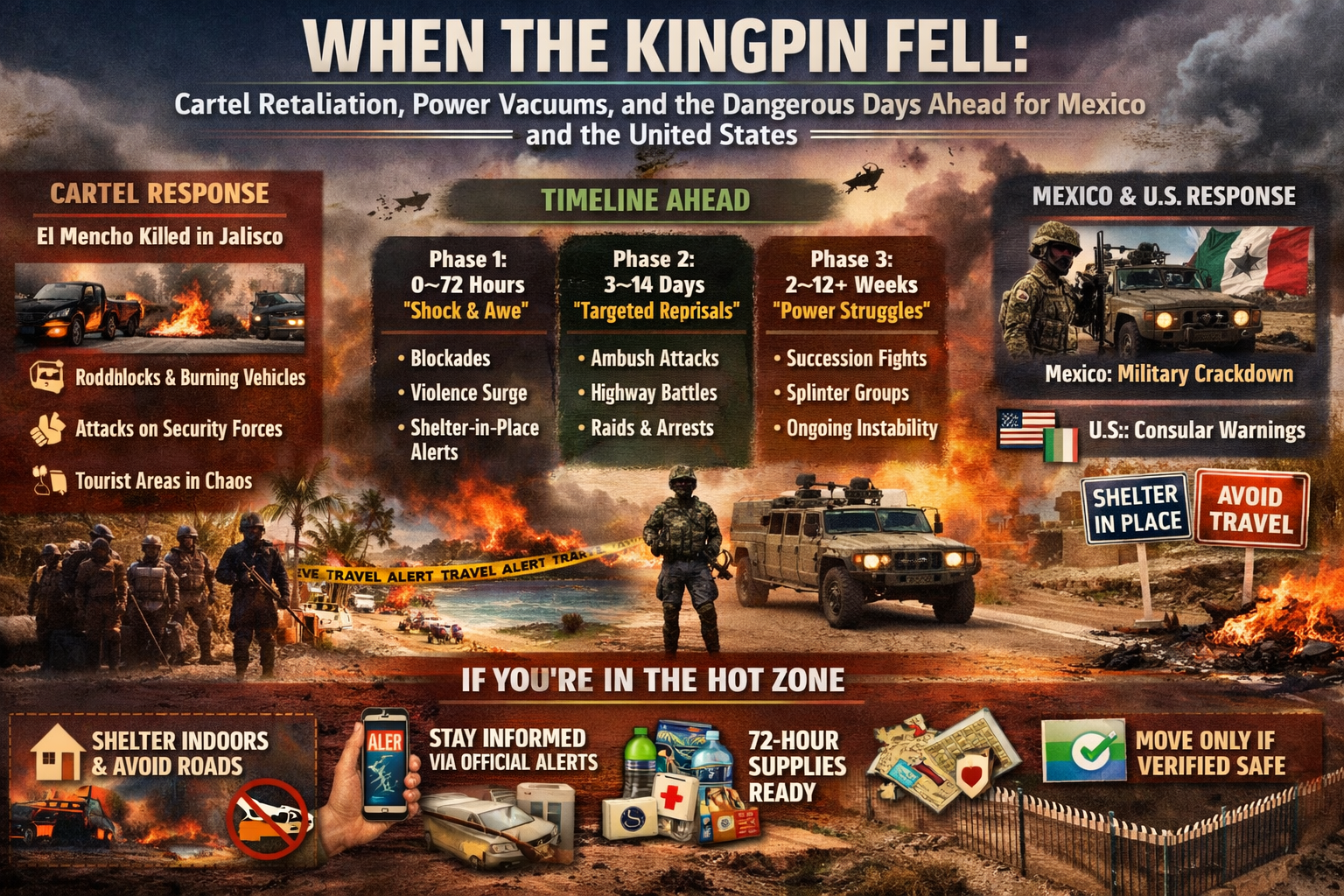
What’s happening in Mexico right now (post–“El Mencho” killing)
Multiple credible outlets are reporting that Nemesio Rubén Oseguera Cervantes (“El Mencho”), leader of the Jalisco New Generation Cartel (CJNG), was killed during a Mexican military operation in Jalisco (Tapalpa area).
What followed (and is still unfolding) looks like a classic cartel shock-response pattern—but on a wide scale:
Coordinated retaliation: Reports describe road blockades, burning vehicles, and multi-location attacks designed to paralyze movement and signal capability.
Significant security-force casualties: Reuters and AP describe dozens of attacks and major losses among Mexican forces in the immediate aftermath.
Tourist-area disruption: Puerto Vallarta and Guadalajara have been repeatedly named in security alerts and news coverage, including travel disruptions and “shelter in place” guidance for U.S. citizens in impacted areas.
Travel interruptions: Multiple reports describe flight cancellations/disruptions and local transportation interruptions (e.g., taxis/ride shares paused in some places), leaving travelers stranded.
Important caution on rumors: There has been viral online talk about Americans being “taken hostage” at airports. Some of the loudest versions come from secondary aggregators; treat those as unverified unless confirmed by primary authorities or wire services.
Why cartel retaliation looks like this
When a top leader is removed, cartels often respond in two ways at the same time:
Immediate “shock-and-awe” disruption (hours to days):
Blockades, vehicle burnings, and attacks meant to overwhelm response capacity, create uncertainty, and demonstrate that the organization still controls territory and routes. This is consistent with what Reuters/AP describe happening now.Internal reordering and conflict (weeks to months):
Leadership removal can create either:Rapid succession (if a clear #2 exists), or
Fragmentation and infighting (if succession is contested), which can increase violence as factions compete.
AP and Reuters both flag the risk of power vacuum/instability after the killing, even if it’s a significant operational blow.
Projected timeline: likely cartel behavior + public-security response (Mexico + U.S.)
This is a projection based on the documented pattern of cartel responses plus what officials are already doing in this event. Real-world conditions can change fast.
Phase 1: 0–72 hours (right now)
Cartel pattern
Rapid, highly visible disruption: blockades, arson, attacks on security forces, intimidation of civilian movement.
Mexico response
“Code red”/heightened posture, event cancellations, school disruptions, surges in patrols and response operations (as reported in coverage).
U.S. response
Consular security alerts and shelter-in-place guidance for U.S. citizens in named locations; restrictions on U.S. government staff movement.
Phase 2: 3–14 days
Cartel pattern
Retaliation can become more targeted (ambushes, selective attacks) as security forces adapt.
Testing response times and re-opening/contesting corridors.
Mexico response
Follow-on raids/arrests, attempts to re-establish highway control, visible force posture to deter further disruption (consistent with reported arrests/kills in the immediate operation window).
U.S. response
Continued alerts; potential tightening/loosening based on incident trendlines; continued emphasis on traveler security posture.
Phase 3: 2–12+ weeks
Cartel pattern
If succession is contested, violence can persist longer (fragmentation, splinter crews, shifting alliances).
If succession is stable, violence may drop but criminal governance and enforcement returns in a new equilibrium.
Mexico + U.S.
Intelligence-sharing and targeted operations can continue (Reuters/AP note U.S. intelligence support in reporting around this operation).
If you’re stranded in an affected area: best plan to maximize safety
Below is practical, civilian-focused guidance aligned with U.S. Mission Mexico and other official travel advisories.
1) Default stance: shelter + reduce movement
Stay inside a secure location (hotel/resort/home) and minimize unnecessary travel—especially at night and especially on highways.
Avoid “curiosity movement” (trying to see what’s happening). That’s how civilians get caught in blockades or crossfire.
2) Avoid the two highest-risk spaces: roads and crowds
Roads/highways can become sudden blockade sites.
Crowds and public gatherings can become flashpoints, and security operations can move quickly.
3) Treat official instructions as your operating manual
Monitor local government announcements, your hotel’s security desk, and U.S. Mission Mexico security alerts.
If authorities say “stay put,” assume it means: do not attempt self-evacuation by road unless you have a verified safe corridor.
4) Build a short “72-hour posture”
Have enough for 2–3 days without leaving:
Water + snacks/food
Medications + ID/passport + phone chargers/power bank
Cash (small bills), but keep valuables low-profile
A way to communicate with family/employer (simple check-in schedule)
5) If you must move (only if unavoidable)
Move in daylight, short distances, and only along verified open routes (hotel security + official advisories).
Avoid stops, avoid secondary roads, keep fuel topped off if you’re already in a vehicle.
If you encounter a blockade or active incident: do not approach. Turn around early.
6) Consular steps (U.S. travelers)
Enroll/monitor STEP and follow the U.S. Mission Mexico instructions for your location.
Keep your travel party together; establish meet points inside the hotel (not outside).
7) Information hygiene (this matters)
Assume social media is 50/50 noise during these events.
Use primary/official sources for decisions: U.S. Mission Mexico alerts, government advisories, and reputable wire reporting.
