
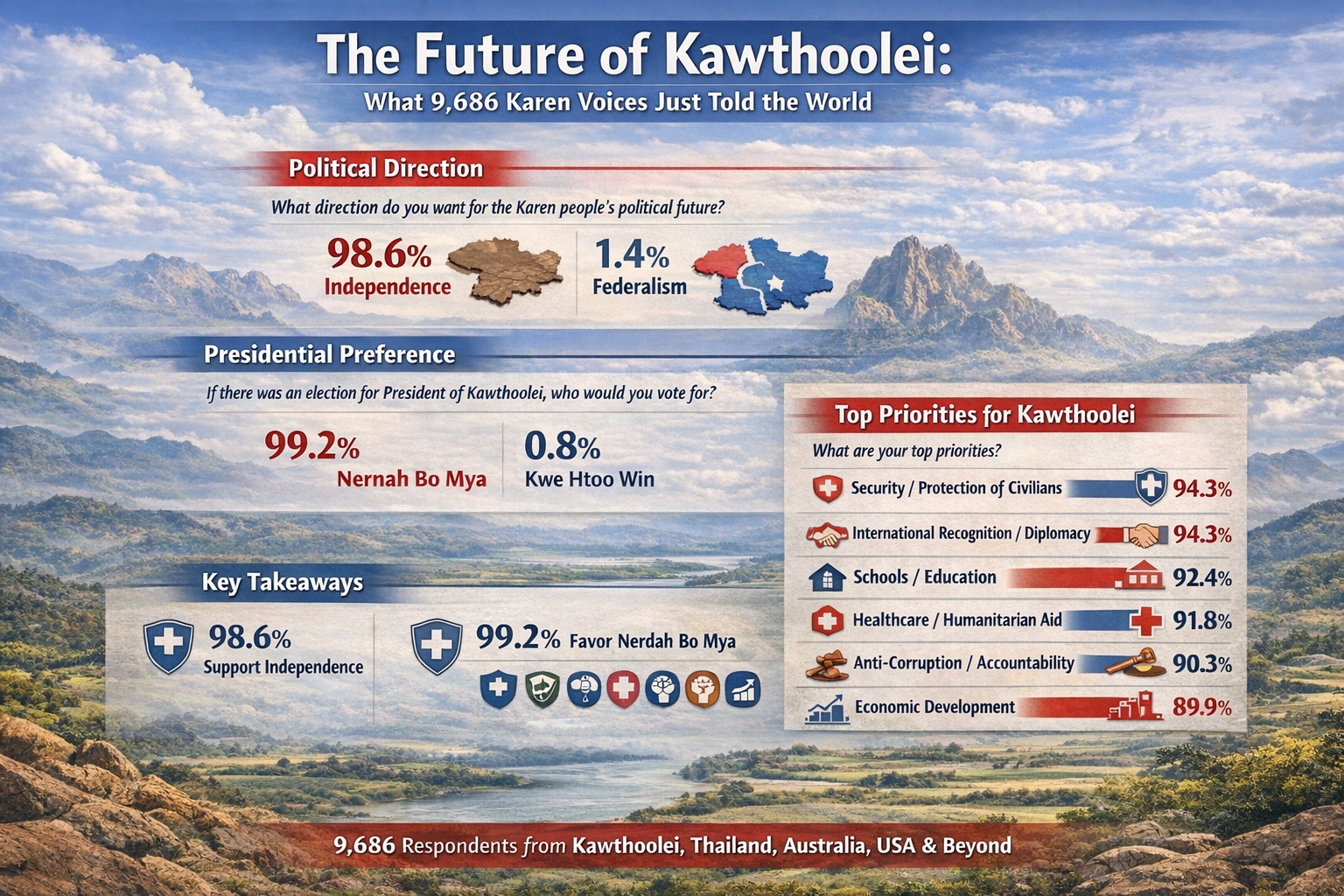
The Future of Kawthoolei: What 9,686 Karen Voices Just Told the World
In a moment when narratives about the Karen people are often shaped externally, nearly 10,000 Karen individuals across the globe have spoken for themselves.
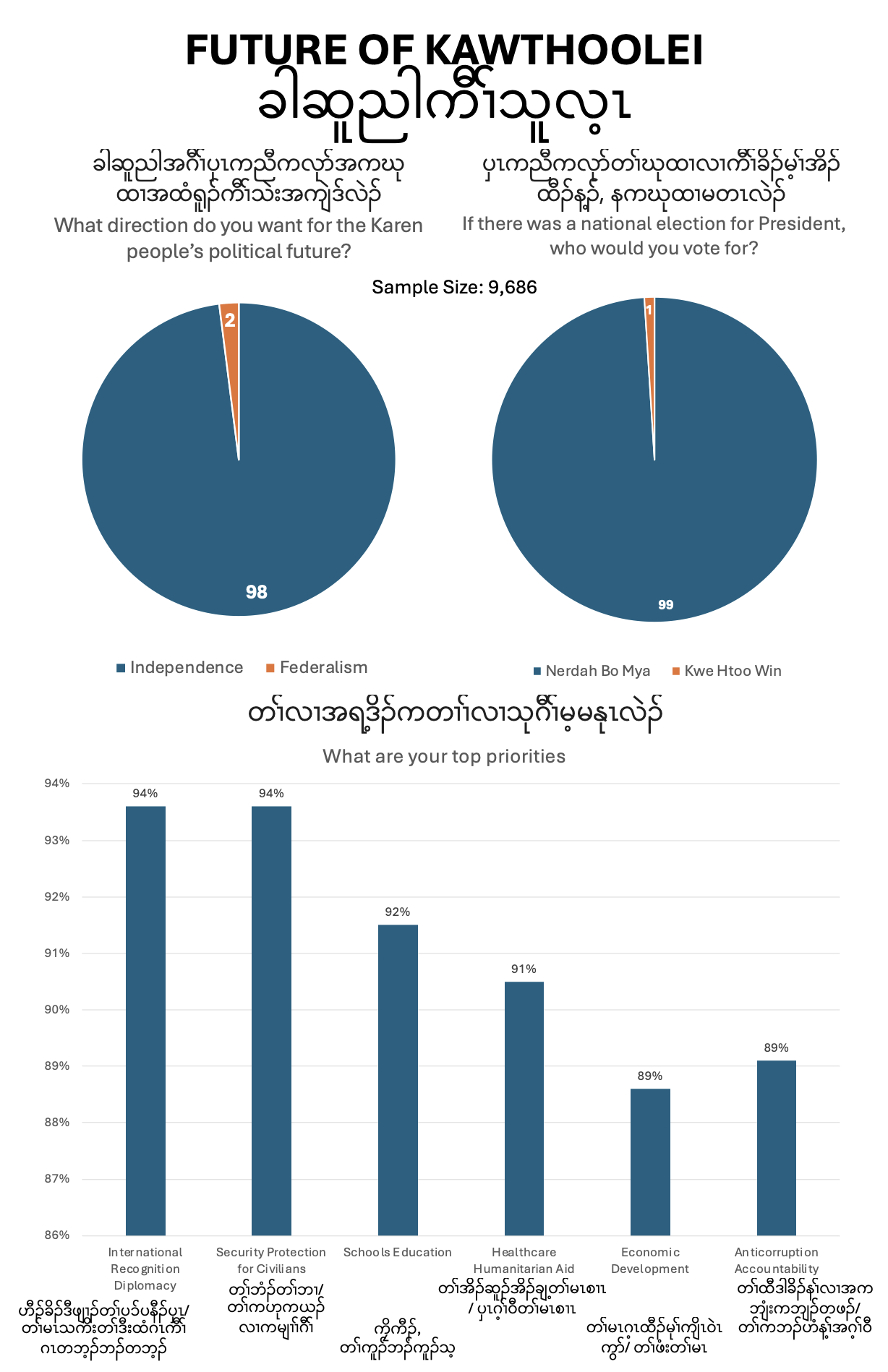
The Future Kawthoolei Poll gathered responses from 9,686 Karen people living in Kawthoolei, Thailand, Australia, the United States, Canada, and other diaspora communities. The results were not fragmented. They were not ambiguous.
They were decisive.
This poll represents one of the most substantial coordinated expressions of Karen political opinion in modern history.
A Clear Mandate: Independence
The first question asked:
What direction do you want for the Karen people’s political future?
98.6% chose Independence
1.4% chose Federalism
This is not statistical noise.
This is near-unanimous alignment.
Across borders and generations, the Karen people are expressing a shared aspiration for self-determination through independence. When a population dispersed across multiple continents arrives at this level of consensus, it signals clarity of national identity and political will.
Leadership Alignment
The second question asked:
If there was a national election for President of Kawthoolei, who would you vote for?
99.2% selected Nerdah Bo Mya
0.8% selected Kwe Htoo Win
Again, the results show extraordinary cohesion.
Whether one analyzes this through the lens of political science, conflict studies, or governance development, such overwhelming alignment around a single potential leader suggests more than preference — it reflects trust and perceived legitimacy among respondents.
The Blueprint for Nation-Building
The third question moved beyond ideology and into governance:
What are your top priorities for Kawthoolei?
The results were striking in their practicality:
Security / Protection of Civilians — 94.3%
International Recognition / Diplomacy — 94.3%
Schools / Education — 92.4%
Healthcare / Humanitarian Aid — 91.8%
Anti-Corruption / Accountability — 90.3%
Economic Development — 89.9%
These are not emotional demands.
They are governance demands.
The top concern is civilian protection — a reflection of lived insecurity.
The second is international recognition — a recognition that legitimacy on the global stage shapes stability at home.
Then education, healthcare, accountability, and economic development — the foundational pillars of a functioning republic.
This is not rhetoric.
It is a policy blueprint.
What This Means for Regional and Global Stakeholders
Three conclusions emerge clearly:
The Karen people demonstrate overwhelming unity regarding political direction.
There is strong alignment around identifiable leadership.
The population’s priorities center on structured governance, not chaos.
For regional actors and international policymakers, these results carry implications.
When nearly 10,000 individuals across multiple countries speak with this level of alignment, it challenges narratives that portray the Karen question as fragmented or undefined.
It suggests maturity of political vision.
It suggests readiness for structured engagement.
It suggests that the conversation about Kawthoolei’s future should not be framed solely by armed dynamics, but by governance capacity, civilian protection, diplomatic legitimacy, and institutional development.
Data Matters
In conflict-affected regions, claims are often loud.
Data is rare.
This poll provides measurable insight into what Karen people themselves say they want — not what outside observers assume.
That distinction is critical.
As discussions about the future of Burma (Myanmar) and ethnic self-determination continue, this dataset deserves careful attention.
The Karen people have spoken with clarity.
The next question is whether the international community is prepared to listen — and engage responsibly.