
Why Iranians Celebrate the Fall of the Regime’s Top Leader
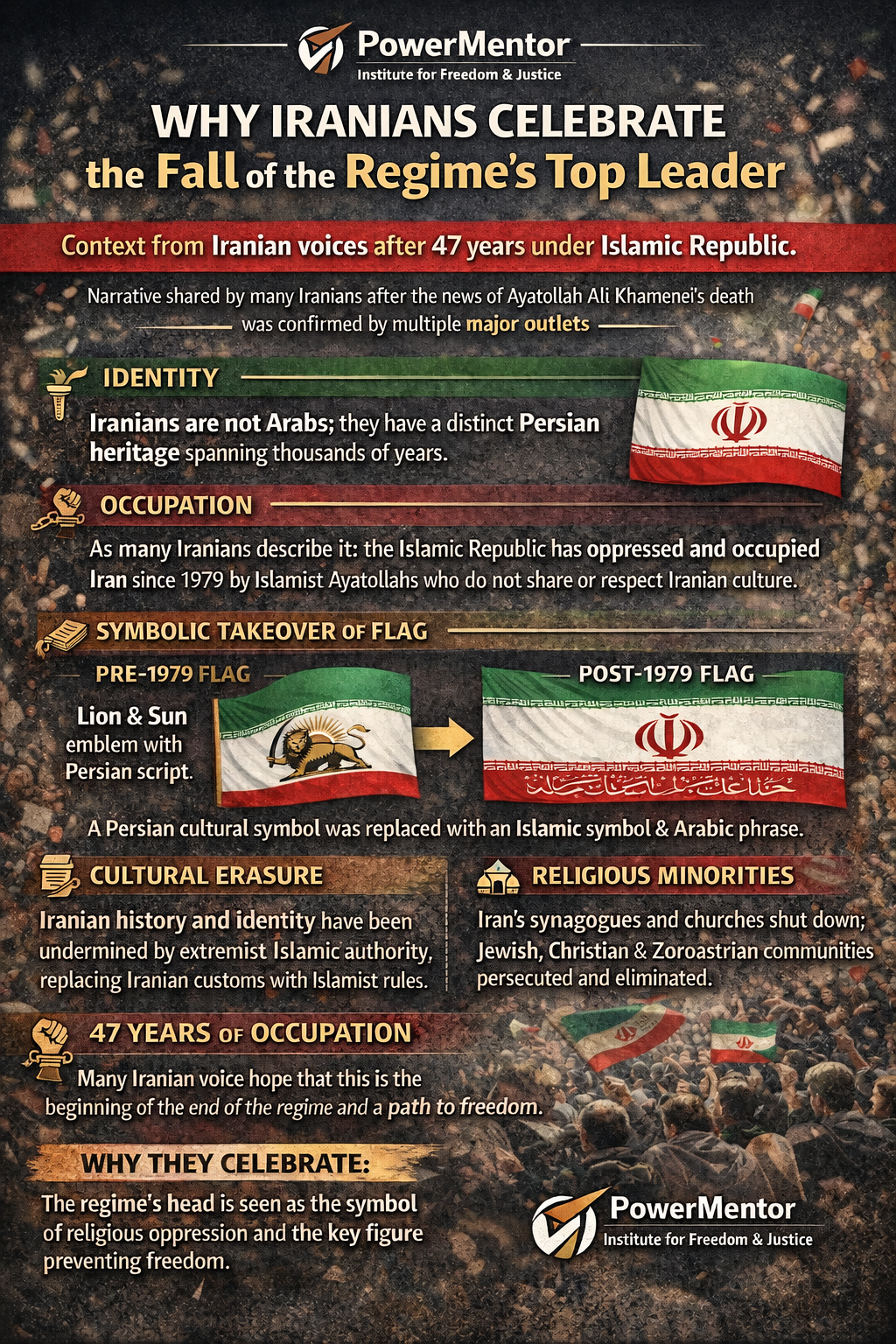
Understanding 47 Years of Cultural Suppression and Identity Conflict
For many outside observers, scenes of celebration inside Iran following the confirmed death of Ayatollah Ali Khamenei may seem confusing. How could citizens celebrate the death of their own country’s top leader?
To understand this reaction, one must understand the distinction many Iranians make between Iran as a civilization and the Islamic Republic as a regime.
This is not merely a political moment.
It is, for many, an identity moment.
Iran Is Not an Arab State
Iranians are Persian. Their civilization predates Islam by millennia. Persian language, culture, literature, and symbolism stretch back thousands of years.
Iran’s identity historically centered around Persian heritage — not Arab nationalism, and not political Islam.
Many Iranians emphasize this distinction strongly:
They are Iranian first.
The 1979 Revolution and the Reshaping of Identity
In 1979, the Islamic Revolution transformed Iran into the Islamic Republic under the leadership of Islamist clerics.
To supporters of the revolution, it was a religious revival.
To critics — especially many inside the country today — it marked the beginning of ideological control over Iranian cultural identity.
From that point forward, the state increasingly merged governance with religious authority.
The Flag: A Symbolic Takeover
Symbols matter deeply in national identity.
Before 1979, Iran’s flag featured the historic Lion and Sun emblem — a Persian cultural symbol representing strength, sovereignty, and heritage.
After the revolution:
The Lion and Sun were removed.
An Islamic emblem replaced the central symbol.
Arabic religious phrases were incorporated into the flag’s design.
For many critics of the regime, this represented more than design changes.
It symbolized a shift from Persian national identity toward religious ideological identity.
The colors remained.
The meaning changed.
Cultural and Institutional Changes
Opponents of the regime argue that over the past 47 years:
Religious authority became embedded into state governance.
Islamic law increasingly shaped social life.
National institutions were restructured under clerical oversight.
Education systems emphasized religious doctrine alongside academics.
Public expression of dissent was restricted.
Critics describe this period as one of cultural narrowing — where religious conformity became central to public life.
Religious Minorities and Tensions
Before the revolution, Iran was home to one of the largest Jewish communities in the Middle East outside Israel, as well as longstanding Christian and Zoroastrian communities.
While minority religions remain legally recognized under the constitution, human rights groups and dissident voices have documented:
Periodic crackdowns.
Restrictions on religious practice.
Social and political marginalization.
Emigration of minority communities over decades.
These issues remain deeply debated inside and outside Iran.
Language, Anthem, and National Narrative
Many critics argue that:
National rhetoric increasingly centered on Islamic ideology rather than Persian nationalism.
The national anthem shifted toward religious themes.
Political messaging emphasized religious identity over historical Persian identity.
Whether one views these changes as rightful religious governance or ideological control depends largely on political perspective.
But the divide is real.
Why Some Celebrations Occurred
For many Iranians who oppose the Islamic Republic, Ayatollah Khamenei represented:
The face of clerical rule.
The continuity of revolutionary ideology.
The symbol of repression and lack of political reform.
The barrier to generational change.
To them, his death represents the possible end of an era.
It does not automatically mean freedom.
It does not guarantee democracy.
But for some, it signals the first crack in a 47-year structure of authority.
A Nation Divided Between Regime and Civilization
The key tension inside Iran is not simply political.
It is civilizational.
One side sees Iran primarily as an Islamic revolutionary state.
The other sees Iran as an ancient Persian civilization constrained by religious governance.
The celebrations seen in some areas reflect that deeper divide.
What Comes Next?
Leadership transitions in authoritarian systems are volatile.
Possible outcomes could include:
Internal power consolidation.
Increased repression.
Reform attempts.
Elite fragmentation.
Or long-term structural change.
History shows that when identity and governance clash for decades, transitions are rarely simple.
Final Reflection
To outside observers, celebration may appear shocking.
To some Iranians, it reflects something deeper:
A longing for cultural reclamation.
A desire for sovereignty rooted in Persian heritage.
A hope — however uncertain — that history may be turning a page.
Time will determine whether that hope materializes.
