
Transition Plan for a Democratic Iran
HRH Reza Pahlavi on Iran’s Transition: A Structured Plan for Regime Collapse, Stabilization, and Democratic Referendum
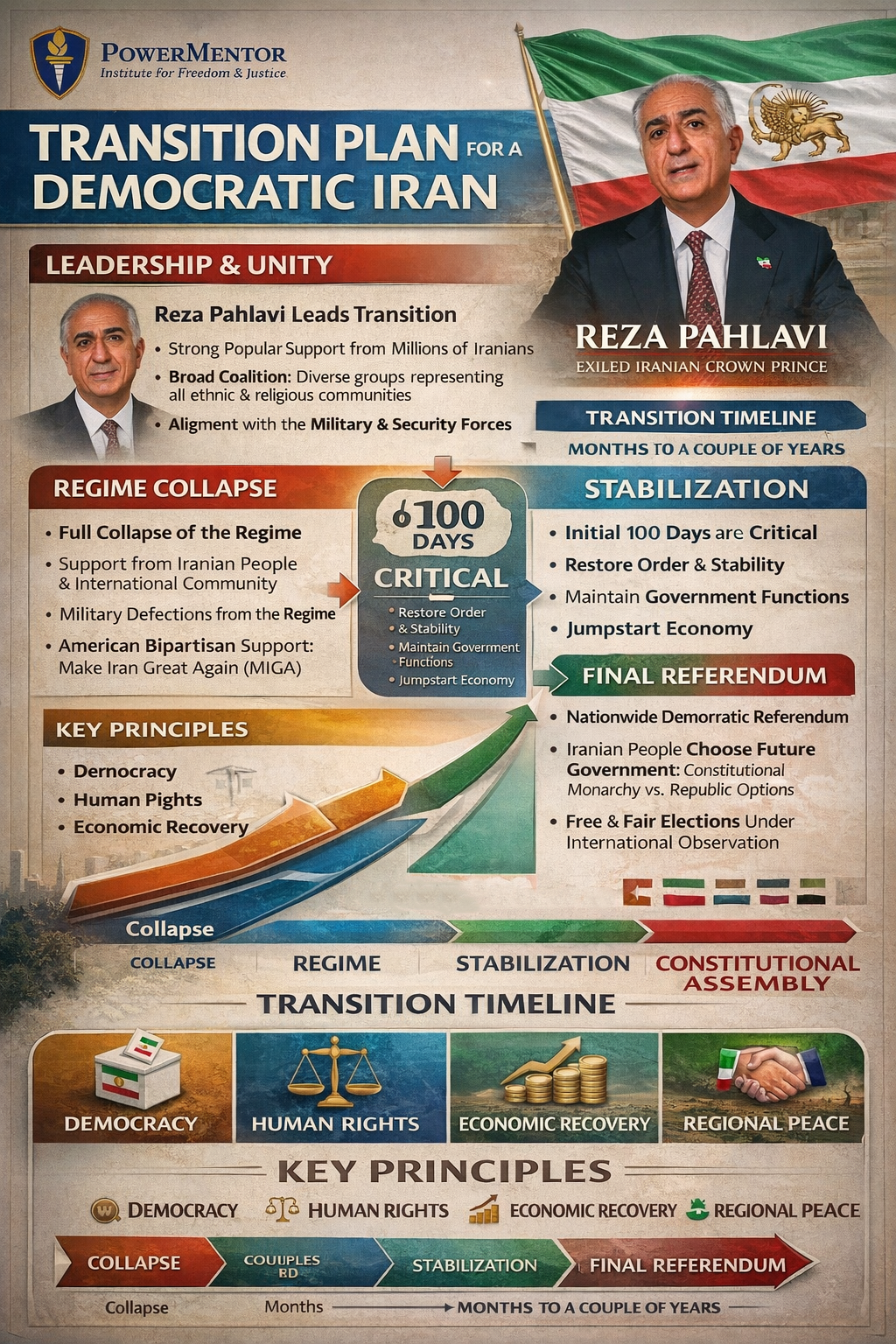
In a recent interview, HRH Reza Pahlavi outlined what he describes as a historic turning point for Iran and a detailed plan for a strong, stable national transition. His remarks focused on five core areas:
Regime Collapse
Immediate Stabilization (First 100 Days)
Coalition & Military Alignment
Constitutional Process
Final Democratic Referendum
Below is a structured breakdown of his transition vision.
1. A “Game-Changer” Moment
Reza Pahlavi framed the current situation as:
A decisive weakening of the regime
A moment of jubilation among Iranians inside and outside the country
The beginning of what he called “the very end” of the ruling system
He argued that significant decimation of the regime levels the playing field, allowing Iranians to return to the streets and reclaim their country.
2. Leadership of the Transition
Pahlavi stated clearly:
He is leading the transition effort.
He has support from millions of Iranians.
A broad coalition is forming inside and outside Iran.
Coalition Characteristics
He emphasized that the coalition:
Represents diverse political perspectives
Includes religious minorities
Includes ethnic groups from across the country
Is united around a national project
He described it as the “most diverse coalition” assembled for this purpose.
3. Alignment with Military and Security Forces
A critical component of his plan involves:
Anticipated defections from the regime
Alignment of military and security forces with the people
Incorporating remaining civilian bureaucracy and security structures into the transition — where possible — to preserve state functionality
He stressed that whatever remains of the collapsing regime is not part of the solution, but that state apparatus must remain functional to avoid chaos.
4. Bipartisan U.S. Engagement & Strategic Partnership
Pahlavi highlighted conversations with:
Senator Lindsey Graham
Senator John Fetterman
He stated:
Iran’s future should be a bipartisan issue in the United States.
A post-regime Iran would align with American national security interests.
The U.S. would be Iran’s primary partner in reconstruction.
He referenced:
The “Iran Prosperity Project (IPP)”
A potential Senate-level bipartisan group to review the transition plan
Significant economic opportunity between the U.S. and Iran
Economic Projection
He claimed:
Opening Iran’s market could generate over $1 trillion in economic impact.
Billions of dollars are ready to be invested into Iran once the regime is gone.
5. First 100 Days: The Critical Stabilization Phase
He repeatedly emphasized:
The first 100 days are critical.
Primary objectives during this period:
Restore order and stability
Maintain functioning government institutions
Keep bureaucratic systems intact
Prevent economic freefall
Jumpstart economic recovery
He stressed that the stabilization phase is measured in months — not years.
The goal is to ensure continuity of governance while the political transition unfolds.
6. Avoiding Past Transitional Failures
Pahlavi directly referenced:
Post-Saddam Iraq de-Ba’athification failures
Venezuela’s stalled transition
He argued:
Iran’s scenario is different.
An “ironclad plan” is in place.
The vacuum will be filled quickly to avoid chaos.
7. Timeline Toward Democratic Outcome
While stabilization occurs in months, he estimated:
The full transition process should not exceed a couple of years.
The ultimate objective:
A final nationwide democratic referendum.
The Iranian people choose their future system.
8. Constitutional Assembly
Before the final referendum:
A Constitutional Assembly will be formed.
Competing visions (including constitutional monarchy vs. republic) will be debated.
Various constitutional proposals will be presented.
He emphasized that:
The Iranian people will ultimately choose their future government and system.
9. Core Principles of the Transition
Throughout the interview, four themes consistently appeared:
Democracy
Human rights
Economic recovery
Regional peace and stability
He described a future Iran that:
Is at peace with its neighbors
Contributes to regional stability
Aligns economically with Western markets
Functions as a democratic state
10. The Strategic Framework at a Glance
Phase 1: Regime Collapse
Phase 2: Immediate Stabilization (First 100 Days)
Phase 3: Coalition Governance & Institutional Continuity
Phase 4: Constitutional Assembly
Phase 5: National Referendum
End State:
A democratically chosen government determined by the Iranian people.
