

Why China and Russia Won’t Fight for Iran
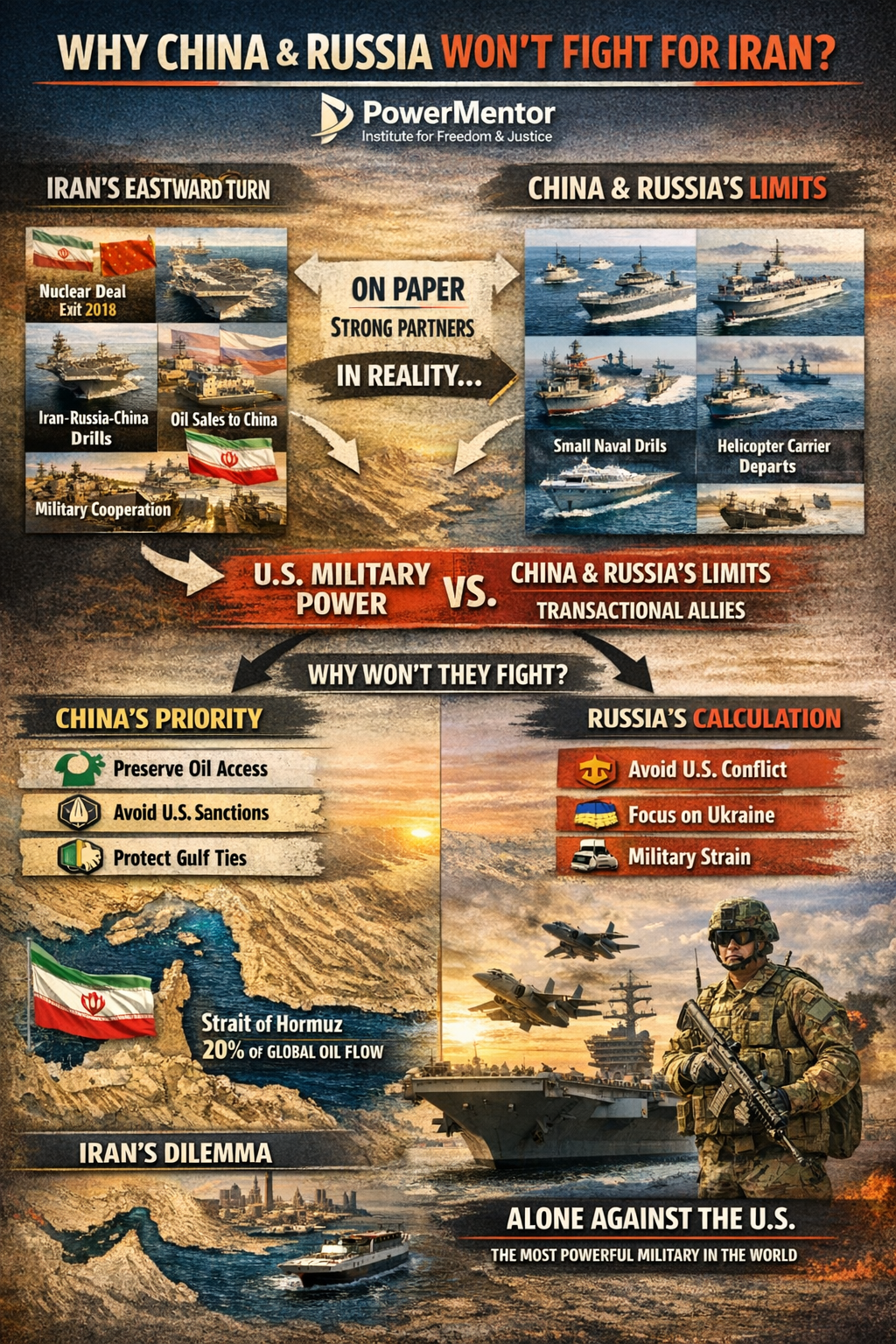
The Myth of the Anti-Western Axis
For years, Iran believed it had powerful friends.
Russia.
China.
After the United States withdrew from the 2015 nuclear deal in 2018, Iran’s Supreme Leader, Ali Khamenei, pushed what Tehran called a “Look East” strategy. The logic was straightforward:
If the West isolates us, we pivot to Moscow and Beijing.
And on the surface, that pivot appeared successful.
Joint naval drills in the Gulf of Oman
Oil exports flowing heavily to China
Missile and drone cooperation with Russia
Military coordination in Syria
Public messaging about a new “multipolar world”
On paper, it looked like a united front.
But war exposes reality.
And reality is far more transactional than ideological.
The Illusion of Strategic Partnership
When tensions with the United States rise, the depth of those alliances shrinks dramatically.
This week, Russia and Iran conducted a modest naval exercise in the Gulf of Oman. China signaled interest in future drills in the Strait of Hormuz.
Symbolism? Yes.
Strategic commitment? Not even close.
Now compare that to U.S. military positioning:
Carrier strike groups
Long-range bombers
Advanced air defense systems
Sustained strike capacity over weeks
Regional base infrastructure
U.S. officials have indicated Washington now possesses the capability to launch a prolonged air campaign—not just a limited strike operation.
Meanwhile, Russia’s helicopter carrier left immediately after exercises ended.
That contrast tells the story.
Why China Won’t Intervene
China is Iran’s largest oil customer.
Roughly 20% of global oil flows through the Strait of Hormuz. Beijing’s core interest is not ideological alignment. It is stability and uninterrupted energy access.
If China were to openly align militarily with Iran against the United States, it would:
Risk severe economic sanctions
Damage trade relations with Washington
Endanger Gulf economic partnerships
Disrupt global oil markets
Increase instability that threatens its own supply chain
China’s global strategy is long-term positioning, not battlefield escalation.
Beijing prefers:
Preserve oil access.
Avoid direct conflict.
Remain positioned for influence — even if leadership in Tehran changes.
If Iran’s regime were to weaken or collapse, China would adapt quickly. It would secure energy flows, not defend Tehran militarally.
China is pragmatic. Not loyal.
Why Russia Won’t Go to War for Tehran
Russia benefits from Iran.
Drone cooperation
Sanctions evasion networks
Regional coordination in Syria
Pressure against U.S. influence
But Russia is calculating carefully.
Moscow does not want:
Direct military confrontation with the United States
To overstretch its already strained military capacity
To risk pushing Washington deeper into its conflict in Ukraine
To open a second high-intensity front
Russia may prefer Iran survive.
But it will not risk national survival to save it.
Strategic sympathy is not the same as military commitment.
Iran’s Leverage — And Its Limits
Iran is not powerless.
Tehran can:
Disrupt the Strait of Hormuz
Target regional oil infrastructure
Activate proxy networks across the Middle East
Strike U.S. regional bases indirectly
About 20% of global oil supply transits through Hormuz. That chokepoint is Iran’s primary deterrent.
But escalation there would also hurt China — its largest customer.
Which again reinforces Beijing’s restraint.
The very leverage Iran holds is constrained by the interests of its supposed allies.
The Overstated “Axis”
There is a popular narrative that China, Russia, and Iran form a unified anti-Western bloc.
That narrative is overstated.
They share interests.
They do not share existential commitment.
If the United States were to strike Iran directly, Beijing and Moscow would calculate based on:
Their economy.
Their wars.
Their sanctions exposure.
Their survival.
Not Tehran’s.
And that leaves Iran facing the most powerful military in the world largely alone.
The Strategic Reality
Alliances in geopolitics are rarely emotional.
They are transactional.
Iran’s “Look East” strategy created economic buffers and diplomatic alternatives. But it did not create a NATO-style defense pact. There is no binding mutual defense guarantee.
China wants energy security.
Russia wants leverage.
The United States maintains overwhelming expeditionary capability.
When war becomes real, interests narrow.
And interests — not rhetoric — determine who fights.
Final Thought
In geopolitics, loyalty is rare.
Leverage is temporary.
Interests are permanent.
The idea of a unified anti-Western military axis may make for strong headlines. But when faced with direct confrontation, Beijing and Moscow will protect themselves first.
And that strategic truth is the uncomfortable lesson Tehran is now confronting.
