

The 24-Hour Pivot: How Regional Moves May Have Shaped Israel’s Strike on Iran
Introduction
In geopolitics, events rarely stand alone. Military strikes often represent the final move in a sequence that began quietly — through diplomacy, positioning, and regional maneuvering.
Recent reports and commentary have suggested that Israel’s strikes inside Iran were not simply tactical air operations, but the culmination of a coordinated 24-hour regional shift involving India, Pakistan, Afghanistan, and key maritime corridors.
This article explores that thesis — connecting the dots in a clear, step-by-step way.
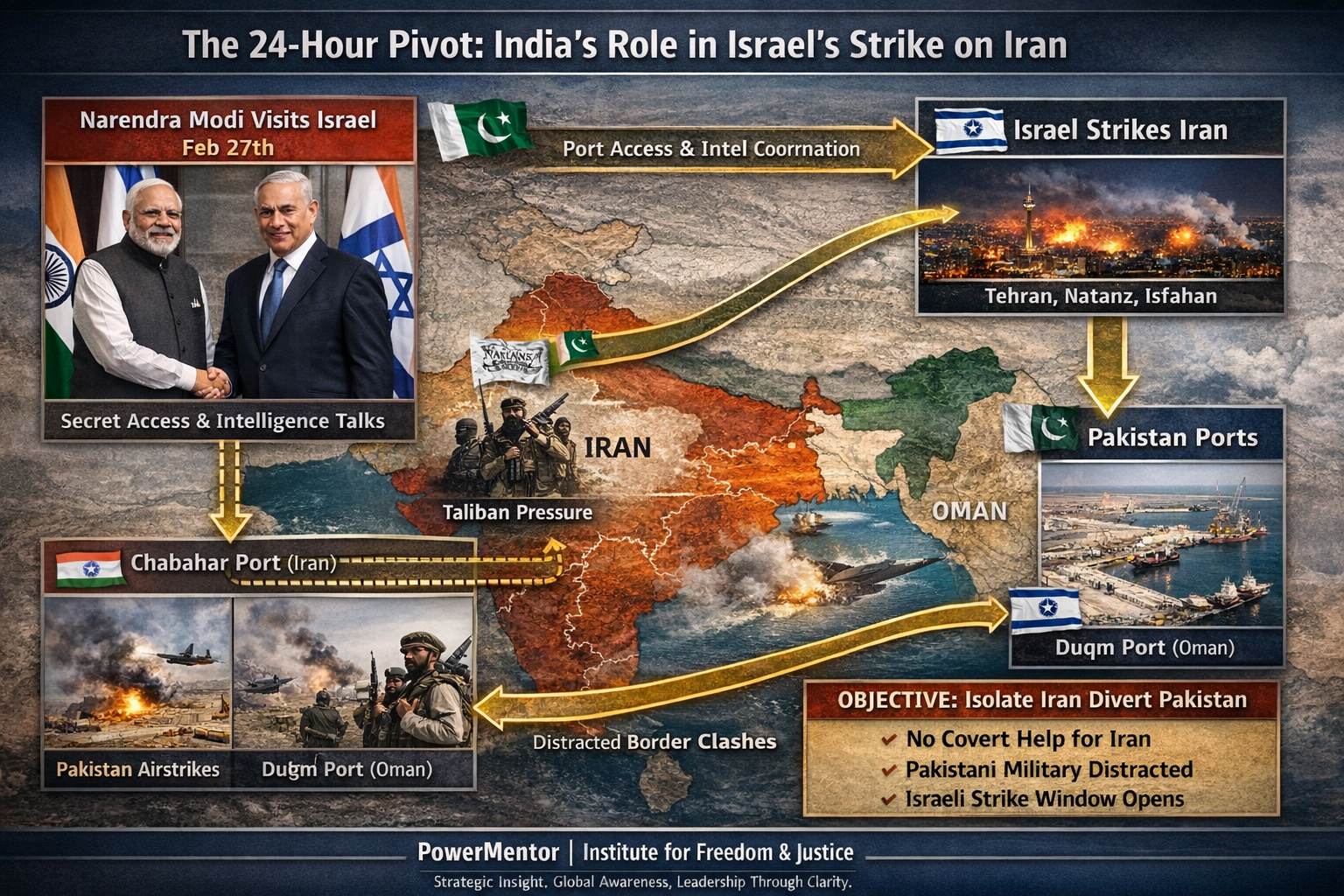
Step 1: The Diplomatic Trigger — Modi’s Visit
On February 27th, Indian Prime Minister Narendra Modi visited Israel during an active conflict phase. He was reportedly the only head of state to do so at that moment.
A visit like this, during heightened tensions, is rarely symbolic alone. At minimum, it signals:
High-level coordination
Strategic alignment
Private security discussions
The timing is what raised eyebrows. Within roughly 24 hours of this visit, regional military activity escalated dramatically.
Step 2: The Port Leverage — Chabahar & Duqm
India operates or has strategic access to two key ports:
Chabahar Port (Iran)
Duqm Port (Oman)
These ports matter because they sit along critical supply and maritime corridors in the region.
The strategic theory suggests that through India’s presence at these ports, indirect logistical insight or regional maritime visibility could be enhanced. Whether through commercial, diplomatic, or security channels, access equals awareness.
In modern conflict, intelligence is not just satellites and drones — it is trade routes, shipping lanes, and port access.
Step 3: Pakistan’s Sudden Western Escalation
Around the same timeframe:
Pakistan launched strikes inside Afghanistan.
Tensions escalated along Pakistan’s western border.
The Taliban increased engagement.
This shift matters for one reason: Pakistan historically has maintained complex relationships in regional conflicts, including previous alignments that were perceived as supportive of Iran in indirect ways.
If Pakistan’s military attention is redirected westward, its ability to assist elsewhere becomes constrained.
Military bandwidth is finite. Focus determines capability.
Step 4: Why Divert Pakistan?
In prior Iran-related confrontations, Pakistan was perceived as leaning diplomatically and strategically toward Tehran.
From a strategic standpoint, if Israel were to conduct a significant strike inside Iran, minimizing:
Additional intelligence sharing to Iran
Logistical support
Diplomatic backing
Risk of a second regional front
…would be critical.
By ensuring Pakistan was consumed with its western border situation, the possibility of coordinated support for Iran diminishes.
This creates what military planners call a “single-theater engagement window.”
Step 5: The Strike Window Opens
Once:
Diplomatic coordination occurred,
Maritime leverage was reinforced,
Pakistan’s focus shifted west,
…Israel reportedly executed strikes in Tehran, Natanz, and Isfahan.
The strategic objective, according to this interpretation, was not just physical damage.
It was isolation.
Isolation of Iran:
Militarily
Logistically
Diplomatically
No second front.
No external reinforcement.
No rapid regional escalation.
The Bigger Impact: Psychological and Institutional Shock
The consequences of such coordination extend beyond infrastructure damage.
When strikes are executed after visible regional positioning, they send signals:
Intelligence penetration may be deeper than assumed.
Alliances may be more coordinated than publicly visible.
Regional actors may hesitate before committing support.
The long-term effect is deterrence through unpredictability.
Important Clarification
It is essential to note:
Much of the above reflects strategic analysis and interpretation based on publicly observed events and timing correlations. Direct evidence of coordinated pressure or secret agreements is not publicly confirmed.
In geopolitics, correlation does not automatically equal causation. However, patterns matter — especially when timing aligns this tightly.
Why This Matters
For leaders, policymakers, and analysts, this sequence demonstrates a core truth:
Modern warfare is multi-domain.
It is:
Diplomatic
Economic
Maritime
Psychological
Informational
The strike may have lasted minutes.
The positioning likely took months.
Final Thought
The real battlefield may not have been Tehran.
It may have been the 24 hours before.
When regional actors move in sync — even indirectly — the battlefield changes before the first missile launches.
That is the lesson of the 24-hour pivot.
