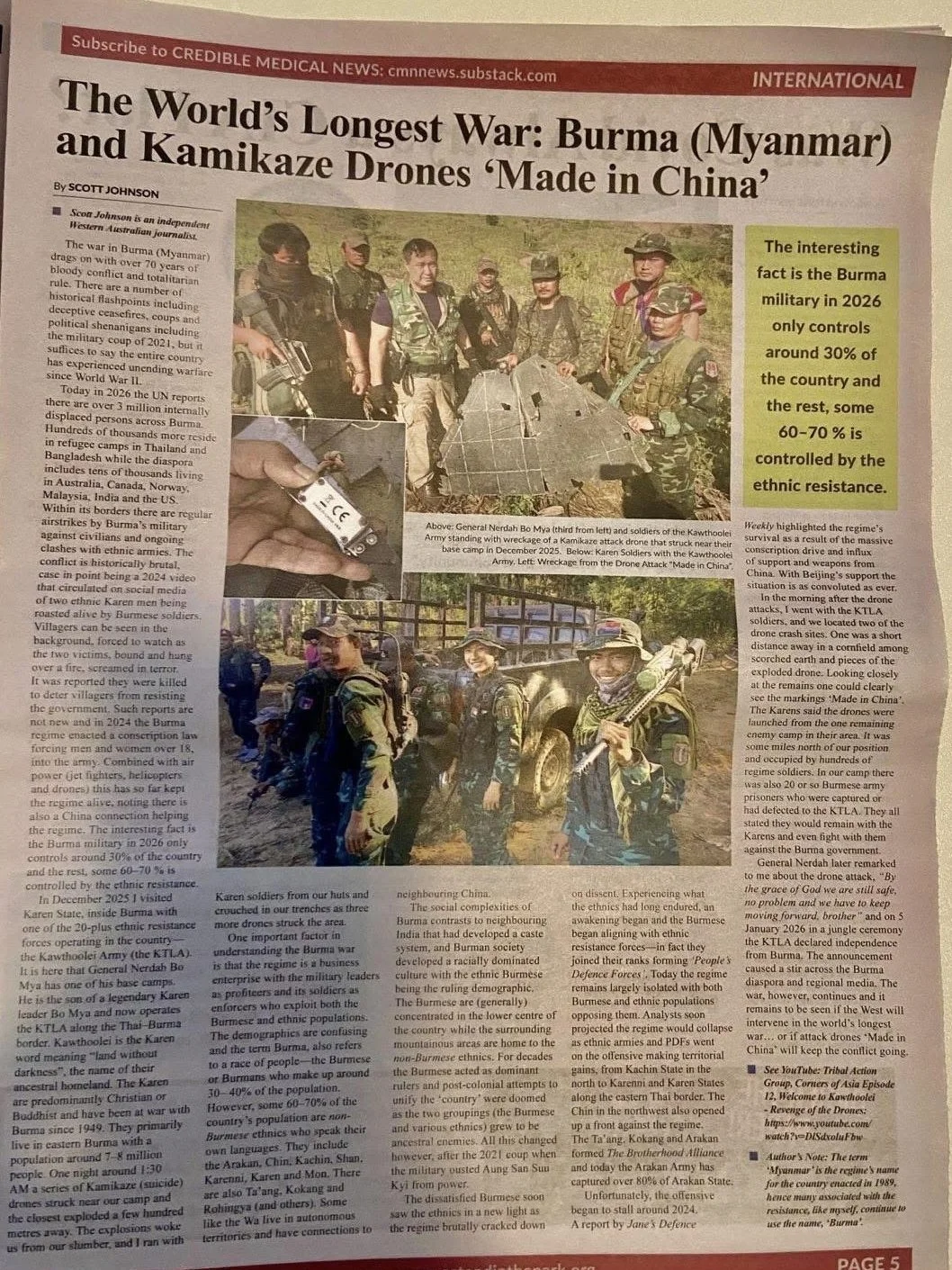

Kawthoolei Under Fire: How the Karen Resistance Is Reshaping the World’s Longest War
For more than seventy years, the Karen people of Burma (Myanmar) have lived inside a war the outside world rarely sees clearly. Long before the 2021 military coup, Karen communities were already navigating airstrikes, forced displacement, scorched-earth campaigns, and political erasure. What has changed is not the existence of the war—but who is winning it, how it is being fought, and who is keeping the Burmese military alive.
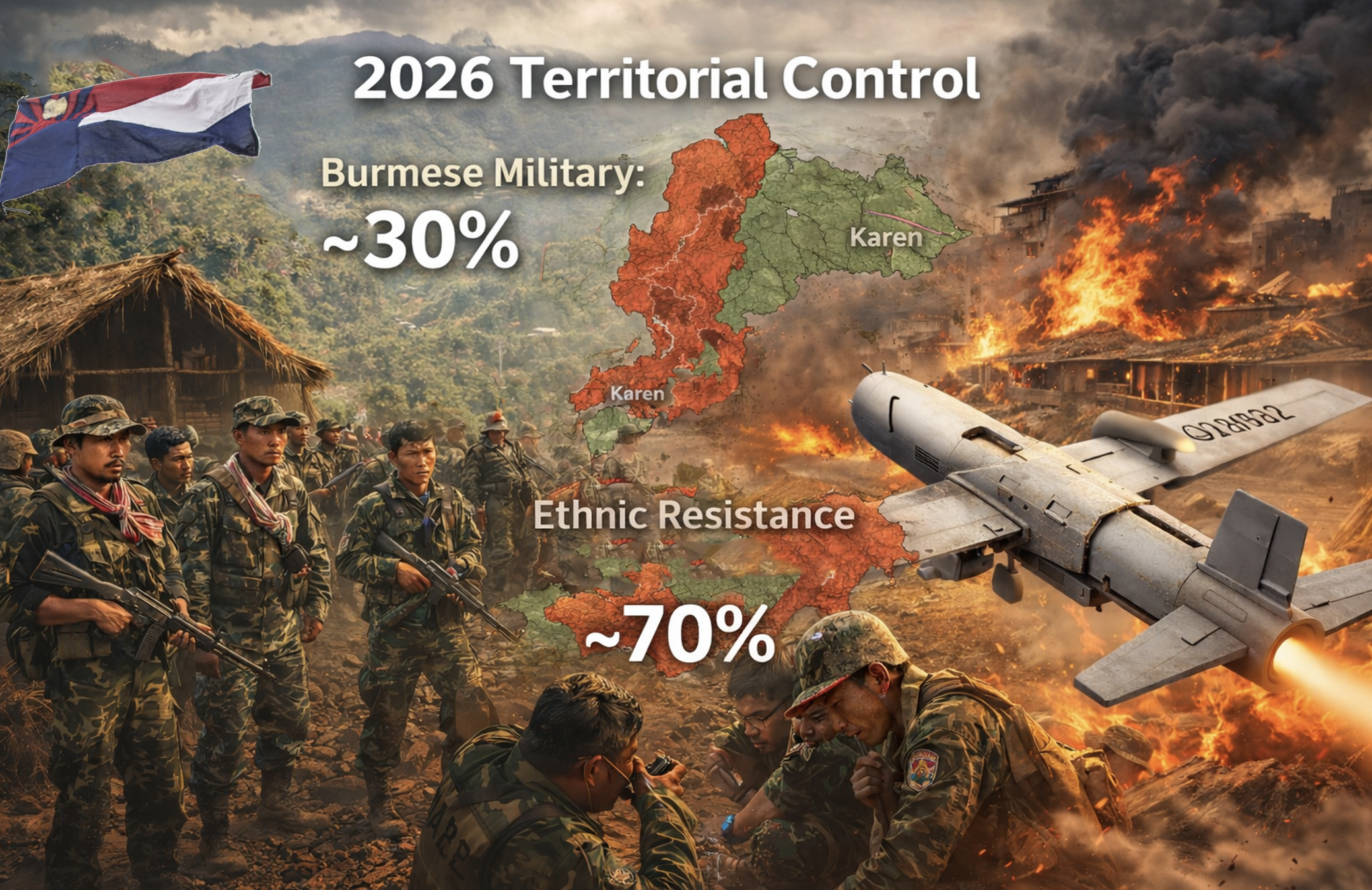
By 2026, the Burmese military reportedly controls only about 30% of the country, while 60–70% is held by ethnic resistance forces, including Karen-led formations. This is not a symbolic shift. It is a structural collapse of centralized military authority—one that has forced the junta to adopt new tools of survival, most notably kamikaze drones sourced through Chinese supply chains.
The Karen: From Survival to Strategic Force
The Karen are not a new resistance. They are one of the oldest. Since 1949, Karen forces have fought successive Burmese regimes in defense of Kawthoolei—a term meaning “land without darkness,” reflecting both territory and identity. With an estimated population of 7–8 million, largely concentrated in eastern Burma along the Thai border, the Karen have endured decades of military campaigns designed to break their cohesion.
Karen resistance groups—particularly the Kawthoolei Army (KTLA) led by General Nerdah Bo Mya—are no longer operating merely as defensive security forces. They are increasingly territorial, coordinated, and politically assertive, holding ground, capturing regime soldiers, and integrating defectors into their ranks. In one camp described, roughly 20 Burmese soldiers had either surrendered or defected, reportedly choosing to remain with the Karen rather than return to junta control.
This is not simply battlefield momentum. It reflects a deeper legitimacy crisis within the Burmese military itself.
Drone Warfare and “Made in China”
Facing shrinking manpower and eroding morale, the junta has turned to remote warfare. The article documents kamikaze drone strikes near Karen positions, including attacks occurring at night while fighters slept. Wreckage recovered at crash sites reportedly bore “Made in China” markings, reinforcing long-standing allegations that Chinese components, weapons, and logistical pathways are sustaining the regime.
These drones serve a strategic purpose: they allow the junta to strike deep into resistance areas without exposing pilots or ground forces it can no longer afford to lose. In practice, however, they also expand civilian risk, as strikes frequently occur near camps, villages, and forest shelters where families are hiding.
China’s role, as portrayed in the article, is not framed as ideological alignment but strategic pragmatism—keeping a weakened regime functional enough to protect Beijing’s regional interests, trade routes, and border stability, even as the junta loses control of its own country.
Terror as Policy: Karen Civilians in the Crosshairs
A 2024 video circulated on social media that allegedly shows two Karen men being burned alive by Burmese soldiers while villagers were forced to watch—an act described as deliberate terror meant to deter resistance.
Such incidents are not presented as anomalies. They are described as continuations of a long pattern: forced conscription (including women and youth), village destruction, and mass displacement. By 2026, more than 3 million people across Burma are internally displaced, with Karen communities among the most heavily affected.
Independence as a Line Crossed
Perhaps the most consequential moment is political rather than military. On January 5, 2026, in a jungle ceremony, the KTLA formally declared independence from Burma. This declaration electrified Karen diaspora communities and sharpened the stakes of the conflict.
For the junta, it marked a red line: resistance was no longer framed merely as insurgency but as irreversible separation. For the Karen, it represented something equally profound—a public assertion that survival alone is no longer the goal. Self-determination is.
A War the World Still Misunderstands
The article ultimately situates the Karen struggle within a larger reality: Burma’s war is no longer just internal. It is technological, proxy-enabled, and asymmetric, where drones substitute for legitimacy and foreign supply chains delay defeat.
For the Karen, this moment carries both danger and opportunity. The regime is weaker than it has ever been. Yet as long as external support—especially advanced weapons—continues to flow, the war’s brutality may intensify even as its outcome becomes clearer.
What remains beyond dispute is this:
The Karen are no longer fighting simply to endure history. They are actively reshaping it.
Reference
Johnson, S. (2026). The world’s longest war: Burma (Myanmar) and kamikaze drones “Made in China”. CMN News (Credible Medical News). https://cmnnews.substack.com