

Why the Trump administration should make Burma (Myanmar) a strategic priority after Iran
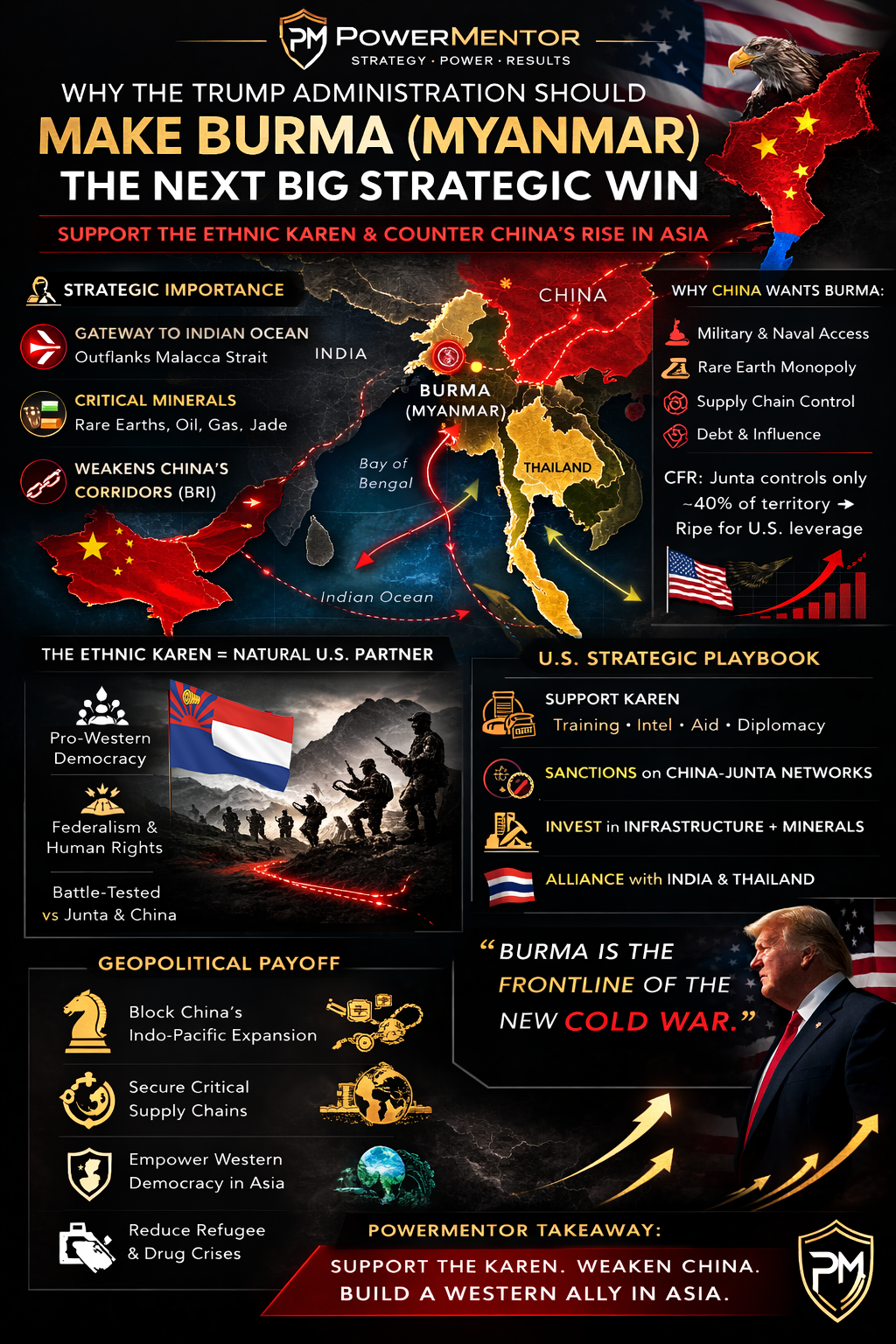
If the Trump administration wants to weaken Chinese influence in Asia without committing to another large-scale U.S. military entanglement, Burma (Myanmar) is one of the smartest places to focus. The case is not mainly humanitarian, though the humanitarian need is enormous. The stronger case is geopolitical: Burma sits at the intersection of China’s access to the Indian Ocean, China’s critical-minerals strategy, regional instability, and the future balance of power in mainland Southeast Asia. A serious U.S. strategy in Burma could help support forces that are more favorable to federalism and western-oriented democratic governance while also denying Beijing a deeper strategic foothold.
The first reason is geography. Burma is one of China’s most important land bridges to the Indian Ocean. U.S. and independent analysts have pointed to China’s goal of using Burma for access to resources, energy routes, and maritime reach beyond the Malacca chokepoint. That makes Burma more than just another conflict zone; it is part of the wider Indo-Pacific context. If Beijing consolidates long-term influence there through the junta, militias, ports, and corridor projects, China strengthens both its economic leverage and its strategic depth in the Bay of Bengal and the wider Indian Ocean region.
Second, Burma is now one of the clearest examples of China backing instability when it serves Chinese interests. Reuters and other analysts have documented how China has worked to protect its projects, broker ceasefires selectively, and preserve access to resources rather than support a genuine democratic settlement. China has also been tied to protection of new rare-earth mining networks through allied armed actors in Burma. That means Burma is not just a humanitarian crisis; it is an active arena where Chinese influence is being translated into real control over territory, supply chains, and political outcomes.
Third, Burma matters economically because of critical minerals. Reuters reported that China relies heavily on Burma for heavy rare earths used in electric vehicles, wind turbines, and advanced technologies and that fighting in Burma has already disrupted those flows enough to move global prices. In plain terms, Burma is part of the supply chain battle with China. A U.S. strategy that helps prevent Burma from becoming an uncontested Chinese extraction zone would fit directly with a broader Trump-style argument for economic security, industrial resilience, and reducing dependence on Beijing-controlled supply chains.
Fourth, the junta is weaker than it looks, which means U.S. policy can still shape the outcome. CFR reported in January 2026 that the military government controlled only a minority of the country’s territory, while ethnic armies and resistance forces held or contested large areas. Reuters has likewise described the junta as deeply embattled, relying heavily on repression, air power, and backing from Russia and China. That matters strategically: Washington does not have to create leverage from scratch. Leverage already exists because the junta is fragile, the country is fragmented, and many non-junta actors are looking for alternatives to Chinese domination.
That is where the ethnic Karen, Karenni, Kachin, and others become highly relevant. The Karen majority is known as a democratic, freedom-loving people seeking self-determination, human rights, and genuine independence rather than permanent military rule. Karen actors have also aligned themselves with broader anti-junta and pro-democracy currents since the 2021 coup. For a U.S. administration looking for local partners who are not pro-Beijing and who have an existing freedom-loving political identity, the Karen movement offers a more natural opening than the junta ever will.
A strong Trump-administration argument would be this: supporting Burma’s anti-junta democratic forces, including the Karen, Karenni, and Kachin, is not charity; it is strategic denial against China. It gives Washington a chance to back a future political order less dependent on Beijing, less useful to Chinese military-commercial expansion, and more open to the West. It also fits the logic of backing regional partners who can hold their own ground rather than requiring large deployments of U.S. troops.
There is also a moral and political contrast that strengthens the argument. The junta overthrew an elected government in 2021 and has presided over a crisis in which around 3.6 million people have been displaced and millions face hunger, according to recent UN-linked reporting summarized by Reuters. Supporting forces seeking self-determination and independence allows Washington to stand against a military regime associated with atrocities while also countering Beijing’s model of propping up authoritarian clients. That combination of strategic realism and moral clarity can be politically powerful.
That said, the smartest version of this policy would not be to treat the Karen, Karenni, and Kachin as the sole answer. Burma is too complex for that. The Karen, Karenni, and Kachin are important, but a durable U.S. approach would have to engage the wider anti-junta ecosystem. The Thai government, ethnic organizations, civil society, border-based humanitarian networks, and pro-democracy actors. Even Reuters has noted that Burma’s conflict involves many armed groups with overlapping goals and tensions. So the best policy is not “pick one militia”; it is “build relationships with credible anti-junta-democratic actors, with the Karen, Karenni, and Kachin being some of the most important pillars.”
A practical Trump-era framework could look like this:
Support cross-border humanitarian and stabilization channels in Karen, Karenni, Kachin, and other resistance-held areas, reducing reliance on junta-controlled access. That would build goodwill and strengthen local governance where anti-junta actors already have legitimacy.
Increase political engagement with freedom loving actors rather than treating the junta as the default state partner. That would align with longstanding stated U.S. support for a peaceful and democratic Burma and the policy language in the BURMA Act.
Use sanctions, financial pressure, and export-control tools against networks that finance junta aviation fuel, arms procurement, and Chinese extraction deals. Congress is still advancing bipartisan Burma-related legislation aimed at increasing pressure on the junta’s revenue streams.
Coordinate with Thailand and India where interests overlap. Burma’s instability affects both countries directly, and both have reasons to resist deeper Chinese domination of routes and infrastructure linking the Bay of Bengal and the mainland.
The core message is this:
If Washington ignores Burma (Myanmar), China fills the vacuum. If Washington helps shape the post-junta future, it can support a friendlier political order in a country that sits on strategic corridors, critical minerals, and one of Asia’s most important geopolitical fault lines. The ethnic Karen, Karenni, and Kachin should be part of that strategy because they have both political legitimacy in their communities and an openly stated commitment to democratic principles.
The biggest caution is credibility. Any U.S. policy that looks purely extractive or purely anti-China will fail. The Karen, Karenni, Kachin, and other Burmese actors have seen outside powers use their struggles for leverage before. So the administration would need to make clear that this is about supporting a federal-democratic future, not simply replacing Chinese dominance with transactional American dominance. That is the difference between a short-term play and a durable strategic win.
References
Geopolitical Strategy and Chinese Influence
Council on Foreign Relations (CFR).
Myanmar’s Civil War and the 2021 Coup.
https://www.cfr.org/global-conflict-tracker/conflict/myanmar-coupU.S.–China Economic and Security Review Commission (USCC).
China’s Strategic Interests in Southeast Asia.
https://www.uscc.govUnited States Institute of Peace (USIP).
China’s Role in Myanmar’s Conflict.
https://www.usip.orgCenter for Strategic and International Studies (CSIS).
China-Myanmar Economic Corridor and Belt and Road Initiative.
https://www.csis.org
Strategic Geography and Indian Ocean Access
International Institute for Strategic Studies (IISS).
China’s Indian Ocean Strategy and Myanmar.
https://www.iiss.orgLowy Institute.
Storey, Ian.
China and Myanmar: Strategic Access to the Indian Ocean.
https://www.lowyinstitute.orgAsia Society Policy Institute.
Myanmar’s Strategic Location in Indo-Pacific Competition.
https://asiasociety.org
Rare Earth Minerals and Resource Competition
Reuters Investigative Report (2024-2025).
Myanmar Rare Earth Mining and Global Supply Chains.U.S. Geological Survey (USGS).
Global Rare Earth Mineral Supply Chains.
https://www.usgs.govBrookings Institution.
Critical Minerals and Geopolitics in Southeast Asia.
https://www.brookings.edu
Ethnic Armed Organizations and the Karen
International Crisis Group.
Ethnic Armed Groups and the Myanmar Civil War.
https://www.crisisgroup.org
Humanitarian and Political Context
United Nations Office for the Coordination of Humanitarian Affairs (UNOCHA).
Myanmar Humanitarian Overview.Human Rights Watch.
Myanmar Military Abuses Since the 2021 Coup.Amnesty International.
War Crimes and Military Atrocities in Myanmar.
