

Havana Syndrome: The Mystery, the Injuries, and the Russian Connection
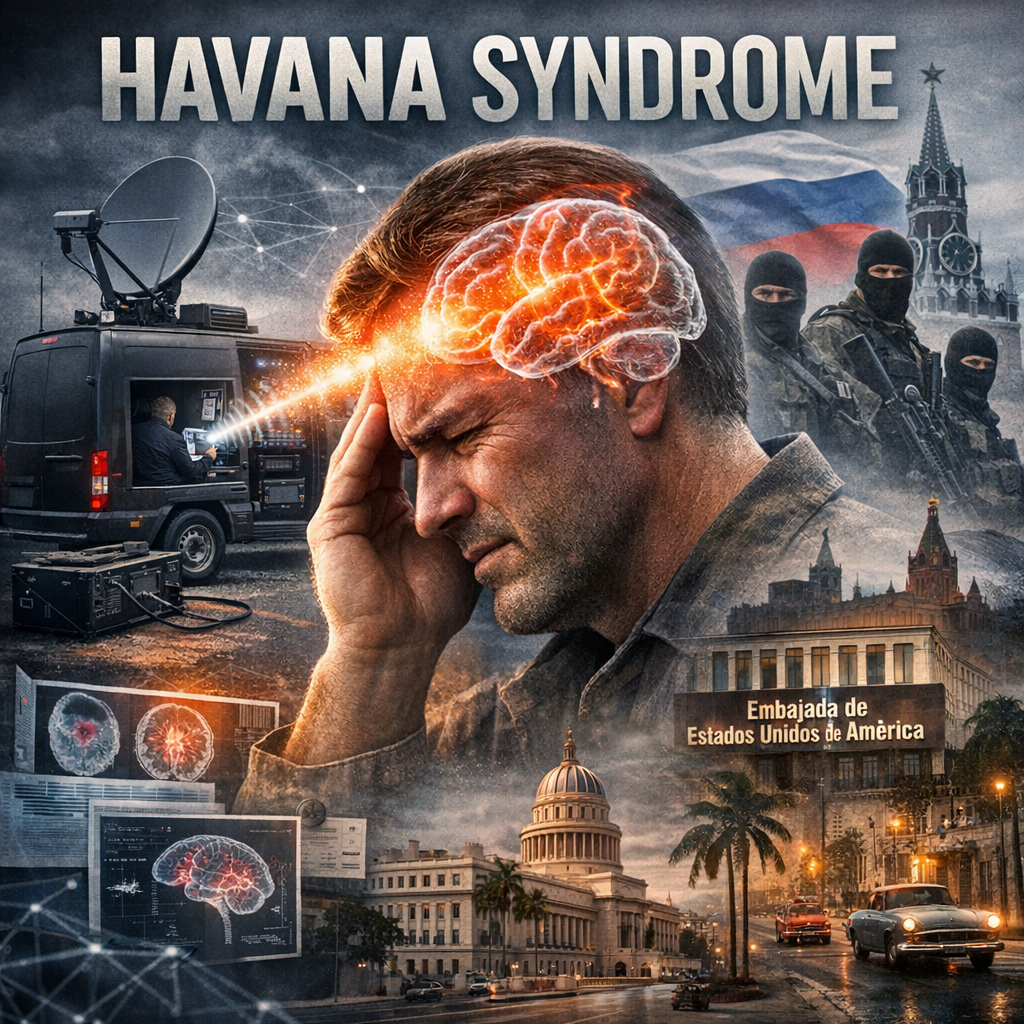
For nearly a decade, a growing number of American diplomats, intelligence officers, and government personnel have reported a disturbing set of symptoms that appear suddenly and without warning. Victims describe piercing sounds, intense pressure in the head, and sudden neurological distress that sometimes leaves permanent damage.
The phenomenon has become known as Havana Syndrome, and while the U.S. government acknowledges the injuries suffered by victims, the true cause remains one of the most controversial national security mysteries of the 21st century.
Recent investigative reporting has added another layer to the story—suggesting that a covert Russian intelligence unit may have been involved.
The First Cases in Havana
The incidents first came to public attention in 2016 in Havana, Cuba, when U.S. diplomats stationed there began reporting strange and alarming experiences.
Many described the same sequence:
A loud buzzing or grinding sound
Pressure or vibration inside the head
Sudden dizziness or loss of balance
Immediate neurological distress
Some individuals said the sensation would stop when they moved to another part of the room, suggesting the source might have been directional.
Doctors later found that several victims showed symptoms consistent with traumatic brain injury, even though they had not suffered any physical blow to the head.
The Medical Damage
Over time, nearly 70 individuals have described similar experiences.
The health effects have been significant and sometimes long-lasting:
traumatic brain injury–like symptoms
severe headaches and migraines
vision impairment
memory and concentration problems
balance disorders
chronic fatigue
sleep disruption
Some victims have required years of neurological treatment, and a number have had to end their careers prematurely.
The U.S. government now acknowledges these injuries as legitimate and often provides medical care for those affected.
The Government’s Official Assessment
In 2023, the U.S. intelligence community released a formal assessment of what it calls Anomalous Health Incidents (AHIs).
The report concluded it was “very unlikely” that a foreign adversary was responsible for most cases.
Investigators suggested that some incidents could potentially be explained by:
environmental factors
existing medical conditions
viral illness
stress
or misinterpretation of normal sounds
However, that conclusion remains controversial among scientists and investigators who have studied the cases.
A Scientific Explanation: Directed Energy
One of the leading experts examining Havana Syndrome is David Relman, who led two independent scientific panels reviewing the evidence.
Relman concluded that one explanation could not be ruled out.
“The most plausible explanation for a subset of these cases was a form of radiofrequency or microwave energy.”
Radiofrequency or microwave energy, when focused in a narrow beam, can interact with the human nervous system. Researchers believe such energy could potentially disrupt the inner ear and vestibular system, which control balance and spatial awareness.
This could explain why so many victims reported sudden vertigo, confusion, and sensory disturbances.
The Cold War History of Microwave Research
The possibility of microwave technology affecting the human brain is not a new concept.
During the Cold War, the Soviet Union conducted extensive research into the biological effects of microwave radiation.
One of the most famous examples was the Moscow Signal, a mysterious microwave beam directed at the U.S. Embassy in Moscow from the 1950s through the 1970s.
American officials eventually discovered the radiation but never fully determined its purpose.
Soviet scientists, however, spent decades studying how microwave radiation might influence human physiology and neurological function.
Much of that research later passed to the Russian Federation.
The Russian Intelligence Unit Identified
A major investigative report by 60 Minutes, working with journalists from The Insider and Der Spiegel, examined travel records, intelligence sources, and classified information connected to Havana Syndrome cases.
Their investigation pointed to a covert Russian military intelligence unit known as:
GRU Unit 29155
This unit has previously been linked by Western intelligence agencies to covert operations including:
sabotage missions
destabilization campaigns
assassination attempts in Europe
Investigators reported that members of Unit 29155 were present in several locations where Havana Syndrome incidents later occurred.
Some intelligence sources also indicated that individuals within the unit received commendations related to work involving non-lethal acoustic or directed energy technologies.
These findings do not constitute definitive proof of responsibility, but they represent one of the most significant investigative leads so far.
The Missing Weapon
Despite years of investigation, one crucial piece of evidence remains missing:
No device has ever been publicly identified.
If a directed-energy system were responsible, experts believe it would likely resemble ordinary electronic equipment rather than a visible weapon.
Possible forms could include:
concealed antenna systems
equipment hidden in vehicles
devices integrated into building infrastructure
directional emitters disguised as communications equipment
Without a recovered device, however, investigators cannot conclusively prove how the incidents occurred.
Why the Mystery Remains Unresolved
The Havana Syndrome investigation remains complicated because several facts point in different directions.
On one side:
victims show real neurological injuries
symptoms across cases are strikingly similar
scientific research suggests directed energy effects are possible
investigative reporting points toward a Russian intelligence unit
On the other side:
no device has been recovered
intelligence agencies remain divided
definitive proof linking an attacker to a specific incident has not been publicly released
Because accusing a foreign government of attacking U.S. personnel would carry serious geopolitical consequences, officials have been extremely cautious in drawing final conclusions.
The Human Cost
For the people affected, the debate is not academic.
Many victims have lost careers in diplomacy or intelligence service. Some continue to struggle with chronic neurological problems years after their initial exposure.
For them, the most important question remains unanswered:
What happened to them—and who was responsible?
A New Kind of Threat?
Havana Syndrome may ultimately prove to be many things—a misunderstood medical condition, an environmental phenomenon, or the early signs of a new technological threat.
But the possibility raised by investigators is sobering.
If directed energy systems capable of silently injuring people do exist, they represent a new form of conflict—one that leaves no visible weapon, no obvious battlefield, and sometimes no clear attacker.
Until the mystery is fully solved, Havana Syndrome remains a warning that the future of conflict may involve weapons that are invisible, silent, and difficult to prove.
