

The Illusion of Civilian Rule in Burma (Myanmar): How the Military Is Rebranding Its Power
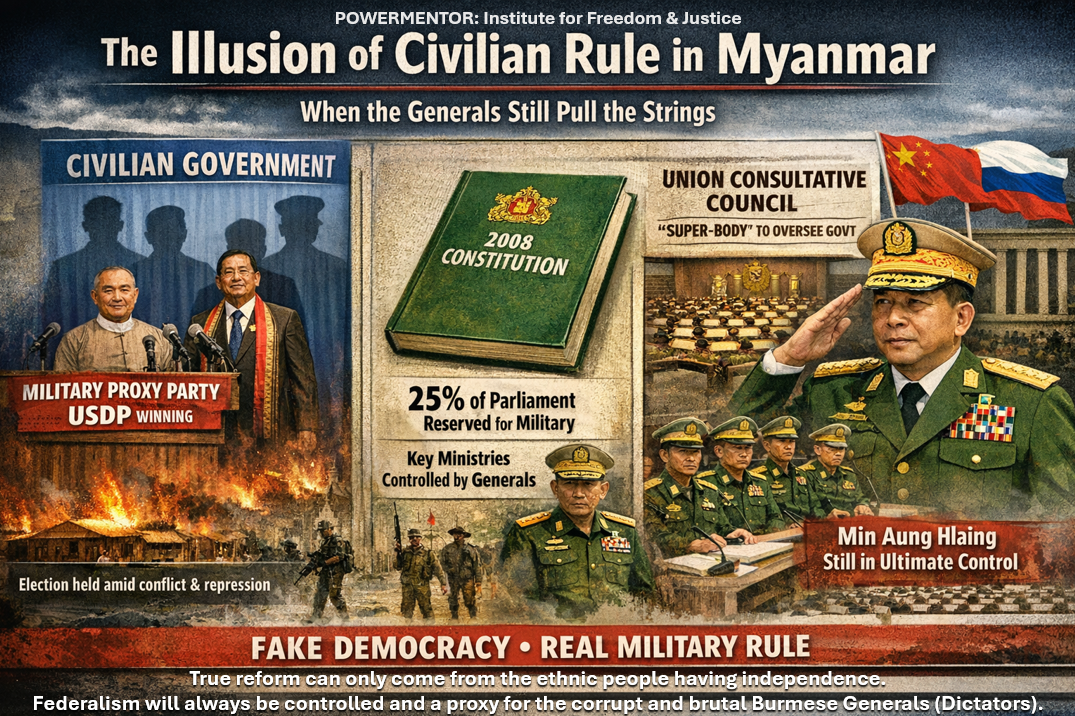
The Burmese military junta has announced that a new civilian government will soon take power following elections organized by the regime. At first glance, this announcement may appear to signal a return to democracy after the 2021 military coup that overthrew the elected government of Aung San Suu Kyi.
However, a closer examination reveals that the so-called transition to civilian rule is largely a political illusion.
The election process, the political party structure, the constitutional framework, and the proposed oversight institutions all point to a single conclusion: the Burmese military is attempting to repackage its rule under a civilian label while retaining ultimate control of the state.
1. Elections Conducted Under War and Repression
The junta’s election cannot be considered free or credible.
Burma (Myanmar) remains in the midst of a nationwide civil conflict following the 2021 coup. Large portions of the country are controlled by resistance forces and ethnic armed organizations. Because of the security situation, voting was not conducted across the entire country.
According to reporting by Reuters, voting occurred in only 263 of Myanmar’s 330 townships, meaning millions of citizens were excluded from participating in the election process, and those voting felt compelled to do so from fear of retaliation (Reuters, 2026).
The same report noted that the election period coincided with widespread violence and repression. The United Nations documented numerous cases of civilians being arrested or intimidated in connection with the election. Human rights monitors also verified airstrikes and attacks on civilian areas during the voting period.
Under these conditions, the election functioned less as a democratic exercise and more as a controlled political process designed to produce a predetermined outcome.
2. The Dominance of a Military Proxy Party
The primary political beneficiary of the election was the Union Solidarity and Development Party (USDP).
The USDP is not an ordinary political party. It was originally created by the military government as a political vehicle for the armed forces. Its leadership has consistently been dominated by retired generals and senior military officers.
Reuters reported that the USDP won a decisive majority in the junta-organized election. The party’s leader, retired Brigadier General Khin Yi, is expected to occupy one of the most powerful positions in the new political system (Reuters, 2026).
This dynamic raises a critical question:
If the party controlling parliament is dominated by former military officers, can the resulting government truly be considered civilian?
In practice, the USDP functions as a political extension of the Tatmadaw (Myanmar Armed Forces) rather than an independent democratic institution.
3. The Constitution Guarantees Military Power
Even if the election had been free, the structure of Burma’s political system would still prevent genuine civilian control.
The 2008 Constitution, written by the military during a previous period of junta rule, embeds military authority directly into the state.
Key provisions include:
• 25% of parliamentary seats reserved for the military, appointed directly by the Commander-in-Chief
• Military control over the Defense, Home Affairs, and Border Affairs ministries
• Constitutional amendment requirements that effectively give the military veto power over structural reforms
Because constitutional amendments require more than 75% parliamentary approval, the military’s guaranteed 25% of seats ensures that it can block any attempt to reduce its power.
This means that even under a nominally civilian government, the military retains institutional supremacy over the political system.
(Constitution of the Republic of the Union of Myanmar, 2008)
4. A “Super-Council” to Oversee the Government
Recent reporting indicates that the junta is planning an additional layer of oversight that would further consolidate military control.
According to Reuters, the regime intends to create a Union Consultative Council, a small body that would oversee both the civilian administration and the armed forces (Reuters, 2026).
Political analysts believe this council would allow Senior General Min Aung Hlaing, the architect of the 2021 coup, to retain ultimate authority even after transferring the presidency to a nominally civilian structure.
In effect, the council would function as a shadow command authority, ensuring that the military remains the final decision-maker in national governance.
5. The Goal: Legitimacy Without Losing Power
Why would the military attempt such a transition?
The answer lies in international legitimacy.
Since the 2021 coup, Burma (Myanmar) has faced widespread diplomatic isolation, sanctions, and economic pressure. By creating a civilian-labeled government, the junta may hope to:
• Reduce international sanctions
• Improve diplomatic recognition
• Encourage foreign investment
• Gain acceptance from regional organizations
However, international observers remain skeptical.
The Association of Southeast Asian Nations (ASEAN) has refused to endorse the election process. Several governments and international organizations have also questioned the credibility of the political transition.
Similarly, analysts at the German Institute for International and Security Affairs concluded that the election represents an authoritarian-managed transition designed to legitimize military rule rather than replace it (SWP Berlin, 2024).
6. A Pattern Repeated in Burmese History
This strategy is not new.
Burma’s military has previously used elections to transition from overt military rule to controlled civilian governance without relinquishing real power.
The most notable example occurred in 2010, when the junta organized elections that led to a quasi-civilian government dominated by military-aligned figures.
That political system eventually allowed the military to retain significant influence even after the National League for Democracy won later elections.
The current situation appears to be a return to that same model.
Conclusion: A Civilian Label Without Civilian Power
The Burmese junta’s plan for a civilian government should not be mistaken for a democratic transition.
The evidence suggests that the proposed system will:
• Maintain military dominance through constitutional safeguards
• Empower a military-aligned political party
• Operate under oversight structures controlled by the armed forces
• Limit the ability of genuine civilian leaders to govern independently
In essence, the military is not surrendering power. It is rebranding it.
Until Burma (Myanmar) establishes a political system where civilian authorities truly control the armed forces, the country will remain under military rule in civilian clothing.
True reform can only come from the ethnic people having independence. Federalism will always be controlled and a proxy for the corrupt and brutal Burmese Generals (Dictators).
References
Constitution of the Republic of the Union of Myanmar. (2008).
https://www.constituteproject.org/constitution/Myanmar_2008
Reuters. (2026). Myanmar election delivers victory for military-backed party amid civil war.
https://www.reuters.com/world/asia-pacific/myanmar-election-delivers-victory-military-backed-party-amid-civil-war-2026-01-30/
Reuters. (2026). Myanmar junta plans super body to tighten grip on military and new government.
https://www.reuters.com/world/asia-pacific/myanmar-junta-plans-super-body-tighten-grip-military-new-government-2026-02-04/
Reuters. (2026). Voting held in only part of Myanmar amid conflict.
https://www.reuters.com/world/asia-pacific/
SWP Berlin. (2024). Sham Elections Amid the War in Myanmar.
https://www.swp-berlin.org/en/publication/sham-elections-amid-the-war-in-myanmar
