

Why a Western Hemisphere security strategy matters — and what the U.S. gains from it
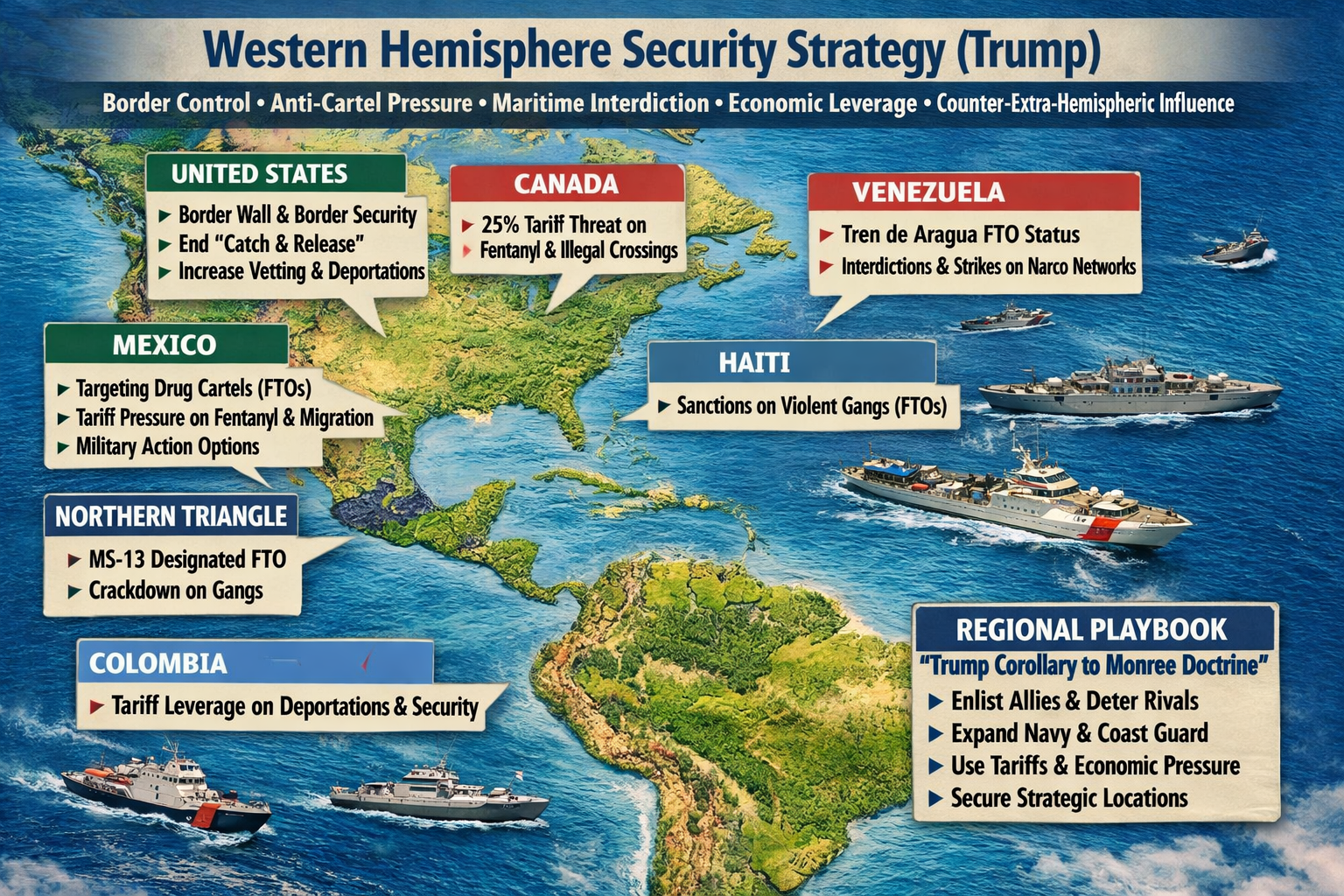
The practical advantage of a Western Hemisphere–focused security strategy is simple: the threats that most directly touch American communities overwhelmingly originate close to home—through land borders, regional migration routes, maritime corridors, and criminal networks that operate across the Americas. The 2025 National Security Strategy (NSS) explicitly frames the Western Hemisphere as a top-tier priority for preventing mass migration, disrupting “narco-terrorists, cartels, and other transnational criminal organizations,” protecting key assets and supply chains, and ensuring U.S. access to strategic locations—describing this approach as enforcing a “Trump Corollary” to the Monroe Doctrine. The White House
What that means in practice is that the Western Hemisphere becomes a “homeland-and-near-abroad” security perimeter: reduce destabilization in the region, deny hostile outside powers room to build leverage, and choke off the drug/trafficking pipelines that fuel violence and addiction in the United States.
The core advantage: move the fight outward, not inward
A regional strategy is designed to prevent U.S. border and public-safety challenges from becoming permanent domestic emergencies. The NSS states goals for the hemisphere that include stabilizing governance enough to reduce mass migration pressure, increasing cooperation against cartels and transnational groups, and preventing hostile “incursion” or ownership/control of key assets. The White House
Think of it as shifting from a purely reactive posture—handling consequences after they reach U.S. territory—to a layered posture where:
Source and transit routes are targeted (cartels, trafficking corridors, maritime lanes),
Partner governments are pressured or incentivized to act,
Border enforcement becomes the final layer, not the only layer.
The toolkit: what the administration says it will use
The administration’s stated toolkit spans immigration enforcement, economic leverage, and security force posture.
1) Border enforcement and immigration pressure
In Trump’s 2025 inaugural address, he called for reinstating “Remain in Mexico,” ending “catch and release,” and sending troops to the southern border. The White House Reuters also reported the administration moving to reinstate Remain in Mexico shortly after inauguration. Reuters
Why this matters regionally: It increases pressure on transit and origin countries—because the U.S. is signaling that the “release into the interior” incentive structure is being tightened.
2) Cartels and transnational gangs treated as national-security threats
On January 20, 2025, Trump signed an executive order creating a process to designate certain cartels and other organizations as Foreign Terrorist Organizations (FTOs) or Specially Designated Global Terrorists (SDGTs), framing cartels as operating with insurgent-like features and as destabilizing governments across the hemisphere. The White House
Subsequently, the State Department announced designations of international cartels/organizations. State Department Independent regional analysts summarize the designated set as including multiple Mexico-based groups along with organizations tied to Haiti, Venezuela, and El Salvador. AS/COA
Why this matters: FTO/SDGT-style frameworks can expand financial sanctions, targeting of support networks, and cross-border pressure tools—treating cartel infrastructure less like “crime” and more like “enemy logistics.” The White House
3) Trade and tariff leverage to compel cooperation
The administration explicitly highlights tariffs as a tool used to secure cooperation (including referencing prior tariff threats) and has issued fact sheets describing tariffs tied to national security priorities. The White House Policy analysts tracking the 2025 U.S.–Mexico dynamic also describe tariffs as leverage applied to migration and fentanyl enforcement cooperation. WOLA
Why this matters: Unlike slow diplomacy, tariff leverage is immediate—and it puts pressure on decision-makers through domestic economic constituencies.
4) Maritime interdiction and “presence” as a hemispheric control mechanism
The NSS calls for a more suitable Coast Guard and Navy presence to control sea lanes, reduce human/drug trafficking, and control key transit routes in crisis. The White House
Why this matters: A large share of trafficking and smuggling value moves through maritime routes; sea control is a way to disrupt flows without waiting for them at the border.
5) A tougher posture: targeted deployments and “lethal force” language
The NSS includes “targeted deployments to secure the border and defeat cartels,” explicitly noting that this could include “where necessary the use of lethal force” and a shift away from what it calls a “law enforcement-only” strategy. The White House
Why this matters: It signals deterrence. Even if rarely used, the stated option changes how cartels, facilitators, and some partner governments calculate risk.
Why the Western Hemisphere framing is strategically important
A) It treats regional chaos as a direct national security risk
The NSS argument is that destabilization nearby turns into mass migration, trafficking, and foreign influence operations—and that those are “core, vital” U.S. interests. The White House
B) It tries to deny “extra-hemispheric” competitors a foothold
The administration’s Western Hemisphere concept is also explicitly about denying non-hemispheric powers the ability to position forces or control strategically vital assets in the region. The White House
C) It links security with supply chains and economic resilience
The NSS ties hemispheric strategy to “critical supply chains” and near-shoring logic—strengthening economic ties so the region becomes a preferred market and manufacturing base, while making it harder for rivals to gain influence. The White House+1
The “freedom and way of life” argument
For the United States, the point isn’t only security metrics—it’s preserving a way of life where freedom is foundational.
That “freedom-first” worldview is directly echoed in the NSS’s framing of America as a sovereign republic whose government exists to secure rights and protect the nation’s way of life. The White House
From that perspective, the Western Hemisphere strategy becomes more than border management—it’s a defense of a civilizational model:
Freedom, sovereignty, and democratic republic self-rule are treated as the moral center of the American project.
Left-leaning ideologies are viewed by supporters of this approach as prone—especially when merged with centralized state power—to coercion and, ultimately, totalitarian outcomes.
Centralized ideological governance tends to expand control over speech, markets, faith, and family life, then “hemispheric security” isn’t just stopping cartels—it’s limiting the conditions under which authoritarian models spread, harden, and export influence.
What success would look like if the strategy works
If the approach succeeds on its own terms, you’d expect to see:
Lower illegal migration pressure because transit incentives change and partner enforcement rises. The White House
Disrupted cartel finance and logistics through designations, sanctions, and intensified interdictions. The White House
Improved maritime and border control via Coast Guard/Navy posture and interagency coordination. The White House
Reduced extra-hemispheric leverage over ports, infrastructure, and strategic assets as U.S. economic/security pressure rises. The White House
A more durable “near-shored” economic base that supports U.S. resilience and regional stability. The White House
A brief note on the tradeoffs
This posture can trigger sovereignty backlash and regional resentment if it’s perceived as heavy-handed or neo-imperial—risks that can reduce partner cooperation over time. Brookings
That’s why the durability of the strategy depends on pairing pressure with credible partnership: security assistance, intelligence cooperation, and economic opportunity that makes alignment with the U.S. more attractive than alternatives. The White House
