
Iran’s Freedom Surge: A Nation Rejects the Boot of Totalitarian Rule
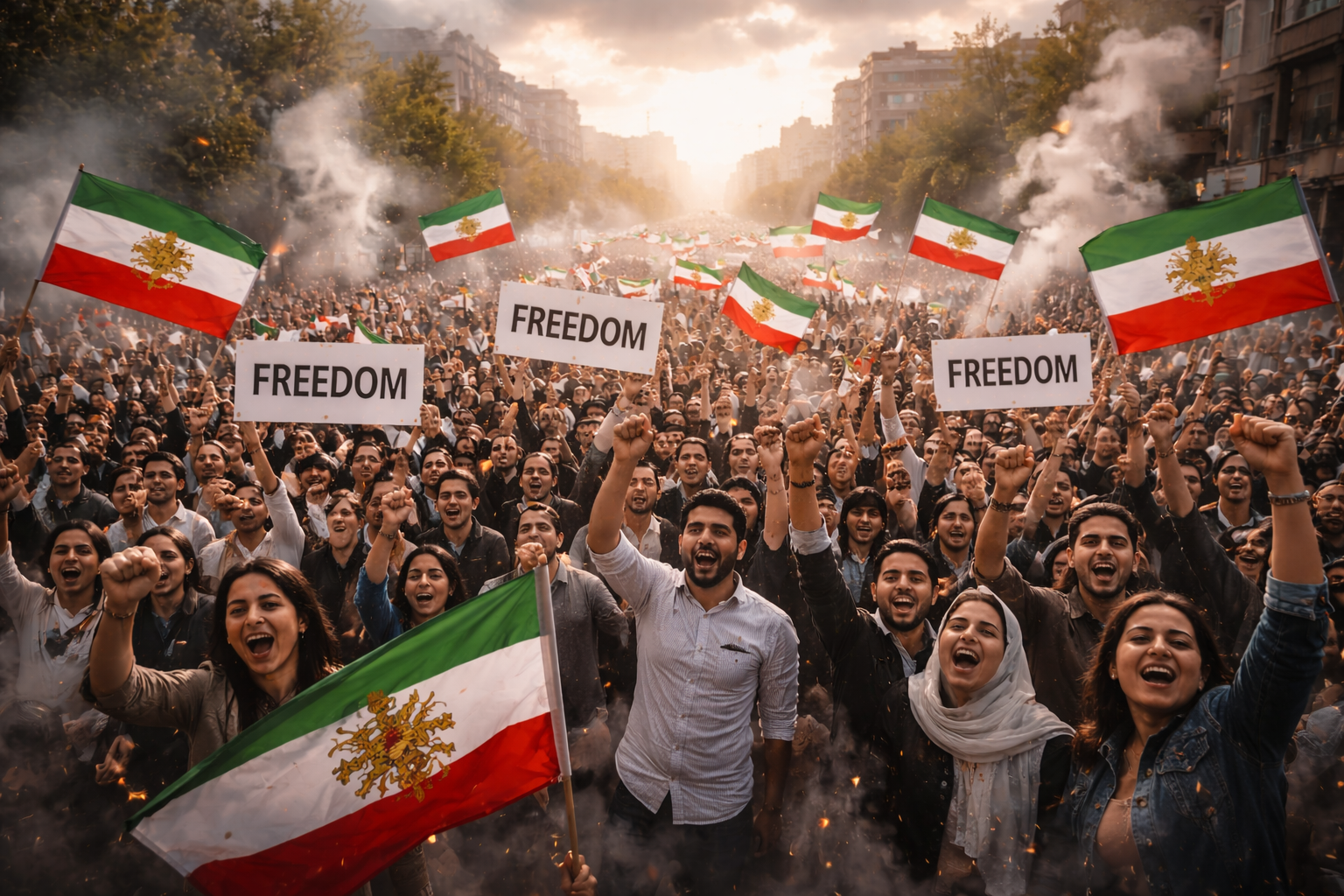
Iran is rising again—not as a temporary outburst, but as a national rejection of a system that survives by fear, propaganda, and force.
What began as an economic revolt—shopkeepers shutting their doors, families crushed by inflation, and a currency in freefall—has rapidly widened into something unmistakably political: crowds chanting against the supreme leader, demanding an end to the Islamic Republic’s coercive rule, and reviving the spirit of “Woman, Life, Freedom.” AP News Al Jazeera
This is what freedom movements look like before the world can neatly summarize them. They start with bread—and quickly become about dignity.
The spark: economic collapse that exposed political rot
Iran’s current unrest is being driven by a familiar truth: when a regime destroys opportunity, it eventually destroys obedience.
The protests have spread widely—reported across more than 100 locations in 22 provinces, according to the Associated Press. AP News
Deaths and arrests are mounting, with reports ranging from at least 7 to at least 10 killed, and arrests from dozens to 100+, depending on the outlet and what can be confirmed amid censorship and chaos. Al Jazeera AP News
Reuters reported fatalities and injuries tied to unrest, including an attack on a police station cited by Iranian media. Reuters
Economic desperation matters—but it’s the loss of legitimacy that makes a movement contagious. Once people conclude “there is no future under this system,” fear begins to lose its power. The Guardian
The regime’s reflex: label the people “rioters,” then unleash force
The Islamic Republic is responding with its standard playbook: delegitimize protest, blame foreigners, and escalate repression.
Supreme Leader Ayatollah Ali Khamenei has publicly signaled crackdowns, saying “rioters must be put in their place,” while also insisting—without evidence—that unrest is driven by foreign enemies. AP News
Iran’s paramilitary Basij, tied to the Revolutionary Guard, has historically been used to smash protests, including during major uprisings in 2009, 2019, and 2022. AP News
And the human rights record behind that warning is not theoretical: Human Rights Watch has documented the impunity that followed prior crackdowns—where survivors faced threats, prosecution, and exile rather than justice. Human Rights Watch
Freedom mindset vs. totalitarian mindset: what Iranians are really fighting
This moment isn’t about left or right in a Western sense. It’s simpler—and more moral—than that.
Iranians are confronting a totalitarian system that claims moral authority while demanding total control: over speech, dress, religion, conscience, and economic life.
And while Iran is not a “Marxist state” in formal ideology, the totalitarian mechanics are familiar to anyone who has studied 20th-century Marxist regimes: centralized power, security-state intimidation, propaganda, censorship, politicized courts, and the reduction of citizens into subjects whose lives are “owned” by the ruling order. Different slogans—same chains.
Freedom, by contrast, rests on timeless principles:
government accountable to the people
rule of law instead of rule by fear
speech without prison
worship without coercion
opportunity without regime connections
That is the moral dividing line.
The path forward for Iranians: win the future without losing the moral high ground
A durable transition requires strategy, not just courage. Here is the most realistic path forward—built around unity, nonviolent discipline, and legitimacy.
1) Unite around a simple national charter
Movements fail when they can’t answer: What replaces this?
A short, widely shared charter can unify liberals, conservatives, secular citizens, religious families, workers, students, and the bazaar around essentials:
free elections
independent courts
freedom of conscience and speech
equal rights under the law
civilian control of security forces
Not every issue needs agreement now—only the foundations.
2) Convert street energy into economic leverage
The regime can absorb marches. It struggles against organized noncooperation: work stoppages, coordinated closures, labor action, professional associations, and student strikes—especially when they are sustained and widespread. Recent reporting already points to demonstrations evolving from economic protest into political challenge. Al Jazeera
3) Protect legitimacy through disciplined nonviolence
The regime wants violence—it gives them cover. The most powerful revolutions don’t just defy tyranny; they expose it.
Nonviolent discipline:
keeps wider public participation possible
reduces fear among undecided citizens
isolates the regime as the aggressor
strengthens international support
4) Build trusted channels and document abuses
Totalitarian regimes thrive in darkness. The single most important “weapon” in modern freedom movements is truth that can’t be erased—credible documentation, timestamps, witnesses, and secure preservation of evidence for future accountability.
5) Prepare for the day after
If the regime fractures, the danger becomes chaos. A responsible opposition prepares now for:
interim public safety plans
protection against revenge violence
continuity of essential services
anti-corruption safeguards
a roadmap to elections
This is how a freedom movement becomes a founding movement.
What the outside world can do—without hijacking the cause
Iran’s regime will scream “foreign interference” no matter what. The answer is not silence; it’s principled support that empowers people, not factions.
The most credible actions:
internet freedom and anti-censorship support
targeted sanctions on proven human rights abusers (not broad measures that punish ordinary families)
international investigations and documentation support
humanitarian pathways for threatened activists and families
U.S. government statements and UN actions are already part of the environment around Iran’s rights record. U.S. Mission to the United Nations
The bottom line
Iran’s uprising is not simply an “economic protest.” It is a national referendum on whether human beings exist to serve the state—or the state exists to serve human beings.
Iranians are demanding what every person deserves: a life where government fears the people, not the other way around. And if they can sustain unity, discipline, and a credible plan for the future, this moment can become more than unrest.
It can become a rebirth.
