

Maduro Captured: Venezuela’s Shot at Freedom After a Stolen Election
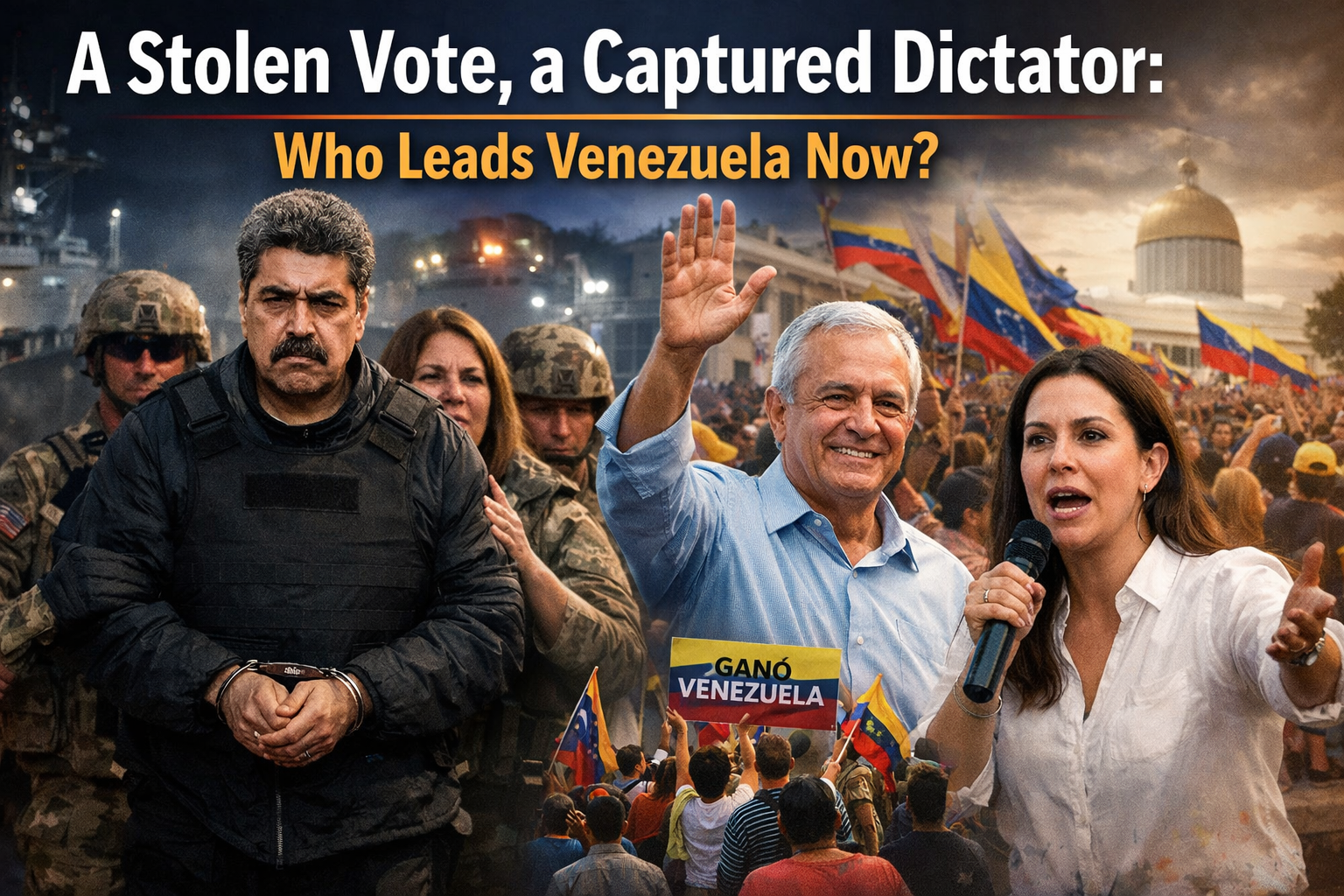
A Nation Reclaimed: Venezuela’s Chance to Break from Communism and CorruptionMaduro’s main opposition leader vs. the 2024 “winner”: who’s who?
María Corina Machado (opposition movement leader)
Role: The political engine of the anti-Maduro coalition—widely described as the “leader of the democratic forces.” European Parliament
2024 status: She won the opposition primary but was barred from running by Venezuela’s institutions aligned with the regime. Le Monde.fr
Strength: Grassroots mobilization, message discipline, and coalition pressure—she’s the figure most identified with the opposition’s broader “change” movement. European Parliament
Edmundo González Urrutia (the opposition’s 2024 presidential candidate)
Role: The unity/consensus candidate the opposition placed on the ballot after Machado was blocked. European Parliament
2024 “winner” claim: Many observers and governments said the official authorities did not provide transparent, polling-station-level results, while the opposition published tally sheets supporting González’s win; the Carter Center said it could not verify the CNE’s declared results and the election did not meet democratic integrity standards. The Carter Center
International recognition: The U.S. recognized González as “president-elect” in late 2024. The Guardian
Key differences (why they’re not interchangeable)
Mandate
González: Electoral/constitutional claim (he was the name on the ballot for the unified opposition). European Parliament
Machado: Political mandate (she built and led the movement and coalition, but was blocked from candidacy). Le Monde.fr
Profile & governance style
González: Diplomat, consensus figure—often viewed as a stabilizing “institutional” face for a transition. European Parliament
Machado: Movement leader—more confrontational toward the regime, and the coalition’s main mobilizer. NobelPrize.org
Coalition dynamics
González: Better positioned to be the formal head of state in a transition framework because he’s tied directly to the 2024 vote. The Guardian
Machado: Better positioned to be the strategic/political center of gravity—keeping the coalition united, sustaining legitimacy, and driving reforms. European Parliament
So who is “poised” to lead Venezuela?
On the morning of January 3, 2026, Venezuelan opposition leader Machado says opposition politician Gonzalez Urrutia who was elected as "legitimate president" in 2024 must assume his "constitutional mandate".
Based strictly on the 2024 election-result dispute and international positioning, González is the most plausible formal leader (the person most directly tied to the opposition’s claim of winning the vote, and recognized as “president-elect” by the U.S.). The Guardian
But politically, any stable transition is hard to imagine without Machado in a top leadership role (chief architect of the coalition + primary mobilizer). In practice, that points toward a shared-transition model: González as constitutional president/transition head, Machado as senior transition leader (or a comparable role with real authority), alongside a broader unity cabinet. European Parliament
Should Venezuela hold a new election?
A “new election” can mean two very different things:
Redo 2024 now
Risk: If the same institutions run it under the same conditions, it can simply repeat the legitimacy crisis. The Carter Center’s critique centered on lack of transparency and integrity safeguards, not just the winner. The Carter Center
Hold a new election after a transition and reforms (the more workable path)
A credible roadmap many analysts point to is: transition authority → release political prisoners & restore civil liberties → rebuild electoral authority → full international observation → new election.
That approach makes a new election a legitimacy capstone, not a rerun inside the same contested system. The Carter Center
New updates: Maduro’s capture + the New York case
What multiple major outlets are reporting (Jan 3, 2026)
U.S. forces captured Nicolás Maduro and Cilia Flores in a nighttime operation amid explosions/strikes in Caracas. AP News The Guardian
AP reports Venezuelan officials said they were taken from a residence at/within the Ft. Tiuna military installation area. AP News
AP also reports they were moved onto the U.S. warship Iwo Jima, headed to New York. AP News
Legal posture: U.S. Attorney General Pam Bondi said they will face charges tied to a 2020 indictment in New York; AP notes it’s unclear whether this is the same 2020 case or a new indictment, and also unclear what charges Flores previously faced. AP News
What the indictment is broadly about
The U.S. Justice Department announced in 2020 that Maduro and other Venezuelan officials were charged for narco-terrorism / drug-trafficking-related conspiracies (the long-running U.S. case framework behind today’s headlines). Department of Justice
Immediate power question inside Venezuela
AP notes Venezuela’s vice president Delcy Rodríguez would take power “under Venezuelan law” in Maduro’s absence, though early reporting described uncertainty about who effectively controlled the state apparatus in the first hours. AP News
