

Where Did the Money Go? Burma, Foreign Aid, Open Society, and the Manufactured Humanitarian Economy
For more than seventy years, the people of Burma (Myanmar) have endured one of the longest-running conflicts in modern history. Entire generations have known little except war, displacement, uncertainty, and survival. Villages have been burned. Families have fled across mountains and rivers. Children have grown up in refugee camps. Communities have survived because of their own resilience, not because the world rescued them.
Yet while the suffering continued, something else was growing.
An entire international industry emerged around Burma's crisis.
Governments allocated funding. Foundations announced grants. NGOs expanded operations. Advocacy organizations launched campaigns. Consultants wrote reports. Experts conducted studies. Conferences were held. Panels were convened. New initiatives were announced. More money flowed.
The public was told these efforts were helping the people of Burma.
But years later, many of the same communities remain trapped in conditions that should have improved long ago. Clinics still struggle to obtain medicine. Teachers still work with little support. Displaced families still live in temporary shelters. Entire ethnic communities continue to survive on the margins despite the enormous amount of money reportedly spent in their name.
This reality forces an uncomfortable question that few people seem willing to ask:
If so much money was raised to help the people, why are so many of the people still waiting for help?
The Humanitarian Industry Nobody Talks About
The answer may lie in the system itself.
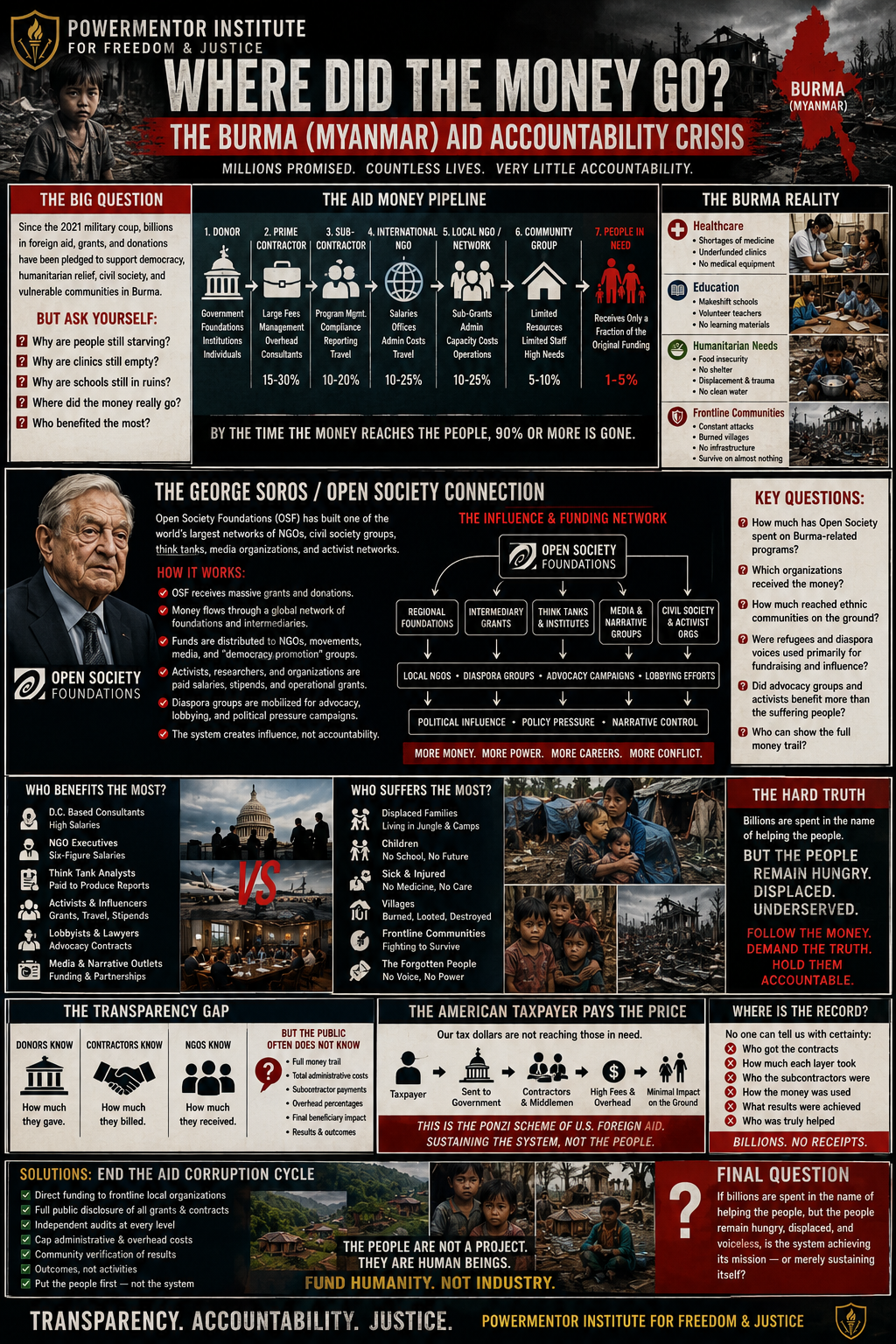
Most people imagine humanitarian aid as a direct path between a donor and a person in need. The image is simple. Money is given, resources are delivered, and lives improve. The reality is often far more complicated. Before a dollar reaches a displaced family, it may pass through multiple organizations, contractors, consultants, compliance offices, regional administrators, and implementing partners. At every step, a portion of the funding is consumed by salaries, overhead, reporting requirements, travel expenses, operational costs, and administrative structures.
The people at the end of the chain often receive what remains.
This is not merely a Burma problem. It is a structural problem that has become increasingly visible across the humanitarian world. Entire professional ecosystems now exist around conflict and crisis. Organizations grow because crises exist. Funding expands because suffering continues. Careers are built around managing problems that somehow never seem to get solved.
When Conflict Becomes a Business Model
In Burma, this phenomenon has become particularly striking.
Following the 2021 coup, a new wave of funding entered the country and its surrounding networks. Democracy promotion, civil society development, media initiatives, advocacy campaigns, humanitarian programs, and resistance-related efforts all became major priorities for international donors. Once again, billions of dollars were discussed. Once again, the world promised action.
But among ordinary people living in conflict zones, a different question began to emerge.
Where is the evidence?
Not the reports.
Not the conferences.
Not the press releases.
The evidence.
Where are the hospitals built? Where are the schools strengthened? Where are the communities transformed? Where are the measurable outcomes that justify the enormous sums spent in the name of Burma's suffering people?
When organizations become dependent upon crises for funding, an uncomfortable incentive structure emerges. Conflict generates attention. Attention generates money. Money supports institutions. Institutions create careers. Careers depend upon continued relevance. In some cases, solving the problem may actually threaten the very funding streams that sustain the organizations built around it.
The Open Society Network and the Question of Influence
These questions become even more important when examining the influence of large international funding networks. Among the most significant is the Open Society network founded by George Soros.
For decades, Open Society has invested heavily in civil society organizations, advocacy groups, media initiatives, policy institutions, and democracy-focused movements around the world. Its supporters view these efforts as essential to advancing freedom, human rights, transparency, and democratic governance.
Critics see something different.
They argue that large transnational funding networks have become powerful political actors capable of shaping narratives, influencing policy discussions, elevating preferred voices, and directing the flow of resources across entire regions.
In Burma, the debate is not simply about George Soros or Open Society itself. The debate is about accountability.
If organizations are receiving funding to serve suffering people, then those suffering people deserve to know how much money was received, where it went, who controlled it, and what results were achieved.
That should not be controversial.
It should be the minimum standard.
Following the Money
The fundamental challenge is that the money trail often becomes difficult to follow.
A donor may know how much funding was awarded.
A contractor may know how much funding was received.
An NGO may know how much funding was distributed.
Yet the ordinary citizen is frequently unable to determine how much of the original funding ultimately reached the people whose suffering justified the grant in the first place.
This lack of visibility creates fertile ground for waste, inefficiency, mismanagement, and abuse.
More importantly, it undermines trust.
Without transparency, accountability becomes impossible.
Without accountability, the people are forced to rely on faith rather than evidence.
The People Who Were Supposed to Benefit
The greatest tragedy in Burma is not simply the conflict itself.
The greatest tragedy is that the people who suffer the most often possess the least amount of power to follow the money being raised in their name.
A displaced mother living near the border cannot hire forensic accountants.
A village medic cannot audit international grant systems.
A refugee child cannot demand financial disclosures from multinational organizations.
Yet they are the very people for whom the money was supposedly intended.
The result is a system where those closest to the suffering often know the least about the resources flowing around them, while those furthest from the suffering frequently control the largest share of those resources.
That reality should trouble anyone who genuinely cares about justice.
A Call for Radical Transparency
Humanitarian aid should never be exempt from scrutiny.
The larger the funding, the greater the responsibility to demonstrate results.
Every grant should be traceable.
Every intermediary should be identifiable.
Every major expenditure should be visible.
Every claim of impact should be supported by measurable evidence.
The people of Burma deserve more than promises.
They deserve transparency.
They deserve accountability.
They deserve answers.
The Question That Refuses to Go Away
Because at the end of the day, one question remains.
It is a question that cuts through politics, ideology, advocacy campaigns, and donor reports.
It is a question being asked by displaced families, ethnic communities, frontline medics, teachers, refugees, and ordinary citizens alike.
If billions were spent in the name of helping the people of Burma, why do so many of those people remain hungry, displaced, underserved, and forgotten?
Until that question is fully answered, another question will continue to echo across Burma's mountains, villages, refugee camps, and conflict zones:
Where Did the Money Go?
PowerMentor Institute for Freedom & Justice
Truth • Accountability • Freedom • Human Dignity
