
The Bigger Chessboard: Iran, Russia, China, and the Risk of American Overstretch
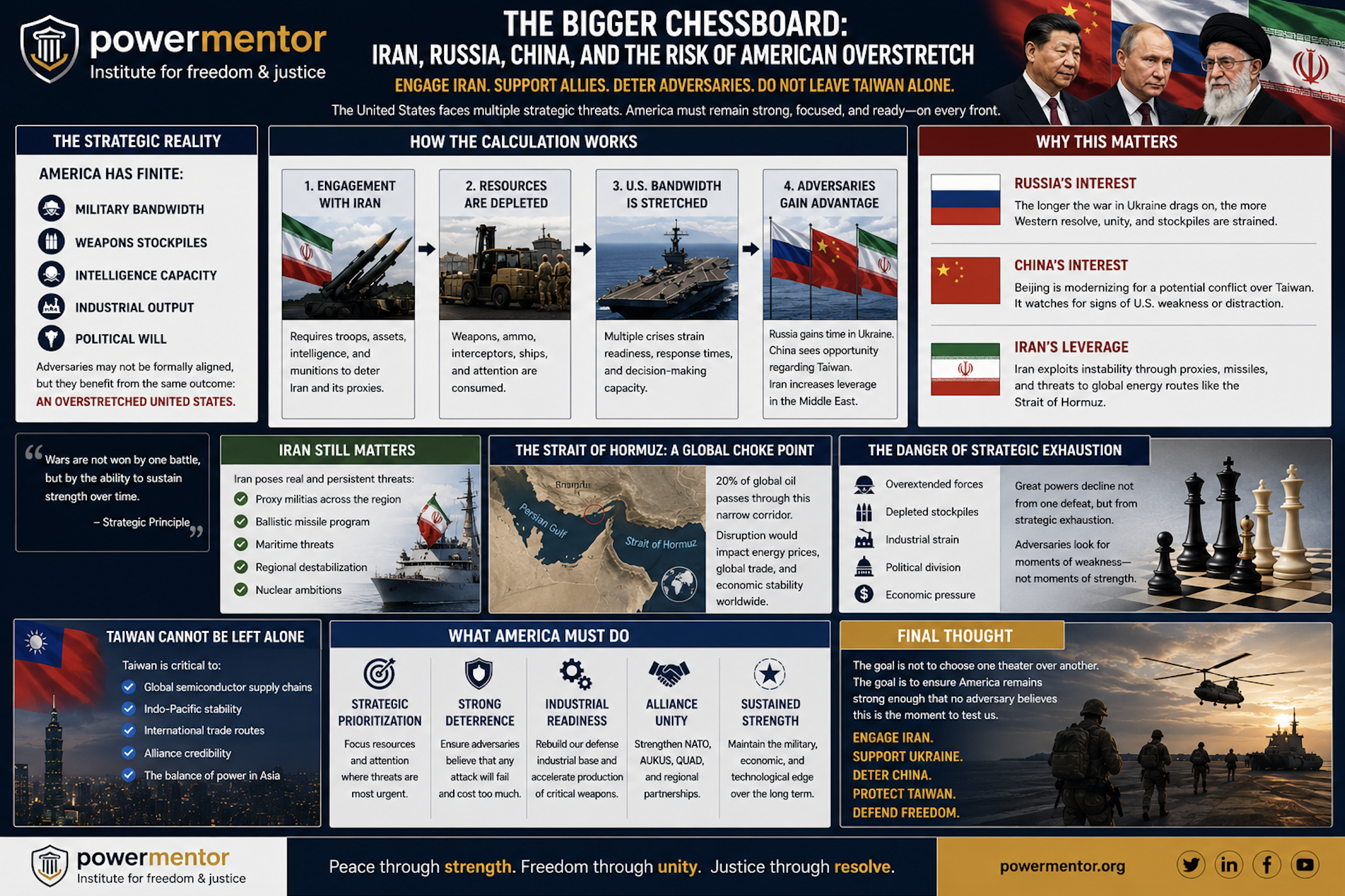
For many Americans, the conflicts involving Iran, Russia, and China appear to be separate global crises happening at the same time. But from a geopolitical perspective, these conflicts are deeply connected through one central strategic reality:
America has finite military bandwidth, finite political attention, and finite weapons stockpiles.
That does not mean the United States should disengage from Iran or ignore threats in the Middle East. Iran’s actions, proxy networks, missile capabilities, and threats to regional stability absolutely require serious engagement and deterrence.
However, the larger concern is whether America can effectively confront multiple high-level strategic threats simultaneously without creating vulnerabilities elsewhere—especially regarding Taiwan and the Indo-Pacific.
Understanding the Strategic Thought Process
The concern being discussed by many defense analysts is not necessarily that China, Russia, and Iran operate as one unified command structure. Rather, it is that they may each benefit from the same outcome:
An overstretched United States.
From their perspective:
If America becomes heavily consumed by Middle East escalation…
If U.S. military stockpiles are depleted…
If naval assets and intelligence resources remain tied down…
If political division and public fatigue increase…
…then America may become less capable of responding decisively in other theaters.
That is where Ukraine and Taiwan enter the conversation.
Russia’s Strategic Interest
Russia’s war in Ukraine has become a prolonged war of attrition. Moscow understands that time matters.
The longer Western nations become distracted or divided, the greater the possibility that:
Support for Ukraine weakens
Ammunition stockpiles decline
NATO cohesion faces pressure
Political fatigue grows in democratic nations
Russia benefits strategically when America’s focus is diluted across multiple crises at once.
This does not mean Russia wants a global war. It means Russia benefits when America is forced to divide its attention, resources, and strategic decision-making.
China Is Watching Taiwan Closely
The biggest long-term concern for many strategists is how this impacts Taiwan.
China has spent years modernizing its military, expanding naval power, increasing missile capabilities, and preparing for the possibility of future conflict in the Indo-Pacific.
Beijing studies:
U.S. response times
Weapons consumption rates
Political division inside America
Alliance strength
Industrial production capacity
Public willingness for prolonged conflict
One of the greatest deterrents protecting Taiwan is the belief that the United States would respond rapidly and decisively if Taiwan were threatened.
If adversaries begin to perceive:
weakened readiness,
exhausted stockpiles,
delayed production,
or political paralysis,
then deterrence itself becomes weaker.
And history shows that wars often begin when aggressors believe deterrence is failing.
Why Iran Still Matters
It is important to be clear:
Acknowledging strategic overstretch does NOT mean Iran should be ignored.
Iran remains a serious regional threat due to:
Proxy militias
Missile programs
Maritime threats
Regional destabilization
Support networks across the Middle East
The United States cannot simply abandon the region and hope the problem disappears.
The challenge is not whether America should engage Iran.
The challenge is whether America can:
engage Iran,
sustain Ukraine,
deter China,
protect Taiwan,
maintain global naval dominance,
and replenish critical stockpiles
…all at the same time over a prolonged period.
That is the real strategic debate.
The Strait of Hormuz and Global Pressure
One major concern is the Strait of Hormuz.
A significant percentage of global energy shipments pass through this narrow corridor. Any prolonged disruption could:
impact oil prices,
disrupt global trade,
strain allied economies,
and increase worldwide instability.
Iran understands the strategic leverage associated with maritime disruption.
That means America must maintain strong regional deterrence while simultaneously ensuring it does not lose focus on the Indo-Pacific theater.
The Danger of Strategic Exhaustion
Historically, great powers often decline not from one catastrophic defeat—but from strategic exhaustion.
Empires weaken when:
they become overextended,
spend faster than they replenish,
divide focus across too many fronts,
and fail to prioritize long-term sustainability.
America’s adversaries understand this principle well.
This is why military readiness, industrial production, alliance strength, and economic resilience matter just as much as battlefield victories.
Taiwan Cannot Be Left Alone
One of the most dangerous outcomes would be allowing China to believe Taiwan stands isolated.
Taiwan is not simply a regional issue. It is connected to:
global semiconductor supply chains,
Indo-Pacific stability,
international trade routes,
alliance credibility,
and the future balance of power in Asia.
If Taiwan were abandoned or perceived as abandoned, the geopolitical consequences would ripple across the world.
That is why the United States must simultaneously:
maintain Middle East deterrence,
support strategic allies,
strengthen domestic industrial capacity,
rebuild weapons stockpiles,
and reinforce Indo-Pacific alliances.
This is not about choosing one theater over another.
It is about ensuring America remains strong enough to prevent adversaries from exploiting moments of distraction or weakness.
Final Thoughts
The real issue is not whether America should confront Iran.
The real issue is whether America can maintain the strength, discipline, industrial capacity, and strategic clarity necessary to deter multiple adversaries simultaneously.
China, Russia, and Iran each have their own goals and interests. But all three benefit if America becomes:
exhausted,
divided,
economically strained,
militarily depleted,
or strategically unfocused.
The answer is not retreat.
The answer is:
strategic prioritization,
strong deterrence,
industrial readiness,
alliance unity,
and maintaining enough national strength to ensure no adversary believes this is the moment America can be outmaneuvered.**
