

Trump’s Next Move on Iran: Negotiation, Military Pressure, or Re-Engagement?
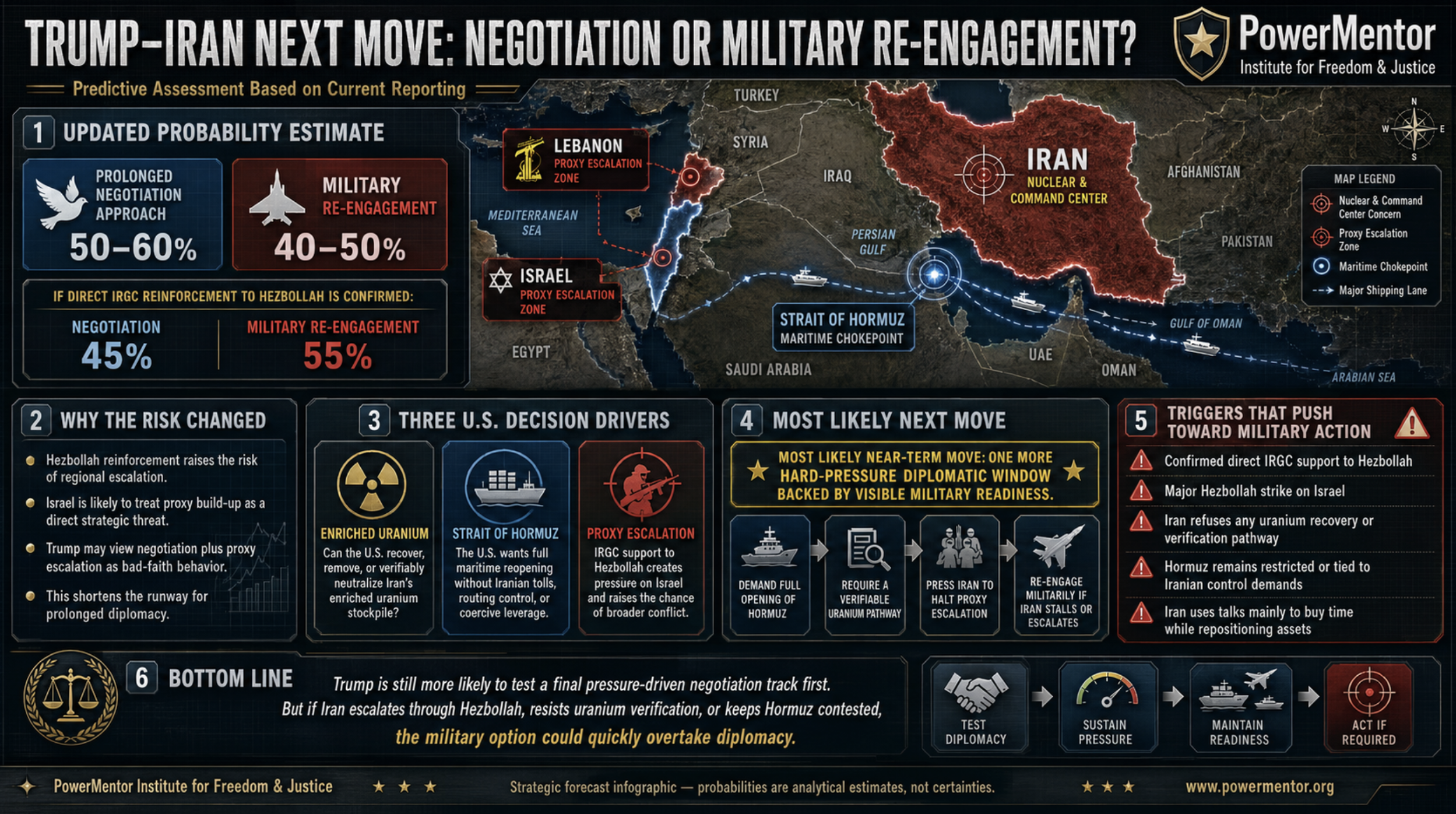
A Strategic Forecast on the Strait of Hormuz, Enriched Uranium, and Hezbollah Escalation
The current Iran situation is not simply a diplomatic dispute. It is a three-dimensional strategic crisis involving nuclear material, maritime control, and proxy warfare. President Trump’s next move will likely be shaped by whether Iran appears serious about negotiation or whether Tehran is using talks to buy time while strengthening its military and proxy position.
At this stage, the most likely path is still a hard-pressure negotiation track, but the likelihood of renewed military action is rising. The key reason is that Iran may be signaling diplomacy on one front while preparing escalation on another.
The Current Situation
Recent reporting indicates that the United States and Iran may be moving toward a temporary understanding or memorandum of understanding that could extend talks and reduce immediate pressure for another military confrontation. Mediators from Pakistan and Qatar are reportedly involved in efforts to extend a ceasefire and reopen the Strait of Hormuz, one of the world’s most important maritime chokepoints.
At the same time, the dispute remains unresolved on two core issues: Iran’s enriched uranium stockpile and control of the Strait of Hormuz. U.S. officials continue to insist that Iran cannot retain its highly enriched uranium, while Iran has signaled resistance to surrendering nuclear material or accepting terms it views as humiliating.
This creates a dangerous gap: Iran may be willing to discuss maritime access and ceasefire terms, but not full uranium surrender or verification.
Updated Probability Assessment
Based on the current reporting and the added concern about IRGC support to Hezbollah, with direct Iranian Revolutionary Guard Corps reinforcement to Hezbollah with active personnel, weapons transfer, command support, or operational coordination, then the probability is:
Negotiation: 45%
Military re-engagement: 55%
The reason is simple: proxy escalation changes the meaning of diplomacy. If Iran is negotiating while simultaneously strengthening Hezbollah against Israel, the United States and Israel may view that as bad-faith behavior rather than a genuine attempt to de-escalate.
Why the Strait of Hormuz Matters
The Strait of Hormuz is not just a regional waterway. It is a global economic pressure point. Any restriction, tolling system, routing control, or military threat in that area affects global shipping, oil prices, insurance costs, and the stability of Gulf states.
Reports indicate that Iran has pushed concepts involving greater control over Gulf transit, including disputed toll or routing ideas. The United States and Gulf countries appear strongly opposed to any arrangement that allows Iran to turn Hormuz into a coercive bargaining tool.
For Trump, the acceptable outcome is likely not just “reopening” the Strait. The likely U.S. demand is full maritime freedom without Iranian tolls, routing control, or political leverage over international shipping.
Why the Enriched Uranium Issue Is Even More Dangerous
The most difficult part of the crisis is not simply whether Iran has nuclear infrastructure. The harder issue is whether the United States can recover, remove, destroy, or verify the neutralization of Iran’s enriched uranium stockpile.
Trump has reportedly stated that the United States will not allow Iran to keep its highly enriched uranium and that the U.S. intends to take control of it or destroy it.
That is a major red line. If Iran refuses to provide a verifiable pathway for the uranium, the military option becomes much more likely. However, the military option is complicated because destroying facilities is one thing; locating, recovering, or verifying nuclear material is much harder.
This is why negotiation still has value for Washington. A military strike may damage Iran, but it may not solve the uranium problem unless intelligence is precise and the U.S. has a realistic plan for the material itself.
The Hezbollah Factor: Why the Risk Changed
The movement or reinforcement of Hezbollah by Iranian-linked forces is the issue that could quickly collapse diplomacy.
Hezbollah is not a side issue. It is part of Iran’s regional deterrence strategy. If Iran believes the United States or Israel may strike again, Tehran may use Hezbollah as a pressure point against Israel. Reports have already described IRGC involvement with Hezbollah operations and preparations, including Iranian-linked command activity inside Hezbollah structures.
If Iran is strengthening Hezbollah while negotiating, the message to Washington and Jerusalem is clear: Iran is preparing escalation options in case talks fail.
That makes the situation more dangerous because Israel may not wait for a direct Iranian attack. Israel may treat Hezbollah reinforcement as an immediate strategic threat and strike preemptively.
Trump’s Likely Next Move
The most likely next move from Trump is not an immediate full-scale military re-engagement. The more likely move is:
One final hard-pressure diplomatic window backed by visible military readiness.
That likely means:
Demand full reopening of the Strait of Hormuz.
Reject any Iranian toll, routing, or control mechanism over international shipping.
Require a verifiable pathway for Iran’s enriched uranium.
Pressure Iran to halt proxy escalation through Hezbollah.
Keep U.S. forces ready for rapid military action if Iran stalls, escalates, or refuses verification.
This fits Trump’s style: keep the threat of force highly visible, maintain public pressure, and frame any deal as Iran backing down.
What Would Push Trump Toward Military Action?
The military option becomes more likely if any of the following occur:
1. Direct IRGC support to Hezbollah.
If direct Iranian personnel, weapons, command coordination, or missile support is confirmed, it would make diplomacy appear less credible.
2. A major Hezbollah strike on Israel.
A large attack could trigger Israeli escalation and pressure the United States to re-engage.
3. Iran refuses any uranium recovery or verification pathway.
This is the core U.S. concern. If Iran keeps the uranium issue off the table, the negotiation track weakens quickly.
4. Hormuz remains restricted or tied to Iranian control demands.
The U.S. is unlikely to accept a situation where Iran can choke global shipping or extract concessions through maritime pressure.
5. Iran appears to be using talks to buy time.
If intelligence suggests Iran is moving uranium, hardening sites, dispersing weapons, or reinforcing proxies during negotiations, Trump’s tolerance for diplomacy will shrink.
My Bottom-Line Assessment
Trump is still more likely to test a final negotiation track first, but the margin is narrowing.
The reason negotiation remains slightly more likely is that a deal could solve multiple problems at once: reopen Hormuz, reduce energy pressure, create a path for nuclear verification, and avoid a wider regional war.
But the reason military re-engagement is now close behind is that Iran may be trying to preserve leverage across multiple fronts: uranium, Hormuz, and Hezbollah.
That combination is dangerous. It gives Iran bargaining power, but it also gives Trump and Israel a stronger argument that Iran is negotiating in bad faith.
Final Forecast
The next phase will likely be a short, intense test of diplomacy. Trump may allow mediators a limited window to produce a deal, but the conditions will be strict.
The decisive question is this:
Will Iran give the United States a verifiable path on enriched uranium and a fully open Strait of Hormuz — or will Iran try to hold both while escalating through Hezbollah?
If Iran chooses the first path, diplomacy survives.
If Iran chooses the second, the military option could quickly overtake negotiation.
