

San Diego Mosque Shooting: Radicalization, Weapon Access, Technological Failure, and the Collapse of Early Intervention
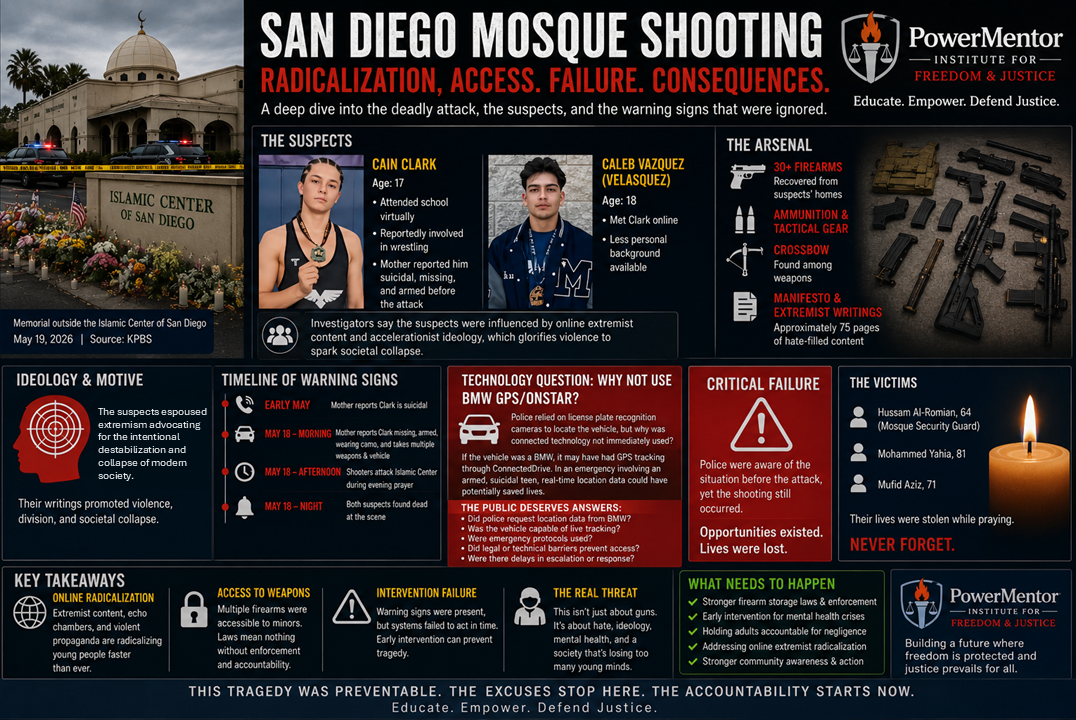
The shooting at the Islamic Center of San Diego was not simply another act of violence.
It was the convergence of:
online radicalization,
youth extremism,
weapon accessibility,
psychological instability,
technological gaps,
and systemic failures to intervene before tragedy struck.

The suspects — identified in reports as Cain Clark (17) and Caleb Vazquez/Velasquez (18) — allegedly carried out a heavily armed attack rooted in extremist ideology and fueled by online propaganda ecosystems that increasingly radicalize isolated young men.
But beyond the headlines lies a far more disturbing reality:
There were warning signs.
There were opportunities for intervention.
And there are serious unanswered questions about whether every available tool was used to stop the attack before lives were lost.
The Rise of Extremism
Investigators reportedly recovered:
manifesto material,
extremist writings,
neo-Nazi symbolism,
tactical equipment,
and references to prior mass killers.
Authorities believe the suspects consumed online extremist propaganda and embraced what experts describe as accelerationist ideology.
Accelerationism is a violent belief system centered around one core idea: Society should be pushed into chaos and collapse through violence, fear, and division.
Accelerationists believe:
democratic systems are weak,
coexistence is impossible,
social collapse is desirable,
and violence accelerates societal breakdown.
In these circles, mass violence is viewed not merely as murder, but as:
propaganda,
psychological warfare,
ideological theater,
and recruitment.
The violence becomes the message.
The Internet Has Become the New Radicalization Pipeline
The San Diego case follows an increasingly familiar pattern seen across multiple extremist attacks worldwide.
Young men spend endless hours online immersed in:
extremist memes,
nihilistic content,
violent propaganda edits,
livestreamed attacks,
and digital communities built around grievance and hatred.
Radicalization rarely begins with overt terrorism.
It often starts with:
“edgy” humor,
anti-establishment content,
identity crises,
social isolation,
online validation,
and gradual desensitization.
Eventually, some individuals descend into extremist ecosystems where previous mass killers are glorified as icons or “saints.”
The reported presence of:
manifesto material,
livestreaming behavior,
tactical symbolism,
and admiration for prior attackers are hallmark indicators of modern digital extremist culture.
This is no longer fringe.
This is an evolving form of decentralized extremism operating largely through algorithms, anonymous platforms, and online tribalism.
The Uncomfortable Question: How Did Teenagers Access an Arsenal?
Authorities reportedly recovered:
more than 30 firearms,
ammunition,
tactical gear,
and additional weapons from residences connected to the suspects.
That immediately raises critical questions.
Why did teenagers have access to this level of weaponry?
Were the firearms secured?
Who legally owned the weapons?
Did adults know these teens were unstable or radicalized?
Reports indicate Clark’s mother contacted police before the attack and allegedly warned that:
her son was suicidal,
armed,
wearing camouflage,
had taken weapons,
and had stolen a vehicle.
That timeline is deeply troubling.
Because it suggests the danger was known before the shooting occurred.
If firearms were accessible to a suicidal and radicalized teenager, then society must ask hard questions about:
negligent firearm storage,
parental responsibility,
intervention protocols,
and whether existing laws were adequately enforced.
This is not simply about gun politics.
It is about accountability.
There is a massive difference between lawful firearm ownership and allowing deeply unstable youth access to military-style arsenals.
The Technology Question Nobody Is Asking
One of the most significant unanswered questions involves the vehicle search itself.
Reports indicate police used license plate recognition cameras in an attempt to locate the suspects’ vehicle.
But that raises a critical issue:
Why was connected-vehicle GPS technology apparently not leveraged immediately?
If the vehicle was equipped with BMW ConnectedDrive or similar telematics systems, law enforcement may have had the ability — under emergency or exigent circumstances — to request live or near-live location information from the manufacturer.
That matters because:
license plate readers are passive,
they only work if a vehicle passes a camera,
and they create delays.
A connected GPS-enabled vehicle potentially offers something far more powerful:
Real-time location tracking.
Given the reports that:
the suspect was suicidal,
armed,
wearing tactical gear,
and had stolen weapons and a vehicle,
this should have represented the highest level of emergency escalation.
The public deserves answers:
Did police request emergency location assistance from BMW?
Was the vehicle capable of live tracking?
Were emergency manufacturer protocols activated?
Did legal or technical barriers prevent access?
Was there enough time to attempt GPS tracking?
Did dispatch have procedures for connected-vehicle emergencies?
To be fair, there may be legitimate explanations:
the vehicle may not have had active services,
GPS tracking may not have been enabled,
account information may have been unavailable,
or legal/process limitations may have delayed access.
But the public deserves transparency.
Because in situations involving:
suicidal armed suspects,
stolen firearms,
extremist behavior,
and imminent threats,
every minute matters.
If the technology existed and was not used, that represents a systems failure.
If the technology could not legally or technically be used, that should be clearly explained.
Modern Extremism Is Decentralized and Difficult to Detect
One of the greatest misconceptions today is that extremism looks like organized groups gathering secretly in compounds.
That is no longer the dominant threat.
Modern extremist ecosystems are:
decentralized,
digital,
emotionally driven,
meme-based,
and algorithmically amplified.
There may be:
no formal membership,
no hierarchy,
and no direct recruitment.
Instead, individuals radicalize themselves through:
endless online consumption,
digital echo chambers,
grievance culture,
and parasocial admiration of prior killers.
This creates a terrifying modern reality:
Young individuals can become highly radicalized with little real-world contact and minimal organizational structure.
The Core Driver: Dehumanization
At the center of nearly every extremist ideology lies one fundamental process:
Dehumanization.
Whether the targets are:
Christians,
Jews,
Muslims,
racial groups,
immigrants,
political opponents,
or entire communities—
the psychological mechanism is the same.
People stop being viewed as human beings.
They become symbols.
Enemies.
Targets.
Once that happens, violence becomes psychologically easier.
That is why rhetoric matters.
That is why propaganda matters.
That is why digital radicalization matters.
A Generation Searching for Meaning in Destruction
Many modern extremist attackers are not deeply intellectual ideologues.
Instead, they are often:
isolated,
emotionally unstable,
angry,
socially disconnected,
nihilistic,
and searching for identity or significance.
Extremist culture offers:
belonging,
purpose,
identity,
enemies,
and notoriety.
The internet has created spaces where:
hatred becomes community,
violence becomes achievement,
and infamy becomes immortality.
In some circles, the goal is no longer even political victory.
The goal is collapse itself.
The Real Warning
The San Diego mosque shooting is not merely about two suspects.
It reflects a much deeper societal crisis involving:
online extremism,
social fragmentation,
mental health deterioration,
technological vulnerabilities,
institutional limitations,
and the growing inability to intervene before violence occurs.
This case should force serious conversations about:
firearm accountability,
connected-technology emergency protocols,
parental responsibility,
youth radicalization,
online extremist propaganda,
mental health intervention,
and early warning systems.
Because ignoring these warning signs will not stop future attacks.
The uncomfortable reality is this:
The next generation is increasingly being shaped not by families, mentors, faith, or communities — but by algorithms, outrage, anonymity, and digital tribalism.
And until society confronts that honestly, these tragedies will continue repeating themselves under different names, in different cities, with different victims.
References
ABC News. (2026, May 19). San Diego Islamic Center shooting suspect apparently posted video of attack: Sources. https://abcnews.com/US/san-diego-islamic-center-shooting-suspects/story?id=133100694
ABC7. (2026, May 19). Islamic Center of San Diego shooting: Teenage suspects identified as Cain Clark and Caleb Vazquez. https://abc7.com/post/islamic-center-san-diego-shooting-teenage-suspects-identified-cain-clark-caleb-vazquez/19130299/
Federal Bureau of Investigation & Department of Homeland Security. (2022). Strategic intelligence assessment and data on domestic terrorism. https://www.dhs.gov/sites/default/files/2022-10/22_1025_strategic-intelligence-assessment-data-domestic-terrorism.pdf
Government Accountability Office. (2024). Countering violent extremism: FBI and DHS need strategies and goals for sharing threat-related information with social media and gaming companies. https://www.gao.gov/assets/870/865897.pdf
KPBS. (2026, May 19). Victims of Islamic Center shooting identified. https://www.kpbs.org/news/public-safety/2026/05/19/victims-of-islamic-center-shooting-identified
Schecter, A., & Milton, P. (2026, May 19). Teen attackers in San Diego Islamic Center shooting were wallowing in hate, investigators say. CBS News. https://www.cbsnews.com/news/san-diego-islamic-center-shooting-attackers-hate-investigation/
The Guardian. (2026, May 19). Teenagers behind mass shooting in San Diego rushed at mosque “fully armored”. https://www.theguardian.com/us-news/2026/may/19/san-diego-mosque-shooting
The Times. (2026, May 19). Cain Clark and Caleb Velasquez: Mosque shooting suspects had “Nazi insignia”. https://www.thetimes.com/us/news-today/article/cain-clark-caleb-velasquez-san-diego-mosque-shooting-teenagers-lp0kdxgt8
The Washington Post. (2026, May 19). Slain guard delayed shooters whose writings espoused “broad hatred,” officials say. https://www.washingtonpost.com/nation/2026/05/19/security-guard-warned-teachers-lock-doors-san-diego-islamic-center-shooting/
