

Roger Stone, Min Aung Hlaing, and the Junta’s Attempt to Rebrand Brutality in Burma (Myanmar)
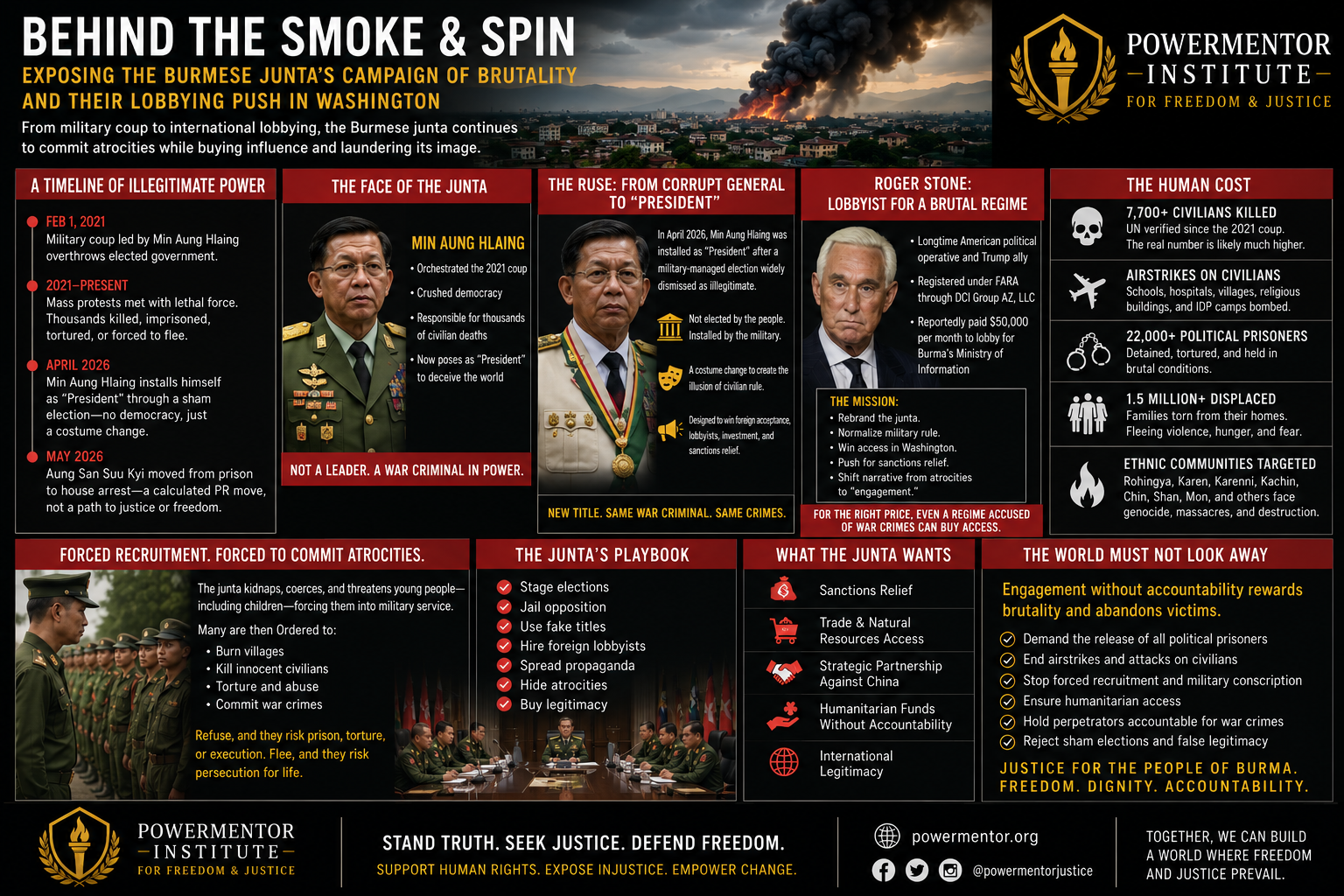
The reported hiring of Roger Stone to lobby on behalf of Burma’s military regime is not merely a public-relations controversy. It represents a broader strategy by the junta to rehabilitate its international image, weaken sanctions pressure, regain influence in Washington, and normalize relations with foreign governments while continuing widespread repression inside Burma (Myanmar).
Following the February 2021 military coup, Burma descended into widespread armed conflict, political repression, forced displacement, and systematic human-rights abuses. While the military regime attempts to portray itself as a stabilizing authority, international organizations, human-rights groups, and United Nations officials continue documenting war crimes, crimes against humanity, arbitrary detention, airstrikes on civilians, and forced conscription.
Against this backdrop, reports that Roger Stone and DCI Group are connected to lobbying efforts on behalf of the junta raise serious ethical, geopolitical, and humanitarian concerns.
The 2021 Coup and the Rise of Military Rule
On February 1, 2021, Burma’s military, known as the Tatmadaw, overthrew the democratically elected government led by Aung San Suu Kyi and the National League for Democracy (NLD). Military leaders alleged election fraud without credible evidence and declared a state of emergency.
The coup triggered nationwide resistance. Initially peaceful demonstrations evolved into armed resistance movements after the military responded with lethal force against civilians. What followed was the rapid deterioration of the country into one of the world’s most severe humanitarian and human-rights crises.
The military’s repression expanded beyond traditional ethnic conflict areas and increasingly targeted the Bamar majority population, including students, doctors, civil servants, journalists, clergy, teachers, and young people refusing military service.
The Junta’s Public Relations Strategy
The junta has increasingly sought to improve its international standing despite ongoing allegations of atrocities. One component of that strategy involves lobbying firms and political operatives in Washington, D.C.
Reuters reported that Burma’s Ministry of Information entered into a multimillion-dollar lobbying arrangement through DCI Group aimed at rebuilding relations with the United States. The agreement reportedly focused on improving diplomatic relations, trade access, humanitarian positioning, and broader international legitimacy.
According to Foreign Agents Registration Act (FARA) filings, Roger Stone was listed as a short-form registrant connected to the lobbying effort.
The military regime’s strategy appears clear:
Present itself as a legitimate governing authority
Shift discussion from human-rights abuses to geopolitical interests
Reduce international isolation
Encourage sanctions relief
Frame itself as a necessary regional partner
This effort is especially significant because the junta remains heavily sanctioned by the United States, European Union, and other democratic governments.
The Ruse of Min Aung Hlaing’s Transformation from Corrupt General to “President”
The junta’s effort to present Min Aung Hlaing as Burma’s president is one of its most blatant legitimacy schemes. He did not rise to power through a free democratic process. He seized power through the February 2021 coup, imprisoned elected leaders, crushed civilian resistance, and then used a military-controlled political structure to convert himself from coup leader into “president.”
In April 2026, Min Aung Hlaing was sworn in as president after a military-managed election process widely dismissed as illegitimate. This was not a transition to democracy. It was a costume change. The same man who led the military coup now wears the title of president to create the appearance of constitutional authority.
The regime’s goal is to tell foreign governments, lobbyists, investors, and regional organizations that Burma has returned to civilian governance, when in reality the military remains the dominant force behind the state.
This staged elevation also helps explain why the junta would hire Washington lobbyists. Roger Stone’s reported lobbying role fits directly into this strategy: rebrand the junta, soften the image of Min Aung Hlaing, and present the military regime as a government worthy of engagement.
The title “president” does not erase Min Aung Hlaing’s record. He remains the architect of the coup, the commander associated with years of military brutality, and the central figure in a system accused of war crimes, crimes against humanity, forced conscription, political imprisonment, and ethnic persecution. His transformation from corrupt general to president is not reform. It is political laundering.
Aung San Suu Kyi and the Illusion of Reform
Recent reports indicated that Aung San Suu Kyi was transferred from prison to house arrest after years of detention. However, many observers argue this does not represent meaningful political reform.
The junta has repeatedly used symbolic gestures to create the appearance of moderation while maintaining authoritarian control. Political prisoners remain detained throughout the country, and opposition groups continue to face severe repression.
Critics argue that moving Suu Kyi to house arrest serves multiple strategic purposes for the regime:
Improving international optics
Reducing external criticism
Creating leverage in diplomatic negotiations
Supporting lobbying narratives that conditions are improving
However, the broader conditions inside Burma remain deeply unstable and violent.
Human Rights Violations and War Crimes
International organizations continue documenting severe abuses committed by the Burmese military.
These include:
Airstrikes on Civilians
Human-rights organizations report extensive aerial attacks targeting:
Villages
Schools
Religious institutions
Hospitals
Displacement camps
Such attacks have disproportionately impacted ethnic minority regions, including Karen, Karenni, Chin, Kachin, and Rakhine areas.
Forced Recruitment and Forced Participation in Atrocities
One of the most alarming developments since the coup has been the junta’s increasing reliance on forced military recruitment to replenish battlefield losses.
Young men across Burma, including within Bamar communities, have reportedly faced coercion, intimidation, detention, abduction, and forced conscription into military service. Families have reported individuals being taken against their will or threatened with imprisonment if they refuse service.
This issue carries enormous humanitarian and legal significance because individuals forcibly recruited into the Tatmadaw may then be ordered to participate in operations involving atrocities against innocent civilians.
Numerous reports and testimonies have documented the Burmese military’s involvement in:
Village burnings
Extrajudicial killings
Torture
Forced displacement
Use of civilians as human shields
Destruction of food supplies
Airstrikes against civilian populations
As a result, many young people fleeing Burma are not merely avoiding military service. They are attempting to avoid being compelled to participate in crimes against humanity and violence against innocent people.
For individuals who flee forced recruitment or desert the military, the consequences upon return can be severe. Human-rights organizations and defectors have described risks including:
Imprisonment
Torture
Forced labor
Execution
Disappearance
Retaliation against family members
This is especially critical in asylum and deportation cases involving Burmese nationals who refused military service. Refusal to serve is often viewed by the junta not only as desertion, but as political opposition.
Arbitrary Arrests and Torture
Thousands of political prisoners remain detained under harsh conditions. Human-rights groups and former detainees have documented torture, incommunicado detention, and deaths in custody.
Ethnic Persecution
The Burmese military has a decades-long history of violence against ethnic populations. Since the coup, the scale and geographic scope of repression have expanded significantly.
The military’s actions against ethnic groups, including the Rohingya, Karen, Karenni, Kachin, Chin, Shan, Mon, and others, have been widely condemned internationally.
Since 2021, the military has increasingly targeted the broader Bamar civilian population as well, especially those opposing military rule.
Why Roger Stone’s Involvement Matters
Roger Stone is not simply another consultant or lobbyist. He is a highly recognizable political operative closely associated with American political power structures.
His reported involvement provides the junta with several advantages:
Access to U.S. Political Networks
The regime gains potential access to influential policymakers, strategists, and political circles within Washington.
Image Rehabilitation
The junta seeks to move global discussion away from atrocities and toward concepts such as:
“Regional stability”
“Strategic engagement”
“Economic cooperation”
“Counter-China balance”
Legitimacy
Hiring a high-profile American political figure helps the regime portray itself as internationally acceptable despite ongoing human-rights violations.
Narrative Control
The military regime understands that modern conflicts are fought not only on battlefields, but also through information operations, media framing, and international influence campaigns.
The Danger of Normalization
One of the greatest risks associated with lobbying efforts on behalf of authoritarian regimes is normalization.
Normalization does not require proving innocence. It only requires:
Creating confusion
Reducing outrage
Delaying accountability
Shifting the narrative
The danger is that international actors begin discussing Burma primarily through:
Trade opportunities
Strategic alliances
Migration concerns
Chinese influence
Regional stability
while the suffering of civilians becomes secondary.
This pattern has historically enabled authoritarian governments worldwide to survive international condemnation.
Conclusion
The Burmese military regime remains accused of widespread atrocities, repression, forced conscription, political imprisonment, ethnic persecution, and attacks against civilians. Any attempt to rehabilitate its image internationally must be viewed within the context of these ongoing abuses.
Roger Stone’s reported lobbying involvement is therefore not merely a political consulting arrangement. It is part of a broader effort by the junta to gain legitimacy, weaken international pressure, and reshape global perceptions while conflict and repression continue inside Burma.
The regime’s attempt to transform Min Aung Hlaing from coup leader into “president” represents a calculated effort to politically launder military rule through optics, lobbying, and staged legitimacy.
At the same time, thousands of young people across Burma face forced recruitment into a military widely accused of committing atrocities against innocent civilians. Many who flee the country are not fleeing ordinary military service. They are fleeing the possibility of being forced to participate in crimes against humanity and violent campaigns against their own people.
For advocates, policymakers, and human-rights defenders, the central issue remains accountability. Diplomatic engagement cannot replace justice for victims of violence, political imprisonment, forced displacement, forced military recruitment, and ethnic persecution.
The people of Burma continue facing extraordinary hardship. Their reality should not be overshadowed by strategic messaging campaigns designed to sanitize the image of military rule.
References
Human Rights Watch. (2026). World report 2026: Myanmar. Human Rights Watch
Amnesty International. (2026). Myanmar 2025/26 report. Amnesty International
Reuters. (2025, August 8). Myanmar signs deal with Washington lobbyists to rebuild U.S. relations. Reuters
Reuters. (2026, May 1). Detained Myanmar ex-leader Suu Kyi to meet legal team this weekend. Reuters
Reuters. (2026, May 7). ASEAN to hold talks with Myanmar foreign minister. Reuters
NPR. (2026, May 1). Myanmar’s Aung San Suu Kyi moved to house arrest. NPR
Office of the United Nations High Commissioner for Human Rights. (2026). Statement on Myanmar human rights and humanitarian crisis. OHCHR
European Union. (2026, April 27). EU extends sanctions against Myanmar. Reuters coverage of EU sanctions
U.S. Department of Justice. (2026). Foreign Agents Registration Act filing: DCI Group AZ LLC. FARA eFile Database
The Guardian. (2026, May 8). Trump ally Roger Stone condemned for providing lobbying services to Myanmar’s military junta. The Guardian
