

After-Action Security Concerns: When Protection Failures Become Systemic Vulnerabilities
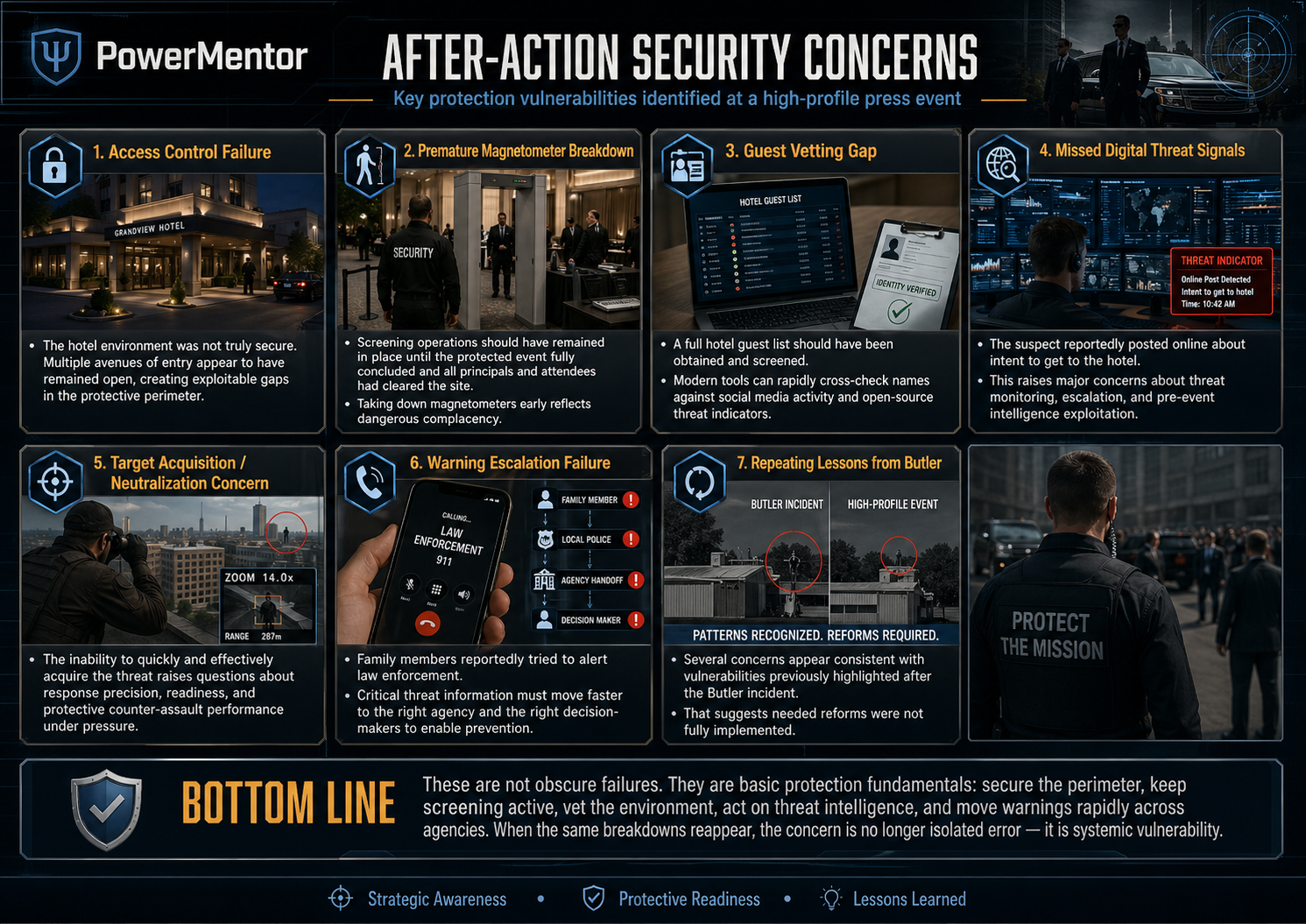
High-profile public events require more than visible security. They require layered protection, disciplined procedures, real-time intelligence sharing, and a culture that refuses to become complacent. When any one of those systems fails, the risk increases. When several fail at the same time, the concern is no longer isolated error — it becomes systemic vulnerability.
The recent White House Correspondence Dinner event exposed several serious after-action concerns that deserve close review. These concerns are not complicated or obscure. They are basic protection fundamentals that should be expected at any event involving national leaders, cabinet officials, elected officials, media, and other public figures.
1. The Venue Was Not Truly Secure
One of the first concerns is the hotel environment itself. From a protection standpoint, the site did not appear to be fully secured. A high-profile event inside a hotel creates unique challenges because hotels have multiple entry points, service corridors, elevators, stairwells, garages, guest rooms, employee access points, and public-facing areas.
That means security cannot focus only on the main entrance or the ballroom. The entire environment must be treated as part of the protective perimeter. If other access points remain open or loosely monitored, a determined individual can exploit those gaps.
2. Screening Should Never Have Been Taken Down Early
Another major concern is the reported early breakdown of magnetometers and screening equipment. Screening should remain active until the event has fully concluded and all protected individuals, attendees, staff, and media have cleared the site.
Taking down security equipment too early creates a dangerous window of vulnerability. It also signals complacency. A threat does not disappear simply because the formal program is ending. In fact, arrivals, departures, transitions, and crowd movement are often among the most vulnerable moments of any protective operation.
3. Hotel Guest Vetting Should Have Been Part of the Plan
A full hotel guest list should have been obtained and screened before the event. In today’s environment, this is basic protective intelligence.
Modern tools can rapidly cross-check names against public records, open-source information, and social media activity. If a person has made threatening statements, posted about getting to the hotel, or shown signs of violent intent, that information must be identified and escalated before the event begins. Reports identified the suspect made statements on social media of his intentions before the event.
This is not about violating privacy. It is about responsible threat assessment when national leaders and public figures are gathered in one location.
4. Missed Digital Threat Signals
One of the most serious concerns is the reported online activity from the suspect. If someone publicly posts about intent to reach the hotel or target an event, that should trigger immediate review.
Threat monitoring must be proactive, not reactive. Law enforcement and protection teams need systems that identify concerning digital behavior, assess credibility, and move information quickly to the people who can act.
In the modern threat environment, social media is often where warning signs appear first. Ignoring those signs, missing them, or failing to escalate them can have devastating consequences.
5. Response Accuracy and Target Acquisition Raise Concerns
Another concern is the reported failure to quickly and effectively neutralize the threat. When rounds are fired and the threat is not stopped, it raises questions about target acquisition, readiness, visibility, positioning, communication, and performance under pressure.
Protective teams train for high-stress moments. However, training must translate into execution. If the response was delayed, inaccurate, or poorly coordinated, that must be reviewed honestly.
The purpose of an after-action review is not to attack individual agents or officers. It is to identify what broke down and fix it before the next incident.
6. Family Warnings Must Move Faster
A major concern is that family members reportedly attempted to alert law enforcement. If credible warnings were made before the incident, then the system failed to move critical information fast enough.
There must be a faster pipeline for threat tips to reach the correct agency, threat assessment team, and operational decision-makers. Local law enforcement, federal agencies, event security, and protective intelligence units cannot operate in silos.
When someone close to a potential attacker raises concern, that information should be treated seriously and escalated immediately.
7. Repeating Lessons from the Butler Incident
Some of these concerns appear similar to issues raised after the Butler incident. That is especially troubling because the purpose of an after-action review is to prevent repeated failure.
If the same vulnerabilities keep appearing — poor perimeter control, missed warning signs, delayed escalation, weak coordination, or inadequate response positioning — then the issue is not simply one bad event. It suggests reforms were either insufficient, poorly implemented, or not fully absorbed into operational culture.
8. Dangerous Rhetoric Is Fueling the Threat Environment
Beyond physical security failures, there is a larger cultural concern: the rise of extreme political and ideological rhetoric.
There has been a growing pattern of language that borders on criminal because it can encourage unstable individuals to view political opponents, public officials, journalists, judges, religious leaders, or ordinary citizens as enemies to be eliminated rather than people to be debated.
Words matter. When public rhetoric dehumanizes others, labels disagreement as evil, or implies that violence is justified against people with different beliefs, it creates a climate where unstable individuals may feel morally licensed to act.
This kind of rhetoric does not have to give a direct order to be dangerous. It can still incite violence by normalizing hatred, glorifying revenge, or portraying assassination and political violence as understandable responses.
America cannot survive as a free society if disagreement becomes a justification for violence. No political party, movement, media outlet, activist group, or public figure should be allowed to excuse language that pushes people toward bloodshed.
The standard must be clear: argue strongly, expose wrongdoing, challenge corruption, and defend truth — but never encourage assassination, political violence, or the destruction of people simply because they do not share the same beliefs.
8. Normalized Threats Against Leaders Must Be Treated as a Serious Security Failure
One of the most dangerous developments in the current threat environment is how threats against public leaders have become increasingly normalized. Statements that once would have triggered immediate condemnation, investigation, and criminal referral are now too often dismissed as political expression, online venting, comedy, activism, or partisan outrage.
That is a serious mistake.
There is a clear difference between protected speech and rhetoric that crosses into intimidation, targeted threats, or incitement. People have every right to criticize elected officials, judges, cabinet members, journalists, candidates, and public figures. They do not have the right to encourage assassination, celebrate attempted murder, call for violent retaliation, or direct unstable individuals toward specific targets.
In many cases, the rhetoric being used today is not simply offensive. It may warrant criminal referral for review because it has been shown to contribute to a climate where violence is encouraged, justified, or made to feel morally acceptable. When public figures are repeatedly described as enemies who must be “stopped,” “removed,” “taken out,” or treated as existential threats, unstable individuals can interpret that language as permission to act.
This is especially dangerous when the rhetoric includes names, locations, schedules, images, maps, family details, or repeated dehumanizing language. Those are not harmless political arguments. They can become targeting cues.
Law enforcement and threat assessment teams should not wait until bullets are fired before acting. Credible threats, assassination language, coordinated intimidation, and rhetoric that appears to encourage violence against public leaders should be documented, evaluated, and referred to the appropriate authorities when the facts support it.
The standard must be consistent regardless of ideology or political party. Threats against leaders are not acceptable when aimed at presidents, cabinet officials, members of Congress, judges, governors, mayors, journalists, candidates, or community leaders. A free society cannot function when political disagreement is converted into permission for violence.
Criticism is protected; threats are not. Debate is protected; incitement is not. Accountability is protected; assassination rhetoric is not. When threats become normalized, the security environment becomes more dangerous for everyone.
Bottom Line
These failures point to a basic truth: protection is not just about agents, barriers, weapons, or metal detectors. Protection is a system.
That system must secure the venue, control access, keep screening active, vet the environment, monitor digital threats, move warnings rapidly, coordinate across agencies, and respond effectively under pressure.
At the same time, the nation must confront the dangerous rhetoric that is making political violence feel acceptable to unstable individuals.
When the same security failures repeat, it is not just a mistake. It is a warning. When violent rhetoric becomes normalized, it is not just speech. It becomes fuel.
The lesson is simple: secure the perimeter, fix the intelligence pipeline, hold agencies accountable, and stop feeding a culture where people believe violence is an acceptable answer to disagreement.
