

Trump Turned Fire Into a Cage: Why Iran’s Regime Is Running Out of Room
The old model of war was simple and costly: invade, occupy, stay, bleed, spend, and hope the enemy eventually breaks. That was the logic of the forever war. It dragged America into long fights where victory was hard to define and even harder to sustain.
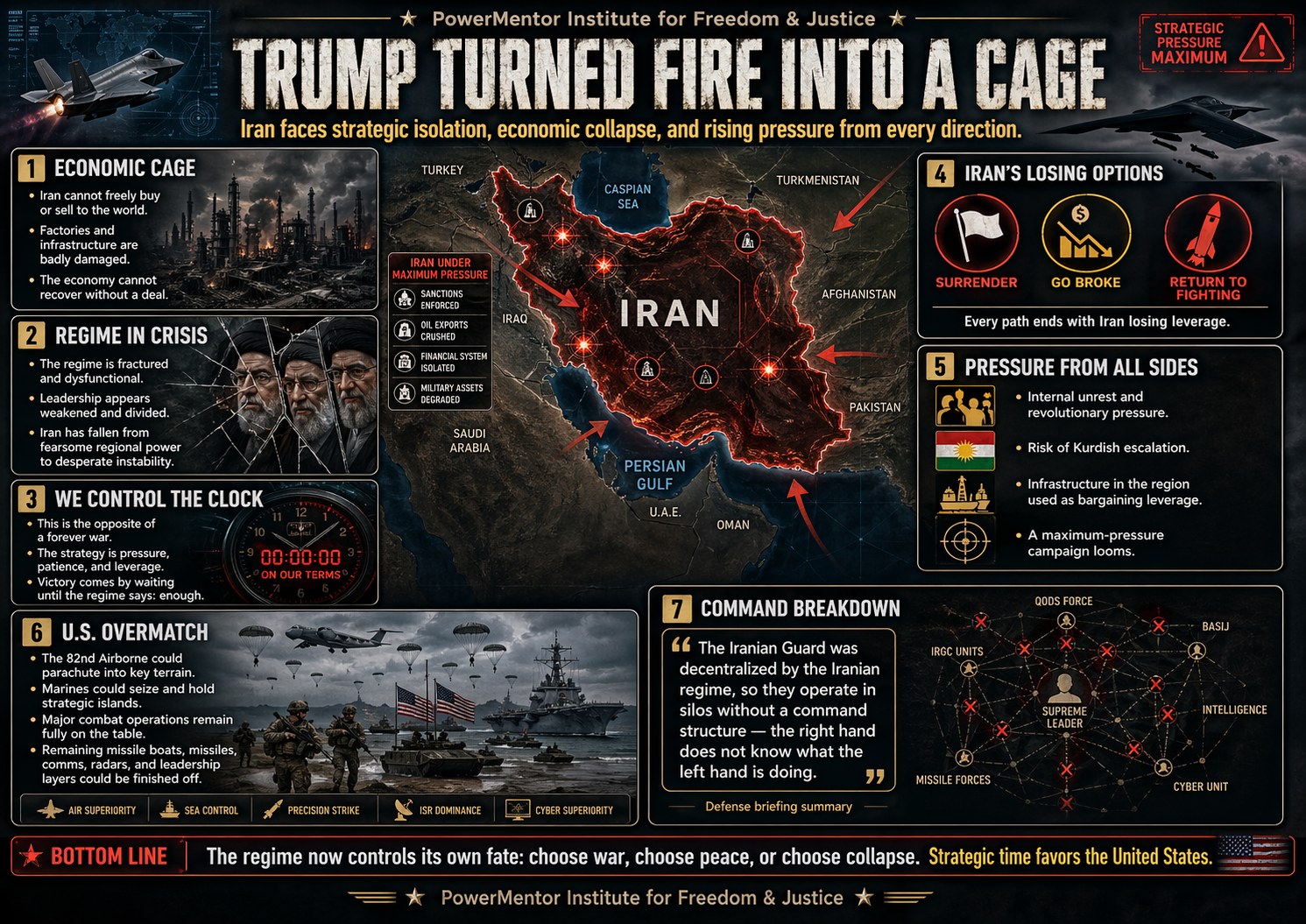
The emerging pressure strategy against Iran is different. It is not built on chasing the regime through every street or holding every city. It is built on isolation, leverage, economic suffocation, military overmatch, and time. The point is not to fight forever. The point is to make the regime run out of good options.
The Trump administration formally restored a “maximum pressure” policy against Iran in February 2025, stating that the goal was to deny Iran a path to nuclear weapons and counter its influence abroad. Since then, pressure on Iran’s financial networks, oil trade, and weapons-linked entities has continued to expand, including new sanctions tied to Iran’s arms industry and oil-smuggling networks.
The Fire Became a Cage
Iran’s problem is no longer just battlefield damage. Its larger problem is strategic confinement.
A country can survive a strike. It can even survive a series of strikes. But it cannot easily survive when its economy is restricted, its oil trade is targeted, its financial system is squeezed, its military infrastructure is degraded, and its leadership is forced to make decisions under pressure from every direction.
That is the cage.
Iran cannot freely buy and sell to the world without risk. Its trade networks face sanctions. Its oil routes face scrutiny. Its banking and procurement channels are under pressure. The regime’s economic recovery becomes difficult without a deal because rebuilding requires money, parts, insurance, shipping access, foreign exchange, and international confidence.
That is why sanctions matter. They do not simply punish the regime. They slow its ability to repair itself.
Iran’s Three Bad Choices
Iran now faces three basic options, and none of them are clean.
First, it can negotiate. That would mean admitting that pressure worked and that the regime needs relief.
Second, it can refuse a deal and continue bleeding economically. That risks deeper internal instability, more public anger, and more isolation.
Third, it can return to open conflict. That risks more military damage, more sanctions, and a larger confrontation with a superior military power.
That is the strategic trap. Every road costs the regime something.
The Clock Now Works Against Tehran
In a forever war, time often works against the United States. The longer the war drags on, the more expensive it becomes. Public patience fades. Political support weakens. The enemy waits America out.
This situation is different.
Here, the pressure strategy is designed to make time work against Iran. The longer Iran remains boxed in, the harder it becomes to rebuild, export, finance operations, and project regional power. The United States does not need to occupy Iran to increase the pressure. It can wait while sanctions, military deterrence, diplomatic leverage, and regional positioning continue to tighten the space around the regime.
That is the meaning of controlling the clock.
From Regional Power to Isolated Regime
Iran once projected itself as a fearsome regional power. It used proxies, missiles, maritime harassment, cyber activity, and ideological influence to intimidate neighbors and pressure the West.
But a regime that depends on smuggling, proxy warfare, and fragmented command structures starts looking less like a state with strategic confidence and more like a desperate network trying to survive.
Recent reporting has described Iran’s Revolutionary Guard Corps as deeply influential inside the state, with reports that the IRGC has expanded its grip over key functions and restricted political decision-making. Other analysis has noted that Iran’s military and Revolutionary Guard structures are designed with decentralized and regional command elements, which may help survival under attack but can also create confusion, fragmentation, and uneven control.
That matters because a fractured system may be harder to destroy quickly, but it is also harder to manage coherently. When units operate in silos, one hand may not know what the other is doing. That creates risk, miscalculation, and internal dysfunction.
Pressure From Every Direction
Iran’s pressure points are multiplying.
Economically, sanctions and trade restrictions limit recovery. Militarily, the regime must protect missile sites, ports, command nodes, islands, air defenses, naval assets, and leadership infrastructure. Politically, it must manage public frustration, elite distrust, ethnic tensions, and the fear of internal unrest.
Regionally, Iran also faces pressure from groups and populations that have long resisted Tehran’s control, including Kurdish communities. Any internal fracture creates another security problem for the regime. Any regional infrastructure it relies on becomes bargaining leverage for its enemies.
This is why maximum pressure is not only about bombs or sanctions. It is about forcing the regime to defend too many weak points at once.
The Military Option Still Hangs Over the Regime
The United States does not need to launch a full-scale ground war for Iran to feel the weight of American military power. The threat alone changes Tehran’s calculations.
Reporting on the current conflict has noted the presence of U.S. forces in the region and concerns that escalation could include targeted operations, maritime control, or pressure around strategic Gulf islands. A larger operation could focus on missile boats, radar systems, communications, naval assets, island positions, and command-and-control layers.
That does not mean war is inevitable. It means Iran has to calculate every decision under the shadow of overwhelming U.S. capability.
The 82nd Airborne, Marines, naval forces, airpower, intelligence assets, cyber capabilities, and regional infrastructure give the United States multiple ways to apply pressure without accepting Iran’s preferred battlefield. The regime understands that if it escalates too far, the next round may not look like the last one.
The Regime Controls Its Own Fate
The most important point is this: Iran still has agency.
The regime can choose negotiation. It can choose escalation. It can choose delay. It can choose survival through compromise or continued decline through defiance.
But it no longer controls the full battlefield. It does not control the global financial system. It does not control the sanctions environment. It does not control the pace of U.S. pressure. It does not control how long its economy can absorb isolation.
That is why the strategy is so powerful. Iran is not being chased. It is being contained.
Bottom Line
Trump turned fire into a cage.
Iran’s regime is trapped between economic collapse, military vulnerability, internal dysfunction, and diplomatic pressure. It can surrender leverage through a deal, go broke under isolation, or return to fighting and risk even greater damage.
This is not the forever-war model where America fights endlessly and waits for nothing. This is a pressure model where time becomes a weapon.
The United States does not have to rush. It only has to hold the cage closed long enough for Iran’s regime to understand that every option outside a deal leads to loss.
References
Fox News. (2026, April 20). IRGC seizes control of Iran state functions, blocks president, report says. https://www.foxnews.com/world/irans-revolutionary-guard-sidelines-president-military-grip-expands
Treadstone 71. (n.d.). IRGC ground forces regional command [PDF]. https://www.treadstone71.com/files/IRGC%20Ground%20Forces%20Regional%20Command%20Report.pdf
U.S. Department of the Treasury. (2026, April 24). Economic fury targets illicit oil smuggling network run by Iranian regime elite. https://home.treasury.gov/news/press-releases/sb0443
The White House. (2025, February 4). Fact sheet: President Donald J. Trump restores maximum pressure on Iran. https://www.whitehouse.gov/fact-sheets/2025/02/fact-sheet-president-donald-j-trump-restores-maximum-pressure-on-iran/
Younge, G. (2026, April 21). With the US-Iran ceasefire about to expire, could Trump put boots on the ground? The Guardian. https://www.theguardian.com/world/2026/apr/21/trump-iran-us-ceasefire-ground-war
