

Burma’s (Myanmar) $3 Million Washington Influence Campaign: Roger Stone, Rare Earth Minerals, and the Fight for Burma's Future
A Regime Seeking Influence in Washington
While millions of people across Burma (Myanmar) continue to live amid war, displacement, and political repression, the military-backed government in Naypyidaw has launched a multi-million-dollar effort to improve its standing in Washington, D.C.
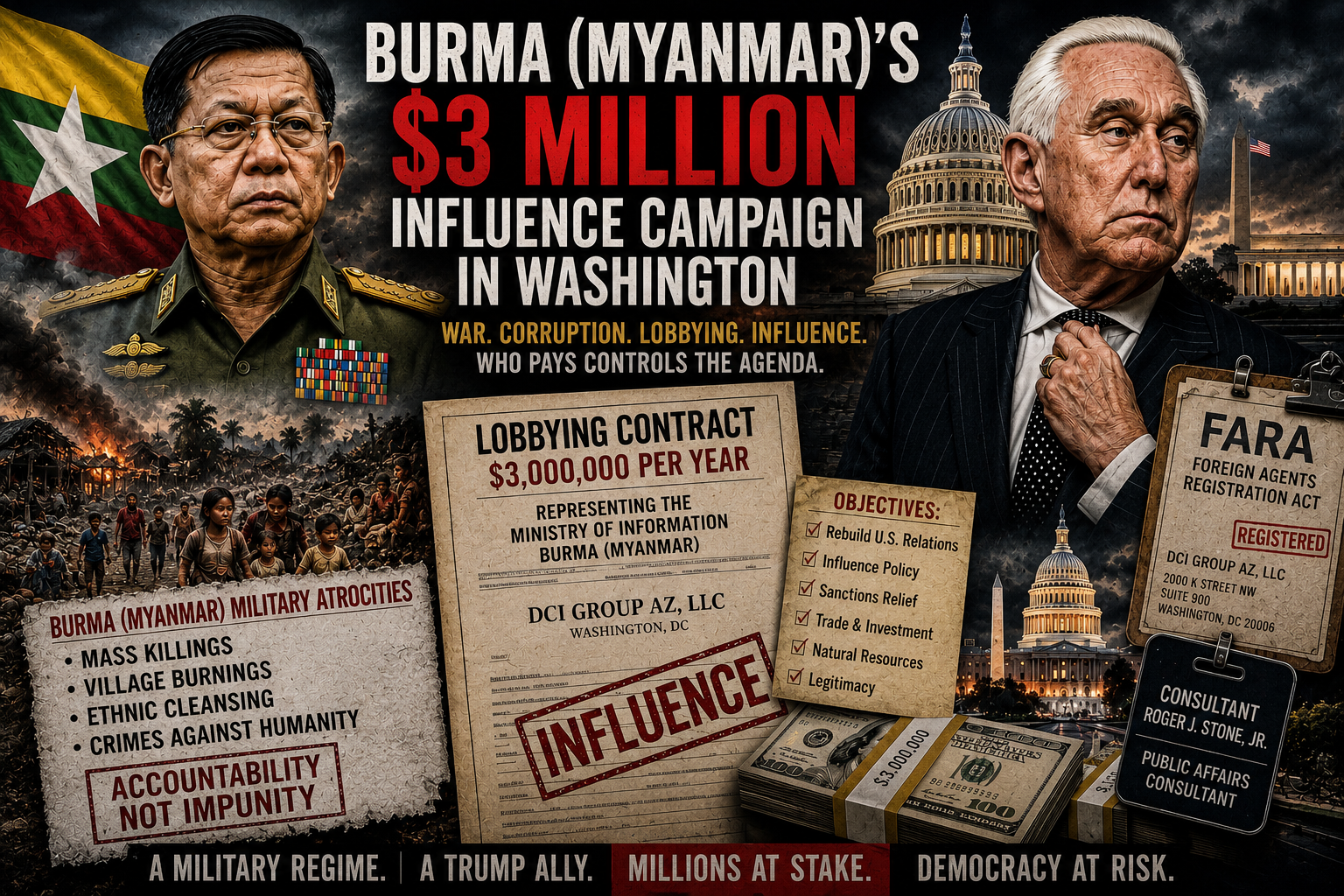
Public filings under the Foreign Agents Registration Act (FARA) reveal that Burma’s (Myanmar) Ministry of Information entered into a lobbying agreement valued at approximately $3 million annually with DCI Group, a prominent Washington lobbying firm. The stated objectives include rebuilding relations with the United States, discussing trade, humanitarian relief, and natural resources.
Among those reportedly involved in the effort is longtime political operative and Trump ally Roger Stone, who has been reported as receiving approximately $50,000 per month for consulting services associated with the engagement.
The question is not whether the lobbying effort exists. The public record shows that it does. The real question is:
Why is a military regime accused of widespread human rights abuses spending millions of dollars to gain influence in Washington?
The Man at the Center of Burma’s (Myanmar) Military Rule
At the center of this effort stands Min Aung Hlaing, the former commander-in-chief of Myanmar's armed forces and the architect of the military takeover that occurred on February 1, 2021.
Following the coup, the military removed the elected civilian government and consolidated power under military rule. Since that time, Min Aung Hlaing has remained the dominant political and military figure in Burma (Myanmar).
Although the military government has attempted to create structures intended to portray a return to civilian governance, most democracy advocates, ethnic organizations, and international observers understand this tactic has long been the strategy of the corrupt Burma regime for decades.
Human Rights Watch and other organizations have described election efforts conducted under military control as attempts to manufacture legitimacy while political opponents remain imprisoned and large portions of the country remain engulfed in armed conflict killing villagers daily.
What Is Documented
Opposition leaders have remained detained.
Large regions of Burma (Myanmar) remain outside military control.
Numerous ethnic organizations rejected the military-led election process.
International observers have questioned the credibility of elections conducted under military authority with clear evidence supporting coercive tactics resulting in a sham election.
Why Critics Call It a Sham
Many ethnic organizations, democracy advocates, and resistance movements argue that elections conducted under conditions of military domination cannot be considered genuinely free or fair. Especially when violence was perpetuated against villagers across Burma to garner their vote.
While opinions differ, critics contend that any election held while opposition leaders are imprisoned and military operations continue across the country serves primarily to preserve military control rather than restore democratic governance.
Roger Stone's Role
Roger Stone is one of the most recognizable political consultants in American politics.
Over several decades he has worked with political figures ranging from Richard Nixon to Donald Trump. His career has been marked by both influence and controversy.
In 2019 Stone was convicted on federal charges including obstruction, false statements, and witness tampering. He later received a presidential pardon from Donald Trump in 2020.
Now Stone's name has surfaced in connection with Myanmar's lobbying effort.
Public filings and media reports indicate that Stone was retained through DCI Group to assist in efforts aimed at improving relations between Myanmar and the United States.
The broader contract has been valued at approximately $3 million annually, with reporting indicating Stone's compensation may be approximately $50,000 per month.
The Rare Earth Question
This may be the most important aspect of the entire story.
Burma (Myanmar) possesses some of the world's most valuable deposits of heavy rare earth minerals.
These resources are not ordinary commodities.
They are essential for:
Advanced weapons systems
Fighter aircraft
Missile guidance systems
Artificial intelligence technologies
Telecommunications infrastructure
Electric vehicles
Strategic manufacturing
In recent years, China has dominated global rare earth processing and supply chains.
As tensions between the United States and China continue to grow, access to alternative sources of rare earth minerals has become a major national security concern.
Reuters has reported that officials connected to the Trump administration have heard proposals concerning potential access to Burma’s (Myanmar) rare earth resources as part of broader strategic discussions involving competition with China.
This raises an important question.
If Burma’s (Myanmar) lobbying contract specifically references natural resources, and if rare earth minerals are among the country's most valuable strategic assets, could access to these resources become a central objective of future U.S.-Burma (Myanmar) engagement?
Verified Facts
✔ Burma (Myanmar) signed a lobbying agreement worth approximately $3 million annually.
✔ Roger Stone has been linked to the lobbying effort through public filings and reporting.
✔ The contract specifically references natural resources.
✔ Burma (Myanmar) possesses globally significant rare earth deposits.
✔ Rare earth minerals are strategically important to the United States.
Analytical Assessment
The overlap between Burma’s (Myanmar) lobbying objectives, the strategic value of rare earth minerals, and ongoing U.S.-China competition raises legitimate questions about whether rare earth access may become a significant factor in future discussions.
Many observers believe that possibility deserves careful scrutiny.
Why Ethnic Minorities Are Concerned
For the Karen, Kachin, Karenni, Chin, Shan, Mon, and other ethnic populations, this discussion is far more than a geopolitical debate.
It is personal.
For decades, ethnic communities have experienced ethnic cleansing pepetuated by Burma’s (Myanmar) military.
Human rights organizations have documented allegations involving:
Village burnings, rape, torture
Forced displacement
Airstrikes on civilian areas
Religious persecution
Extrajudicial killings
Destruction of schools and churches
Millions of people have been affected by decades of military operations.
As a result, many ethnic leaders fear that international engagement driven primarily by strategic interests could come at the expense of accountability, justice, and self-determination.
A Different Path for American Policy
An important question rarely discussed in Washington is whether the United States should focus its engagement on the military regime at all.
Some analysts, advocates, and ethnic leaders argue that a more sustainable approach would involve deeper engagement with Burma’s (Myanmar) ethnic organizations and democratic forces rather than granting legitimacy to Burma’s military rulers.
Organizations such as the Kawthoolei Army (KTLA), Government of Kawthoolei (GOK) and the Kachin Independence Organization (KIO) have maintained governance structures, educational systems, healthcare networks, and security institutions in territories outside military control for decades.
Many supporters of ethnic self-determination argue that these organizations represent freedom loving values, a more legitimate foundation for long-term peace and stability than continued reliance on military leadership.
Strategic Advantages of an Alternative Approach
Supporters of this strategy point to several realities:
Ethnic organizations control significant territory.
Many ethnic regions contain valuable natural resources.
Local populations trust ethnic institutions more than Burmese military authorities.
Ethnic organizations have long advocated for self-governance and democratic participation.
Durable peace is unlikely without addressing the aspirations of ethnic communities with balance of power with each ethnic people having their own land with full autonomy with self-determination and their own security.
From this perspective, observers argue that if the United States seeks strategic partnerships, access to resources, and long-term regional stability, it should prioritize relationships with democratic and ethnic stakeholders rather than focusing exclusively on military leaders seeking international legitimacy.
The Choice Facing Washington
The future of Burma (Myanmar) may ultimately hinge on a fundamental decision.
Should policymakers pursue engagement primarily through a corrupt Burma military regime seeking acceptance and sanctions relief?
Or should they cultivate relationships with ethnic and democratic movements that have spent decades pursuing freedom, autonomy, and self-determination?
This is not simply a question about lobbying.
It is not simply a question about rare earth minerals.
It is a question about what kind of future the international community chooses to support.
For many ethnic communities across Burma (Myanmar), the answer is clear.
They do not seek another arrangement that strengthens military control.
They seek freedom.
They seek self-determination.
They seek the ability to govern their own communities, protect their own cultures, and build their own future without fear.
As Burma’s (Myanmar) military government spends millions of dollars attempting to influence Washington, the voices of those communities must not be ignored.
Because the true test of American leadership is not whether it can secure access to strategic resources.
It is whether it can support freedom, accountability, and human dignity while doing so.
References
U.S. Department of Justice Foreign Agents Registration Act (FARA) filings.
Reuters reporting on Myanmar's lobbying agreement and rare earth discussions.
Human Rights Watch reports on Myanmar.
Amnesty International reports on Myanmar.
Public reporting regarding Roger Stone's involvement through DCI Group.
U.S. Department of Justice records regarding Roger Stone's criminal convictions and pardon.
