

When the Worst Days Become the Job: What Policing Does to the Human Behind the Badge
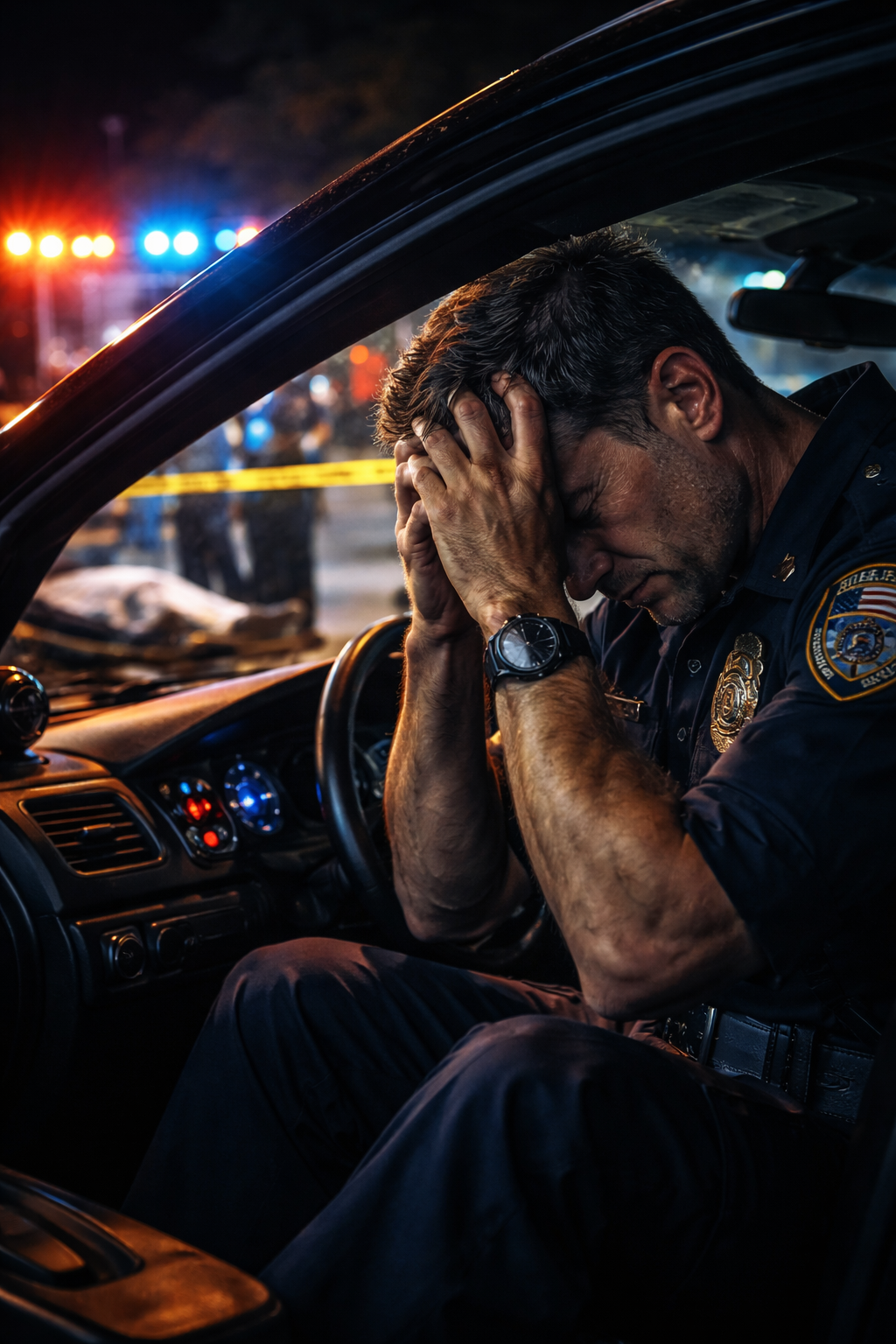
Over a 20-year career, many police officers will move through hundreds of critical incidents—events most people would describe as the worst day of their lives—while the average civilian may experience only a handful of traumatic events across an entire lifetime. The difference is not just exposure. It’s what happens after the exposure.
A civilian who experiences something horrifying—an unexpected death, a violent event, a terrible accident—often has the option to go home, decompress, take time off, and process what happened. Police officers usually don’t. They clear one call and immediately roll into the next. The work doesn’t pause so the nervous system can catch up.
Researchers and law-enforcement wellness literature describe this as cumulative trauma—the stacking effect of repeated high-stress and high-threat exposure across years. Even the estimates of exposure vary depending on how “critical incident” is defined: one FBI Law Enforcement Bulletin article cites an average of 178 critical incidents across a career, compared with two to three traumatic events for the average person. Other policing organizations and training/wellness discussions cite higher “traumatic event” totals (often hundreds) using broader definitions.
The forced “switch” that never turns off
In the source you provided, the core point isn’t just that officers see more trauma—it’s that officers are repeatedly required to shut down what they feel to keep functioning.
That shows up in a simple moment most families recognize:
“How was your day?”
“Fine.” “Good.” “Okay.”
Those words can become a shield. Not because an officer doesn’t have feelings, but because the job trains the body and mind to compartmentalize fast—then brings that same coping style home. Over time, the habit can harden into emotional suppression: don’t show what’s inside; move to the next task; stay controlled.
And it doesn’t take a dramatic Hollywood moment for the internal conflict to hit. It can happen in plain sight—right between calls.
An illustrative call-to-call whiplash
An officer responds to a two-vehicle collision at dusk. One driver is trapped. A passenger is unresponsive. The officer works with fire and medics, helps block traffic, manages a frantic family member, and watches CPR end with a quiet head shake.
Ten minutes later, the officer clears the scene and is dispatched to a neighborhood complaint: a car break-in with a furious reporting party. When the officer arrives, the resident is yelling—Why did it take you so long? This city is falling apart! What are you even doing out there?
Inside, the officer is still carrying the image of the crash—still hearing the panic, still seeing the paramedics’ face. But the uniform requires a different script:
“Sorry, ma’am. We’re a little busy today. Tell me what happened.”
That’s the job: absorb the worst, then perform calm on demand. Do that enough times, and the emotional system can start to blunt itself—not only at work, but everywhere.
What “numb” can really mean
Emotional numbness is often described as a survival adaptation: the brain trying to reduce overload by turning the volume down. But that coping style can come with a cost—relationship strain, irritability, sleep disruption, intrusive memories, hypervigilance, and difficulty feeling normal joy or connection.
Research consistently finds elevated rates of trauma-related symptoms in policing compared with the general population. A systematic review of PTSD in police reported prevalence varying widely by study and measurement approach, with an average estimate around the mid-teens and a median under 10% across included studies—still elevated relative to general-population baselines. A large review in Frontiers in Psychiatry (2024) likewise reports an overall pooled point prevalence of PTSD in police around the mid-teens across many studies and countries.
Other reviews synthesize a broader mental-health picture: depression, anxiety, sleep disorders, substance misuse risk, and burnout, often shaped by both operational trauma (what officers see) and organizational stressors (shift work, staffing shortages, internal culture, discipline concerns, public hostility).
Suicide risk: what the data says—and why counting is hard
Your source text lands on a disturbing bottom line: in many jurisdictions and time periods, law enforcement suicide has been discussed as a risk that can rival—or even exceed—other duty-related threats.
National research using U.S. occupational mortality surveillance data has found a significantly higher proportion of deaths from suicide among law enforcement officers compared with other decedents with recorded occupations; one analysis reported officers were about 54% more likely to die of suicide in that dataset’s framework.
At the same time, the U.S. has historically lacked a single complete, mandatory, nationwide system for tracking police suicides, which is why different sources report different totals. The FBI’s Law Enforcement Suicide Data Collection (LESDC) exists, but reporting is voluntary. CNA’s analysis highlights how limited participation can dramatically undercount cases in official channels and compares that with larger totals assembled through voluntary/public reporting efforts such as First H.E.L.P.
That data gap matters because comparisons (suicide vs. line-of-duty deaths) can shift depending on which dataset, which year, and which definitions are used. For context, NLEOMF’s year-end reports show 147 line-of-duty deaths in 2024 and 111 in 2025. CNA reports 1,287 public safety deaths by suicide recorded (law enforcement and corrections) from 2016–2022 in the First H.E.L.P.-compiled dataset, with annual counts peaking in the 200s in some years.
The point your source is making
Your source isn’t asking for sympathy points. It’s describing a mechanism:
Repeated exposure to worst-day events
Immediate return to service with no decompression
Emotional suppression as a professional requirement
Spillover into home life (“Fine. Good. Okay.”)
Numbness and disconnection as a learned default
A higher risk environment for mental-health crises, including suicide
In plain terms: when the job demands you bury your reactions to survive the shift, it can train you to bury your reactions everywhere—until you can’t feel much of anything at all.
References
Jaeger, S. (2023). Perspective: The impact of life experiences on police officers. FBI Law Enforcement Bulletin. Retrieved January 29, 2026, from
Steege, A. L., & Violanti, J. M. (2021). Law enforcement worker suicide: An updated national investigation (NIOSH). Centers for Disease Control and Prevention. Retrieved January 29, 2026, from
Violanti, J. M. (2021). Law enforcement worker suicide: An updated national investigation (record page). Centers for Disease Control and Prevention (CDC) Stacks. Retrieved January 29, 2026, from
Carson, L. M., et al. (2023). An analysis of suicides among first responders (NIOSH). Centers for Disease Control and Prevention. Retrieved January 29, 2026, from
Federal Bureau of Investigation. (n.d.). Law Enforcement Suicide Data Collection (LESDC). Retrieved January 29, 2026, from
Federal Bureau of Investigation. (2024, November 15). Law enforcement suicides: Online platform provides current data on law enforcement suicides. Retrieved January 29, 2026, from
CNA. (2024, April 18). What suicide data for public safety officers tell us. Retrieved January 29, 2026, from
First H.E.L.P. (n.d.). The numbers. Retrieved January 29, 2026, from
Wagner, S. L., et al. (2020). Systematic review of posttraumatic stress disorder in police officers following routine work-related critical incident exposure. American Journal of Industrial Medicine. Retrieved January 29, 2026, from
Adugna, B., et al. (2024). Prevalence of post-traumatic stress disorder and associated factors among police officers: A systematic review and meta-analysis. Frontiers in Psychiatry. Retrieved January 29, 2026, from
National Law Enforcement Officers Memorial Fund. (2025). 2024 end-of-year law enforcement officers fatalities report (PDF). Retrieved January 29, 2026, from
National Law Enforcement Officers Memorial Fund. (2026). 2025 end-of-year law enforcement officers fatalities report (PDF). Retrieved January 29, 2026, from
