
Manufactured Chaos: How So-Called “Peaceful” Protests Are Built to Escalate Into Violence
Across several U.S. cities, including Minnesota and New York, large anti-ICE demonstrations have been presented publicly as spontaneous, community-driven expressions of outrage. However, available evidence and public statements from organizers indicate these events are highly coordinated operations, organized by national ideological networks, trained in disruption tactics, and designed to provoke confrontation.
This is not a warning against lawful protest. It is a warning about risk—to public safety, to families, and to democratic stability.
These Protests Are Not Organic
Video evidence and on-the-ground reporting show professional activists arriving in rented vehicles, including U-Hauls, unloading pre-printed signs, standardized slogans, frozen water bottles used as weapons, and coordinated materials, then moving as a group between federal targets such as courthouses and hotels believed to house federal agents.
The consistency of messaging and speed of mobilization across states indicate pre-planning, not spontaneous reaction. Organizers have openly identified themselves as members of the Party for Socialism and Liberation (PSL), a national organization whose stated mission is the dismantling of capitalism and the replacement of U.S. economic and political systems with a Marxist-Leninist framework. PSL aligns with Indivisible on the national level, and Twin Cities Indivisible as well.
Their own published materials call for the end of private property and the destabilization of Western institutions.
Training for Disruption, Not Safety
Key organizers involved in these movements publicly describe themselves as experts in civil resistance and non-cooperation. Trainings openly promoted include:
Neighborhood alert systems using whistles to warn of ICE presence
Coordinated walkouts and strikes
Businesses refusing lawful access to federal agents
Federal and municipal employees declining to carry out directives
Organized physical obstruction of enforcement operations
These tactics are framed as “nonviolent.” However, organizers themselves acknowledge that confrontation is expected and, strategically useful.
The stated objective is not merely protest—but to force enforcement responses that can be framed as repression, generating media amplification and public outrage.
Why Violence Becomes Likely—Even When “Nonviolence” Is Claimed
Civil resistance doctrine, as publicly described by organizers, relies on maintaining discipline while eliciting a forceful response from authorities. This strategy assumes that confrontation will “backfire” against enforcement agencies.
In real-world conditions, this creates severe risk:
Crowds surge unpredictably
Individuals act independently of organizers
Opportunistic actors exploit chaos
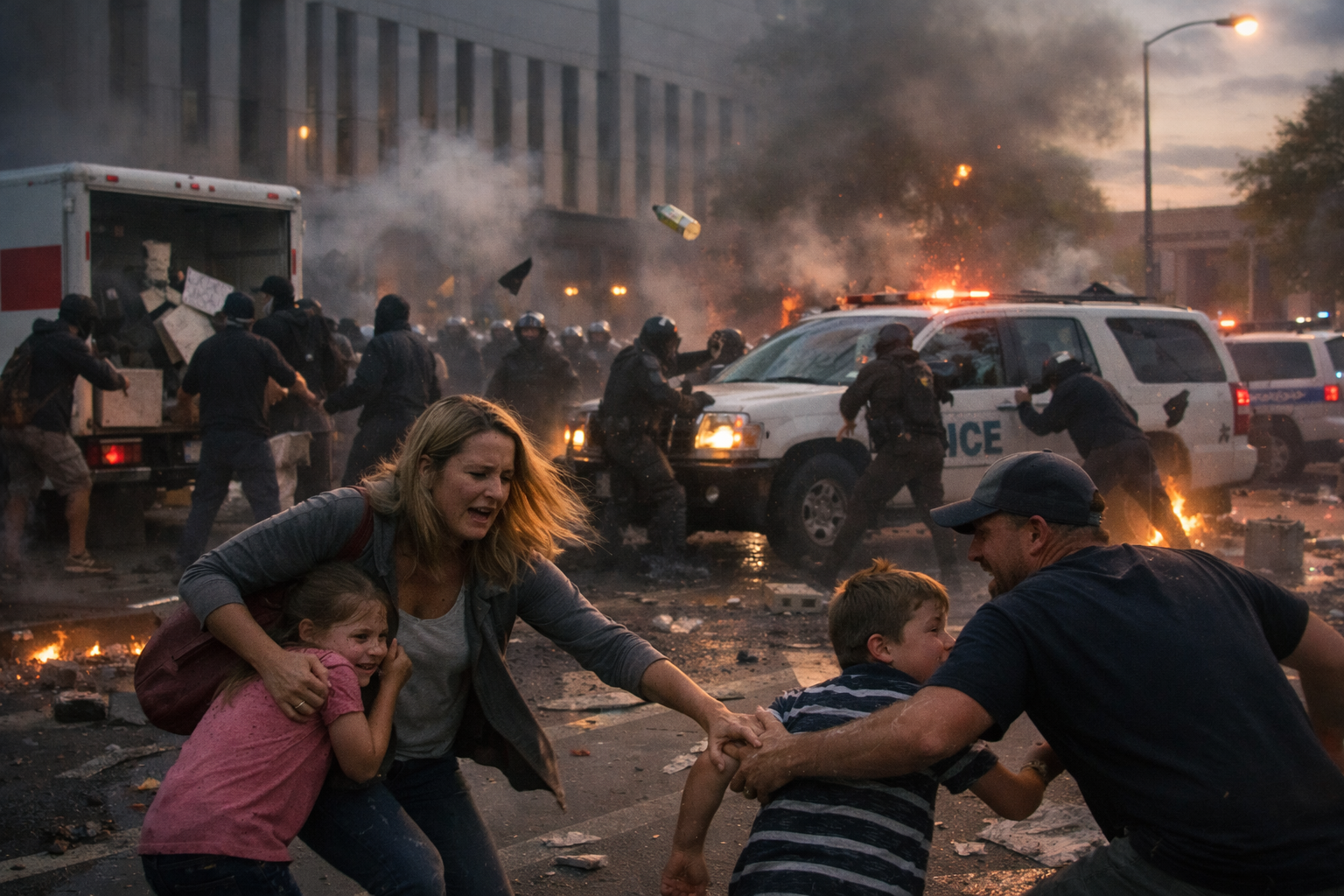
Projectiles are thrown at vehicles and personnel
Panic spreads rapidly
Recent demonstrations have included:
Protesters surrounding federal vehicles
Objects thrown at car windows
Attempts to identify, track, or confront individual agents
The use of civilians—including children—to block operations
At this point, no organizer controls the crowd.
Tragedy Is Not an Accident—It Is a Known Risk
The deaths of individuals such as Alex Preddy and Nicole (Renee) Good are now used as rallying points and symbolic “martyr” narratives. Organizers understand that tragedy amplifies movements.
But for families attending these events, tragedy is not theoretical.
Crowd psychology research and law-enforcement assessments consistently show that once protests move from expression to obstruction, the probability of injury or death—intentional or accidental—rises sharply.
Democracy Is Not Strengthened by Chaos
Persistent rhetoric portraying lawful federal enforcement as “fascist,” “illegitimate,” or equivalent to warfare erodes public trust in democratic institutions. Encouraging selective obedience to law creates parallel authority structures, where rules apply differently depending on ideology.
This environment increases polarization, radicalization, and the likelihood of retaliatory violence. It does not protect communities—it destabilizes them.
A Direct Warning to Families
These demonstrations are not safe environments for anyone.
They are not controlled marches.
They are not family-friendly civic gatherings.
They are high-risk, emotionally charged confrontations designed to disrupt law enforcement operations.
Families cannot control crowd escalation.
No slogan or cause prevents panic, stampedes, or sudden violence.
Bringing children into these environments places them directly in harm’s way.
Lawful Dissent Has a Place—These Events Cross a Line
Peaceful protest is a constitutional right. But when protests are:
Centrally coordinated
Trained for obstruction
Designed to provoke confrontation
Framed around revolutionary ideology
They cease to be safe civic spaces.
The public deserves transparency—not romanticized narratives that ignore real danger.
References
Chenoweth, E., & Stephan, M. J. (2011). Why civil resistance works: The strategic logic of nonviolent conflict. Columbia University Press.
Department of Homeland Security. (2020). Strategic framework for countering terrorism and targeted violence. U.S. DHS.
Federal Bureau of Investigation. (2021). Managing large-scale demonstrations and civil disorder. U.S. Department of Justice.
National Institute of Justice. (2017). Crowd dynamics and public safety during mass demonstrations. U.S. DOJ.
