

How the Burma Junta Turned “Election Security” Into Control-by-Compliance in Myawaddy
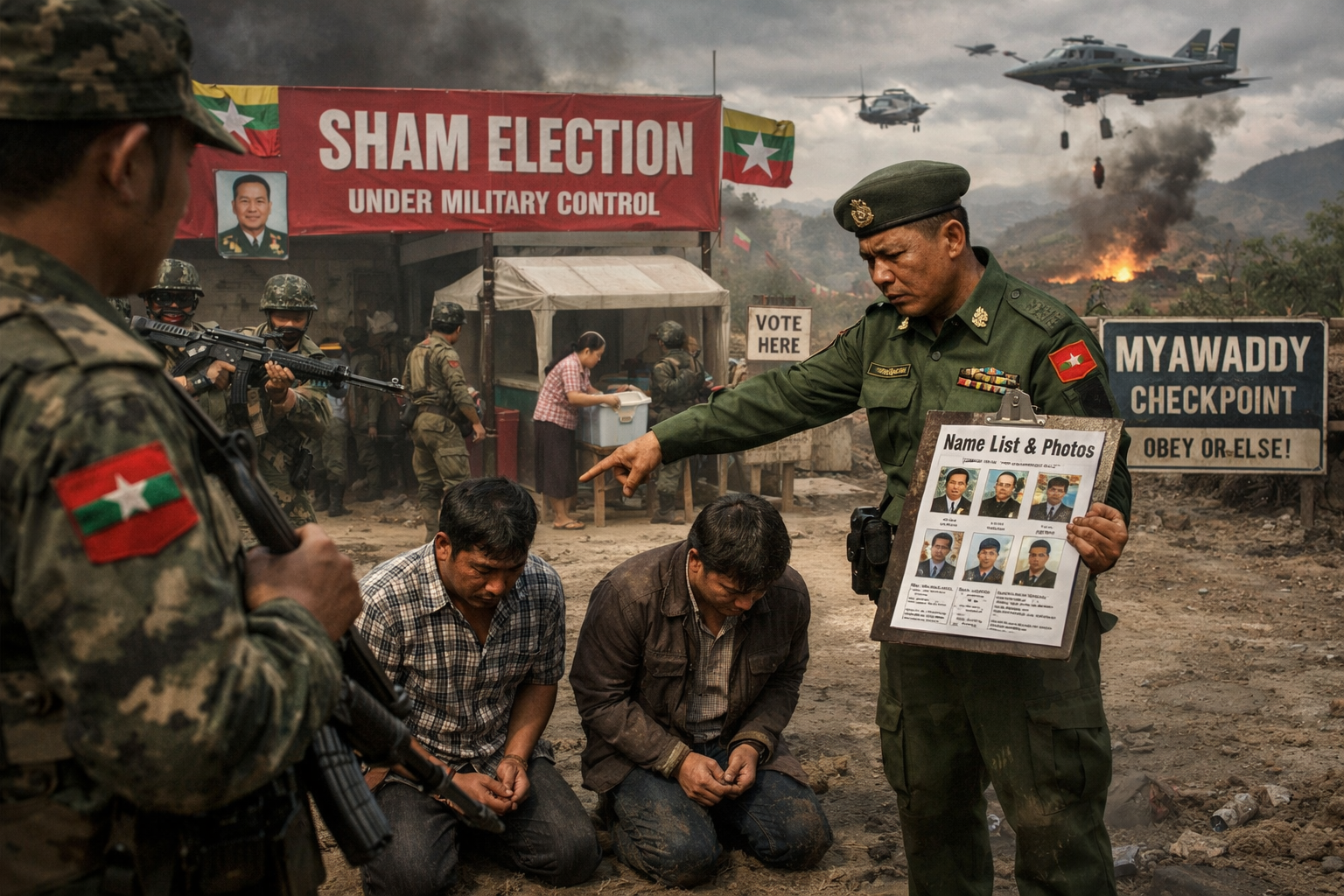
In Myawaddy, a strategic border town in Karen State (Kayin State) on the Thailand frontier, the Burma (Myanmar) military isn’t just trying to “secure an election.” It’s using election security as a pretext to force armed actors into a compliance framework—one built on identity disclosure, movement control, and punitive threats.
Open reporting in late January 2026 describes a clear pattern: the junta leans on local, semi-aligned Karen armed groups to help stabilize a critical trade corridor—then uses that relationship to demand rosters and weapon data, restrict who can operate in town, and warn of air power retaliation if its garrison is hit again.
The mechanism: “Election security” as a compliance trap
1) Deputize local armed groups, then treat them like subordinates
The Irrawaddy reports the junta pressured the DKBA and the KNU/KNLA–Peace Council (KNU/KNLA-PC)—groups that have operated in a gray zone between local power and junta accommodation—within a Myawaddy context that included election support/security dynamics.
Once groups are positioned as “election security partners,” the junta can frame demands as routine coordination rather than coercion.
2) Demand identity lists and force data as the “price of operating”
This is where election security becomes control-by-compliance. Reporting says the junta ordered DKBA and KNLA-PC to submit:
troop deployment details
personnel lists (including photographs)
weapons inventories
by Jan. 24.
Myanmar Now similarly reports orders for names and locations of fighters in Myawaddy.
That’s not casual coordination. It’s the kind of information that turns “partners” into trackable, controllable actors.
3) Pair the paperwork with a punishment threat aimed at the entire town
To make compliance stick, reporting says the junta warned that if Infantry Battalion 275 is attacked again, it would retaliate by bombing / conducting airstrikes on Myawaddy.
This matters because it shifts the pressure onto civilians too: local leaders and communities become hostages to the junta’s demand that armed actors “keep the peace.”
4) Enforce “who is allowed in town” by pushing rivals out
Mon News reports the junta ordered elements linked to KNA (widely described as tied to the former BGF milieu in the area) to withdraw, while town security roles were being reassigned on the ground.
Whether or not every detail holds in every township, the logic is consistent: election security becomes the justification for deciding which armed uniforms are authorized and which are not.
Why Myawaddy is the test case
Myawaddy isn’t just another town—it’s a border gateway with trade, revenue, and strategic leverage. The junta cannot reliably “govern” many contested areas through normal administration, so it tries to govern through managed security arrangements—especially during an election it wants to use as proof of legitimacy.
International reporting has widely described the junta-run election as widely denounced / not credible, held under conflict conditions with opposition excluded and many areas unable to vote. That context makes the Myawaddy approach even more important: the election is less a democratic exercise than a structure the junta uses to reorganize power and display “order.”
Key nuances to keep straight
Geography: The strongest, most specific reporting is about Myawaddy / the border corridor, not definitively “all Karen areas” across the state.
Stated rationale vs. operational reality: The junta frames list-demands as verification/security. But adding photos, locations, and weapons inventories makes the relationship inherently coercive—because it creates long-term leverage over people, not just “coordination.”
Civilian risk is central: the strike threat is explicitly tied to a future attack on IB-275, but the consequence described is aimed at the town.
Bottom line
In Myawaddy, “election security” is functioning like a compliance regime: submit your lists, accept movement controls, and keep the junta’s battalion safe—or the town pays. That’s not security for an election. It’s security as a tool to compel obedience and reassert control in a place the junta can’t hold by legitimacy alone.
References
Guardian staff. (2026, January 25). Myanmar military proxy expected to win landslide in widely denounced election. The Guardian. https://www.theguardian.com/world/2026/jan/25/myanmar-election-enters-final-stage-amid-airstrikes-and-exclusions
monnews. (2026, January 27). KNA Forces Remain in Myawaddy Despite Junta Orders to Withdraw. Independent Mon News Agency. https://monnews.org/2026/01/27/kna-forces-remain-in-myawaddy-despite-junta-orders-to-withdraw/
Myanmar Now. (2026, January 28). Myanmar military demands troop lists from Karen armed groups in Myawaddy. Myanmar Now. https://myanmar-now.org/en/news/myanmar-military-demands-troop-lists-from-karen-armed-groups-in-myawaddy/
Peck, G. (2026, January 26). Military-backed party secures Myanmar election win with opposition excluded. AP News. https://apnews.com/article/myanmar-election-military-party-6c0e5330696d421e4c58d7a363d75175
Reuters. (2026, January 3). Myanmar's junta leader dismisses critics as military allies head for landslide election win. Reuters. https://www.reuters.com/world/asia-pacific/myanmars-junta-leader-dismisses-critics-military-allies-head-landslide-election-2026-01-03/
The Irrawaddy. (2026, January 23). Loyalties Shift in Myawaddy as Myanmar Junta Calls Armed Groups to Heel. https://www.irrawaddy.com/news/burma/loyalties-shift-in-myawaddy-as-myanmar-junta-calls-armed-groups-to-heel.html
