
When Bureaucrats Override the Ballot: Sabotage Is a Threat to Self-Government
An election must mean something after the votes are counted.
Americans elect leaders to exercise authority within the Constitution and the law. That authority includes changing policies, revising priorities, and replacing approaches voters have rejected. If government employees secretly obstruct those decisions whenever they disagree, the public’s ability to change its government becomes an illusion.
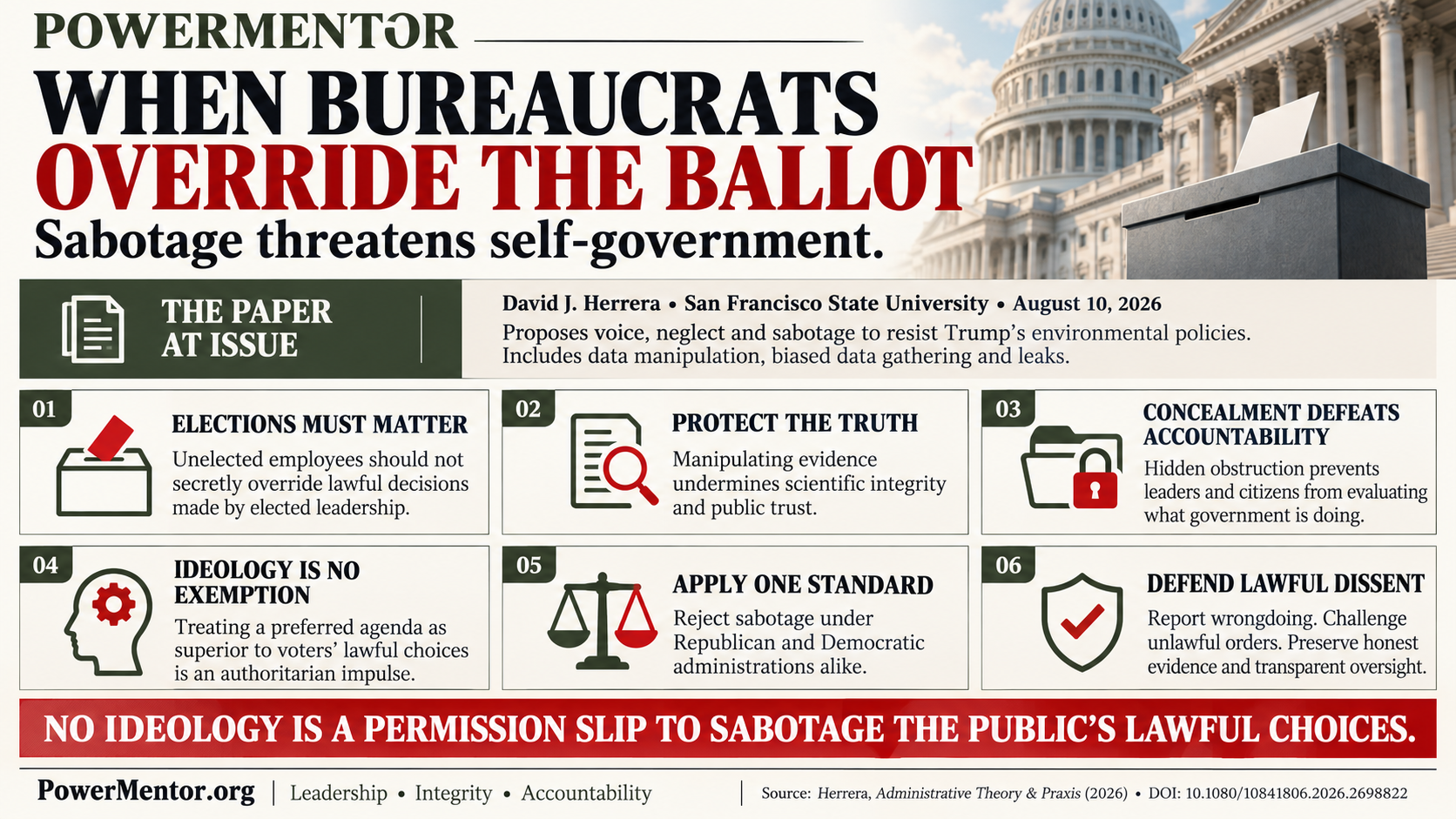
A paper by San Francisco State University assistant professor David J. Herrera brings this danger into focus. Published in Administrative Theory & Praxis, it proposes resistance to the Trump administration’s environmental policies through three approaches: voice, neglect, and sabotage. Its discussion includes manipulating data, biased data gathering, leaking information, and coordinating with outside organizations. The conclusion advises administrators to “disguise compliance issues when needed.”
PowerMentor rejects the idea that a preferred political outcome excuses deception, concealed obstruction, or compromised evidence.
The paper frames these methods as serving environmental justice and defending democracy. But that justification raises an unavoidable question: Who gave unelected employees the authority to decide that their preferred agenda should prevail over lawful decisions made by elected leadership?
Expertise deserves a hearing. It does not confer ownership of government.
The public must retain the power to change direction
A functioning republic requires more than holding elections. It requires institutions that respect their consequences.
When voters choose different leadership, they may also choose different priorities. Public employees can disagree with those priorities. They can identify risks, present evidence, challenge faulty reasoning, and report wrongdoing through appropriate channels.
Secretly frustrating lawful decisions is a different exercise of power. It allows insiders to make choices that the public cannot easily see, evaluate, or reverse.
Under that arrangement, elected leaders carry responsibility for results while hidden actors exercise influence without equivalent accountability. Citizens cannot meaningfully judge their government if they cannot determine whether a policy failed on its merits or because people responsible for implementing it deliberately undermined it.
Scientific integrity cannot depend on political convenience
The inclusion of data manipulation is especially troubling.
Evidence must remain trustworthy when it supports our position and when it challenges us. Once manipulating evidence becomes acceptable in pursuit of a cause, the cause becomes more important than the truth.
That is a dangerous standard for any public institution. In environmental protection and public health, it is particularly corrosive. Communities need accurate information to understand risks. Policymakers need reliable findings to weigh competing needs. Taxpayers need honest reporting to assess whether programs work.
A supposedly righteous objective cannot repair corrupted evidence.
The same principle applies to concealing noncompliance. Leaders cannot correct problems they are deliberately prevented from seeing. Oversight cannot function when employees disguise their actions to avoid scrutiny.
The authoritarian danger is ideological entitlement
There is an authoritarian impulse in the belief that one group possesses such superior moral insight that ordinary accountability should no longer constrain it.
That impulse resembles the ideological entitlement associated with totalitarian movements, including communist party rule: the conviction that those claiming to represent the people’s true interests may override the people’s actual choices.
This does not make every environmental advocate a communist, or every socialist a supporter of sabotage. The relevant danger is the governing method—placing ideological certainty above transparency, consent, and accountability.
When officials decide that elections are legitimate only when they produce acceptable policies, they weaken the very principle of self-government.
Calling that conduct a defense of democracy does not resolve the contradiction.
Apply the same standard when power changes hands
Would defenders of this approach accept employees secretly obstructing a Democratic administration’s environmental protections?
Would they accept manipulated findings, concealed noncompliance, or coordinated efforts to frustrate policies they support?
A sound ethical standard must survive a change in political leadership. If sabotage becomes admirable when it benefits our side and intolerable when it benefits the other, the standard is partisan advantage.
PowerMentor’s position is consistent: government employees should provide honest expertise, identify unlawful conduct, and remain accountable for how they exercise public authority.
Elected officials are also accountable. An election does not authorize unlawful orders, fabricated evidence, or disregard for constitutional limits. Courts, legislative oversight, and legitimate reporting mechanisms matter precisely because power must remain subject to review.
Those safeguards depend on truth and visible accountability. Secret ideological obstruction undermines both.
Leadership requires integrity when disagreement is strongest
The hardest test of professional integrity comes when an institution takes a lawful direction we personally oppose.
At that moment, leadership requires honesty about the disagreement, discipline in handling evidence, and accountability for our own choices. Declaring our intentions noble does not exempt our methods from examination.
Public service carries a responsibility to the public—including citizens who voted differently and want government to change.
The ballot must retain its meaning. Evidence must retain its integrity. And no ideology should become a permission slip to sabotage the public’s lawful choices.
