

JFK Warned Us: The Socialist Push Reshaping the Democratic Party
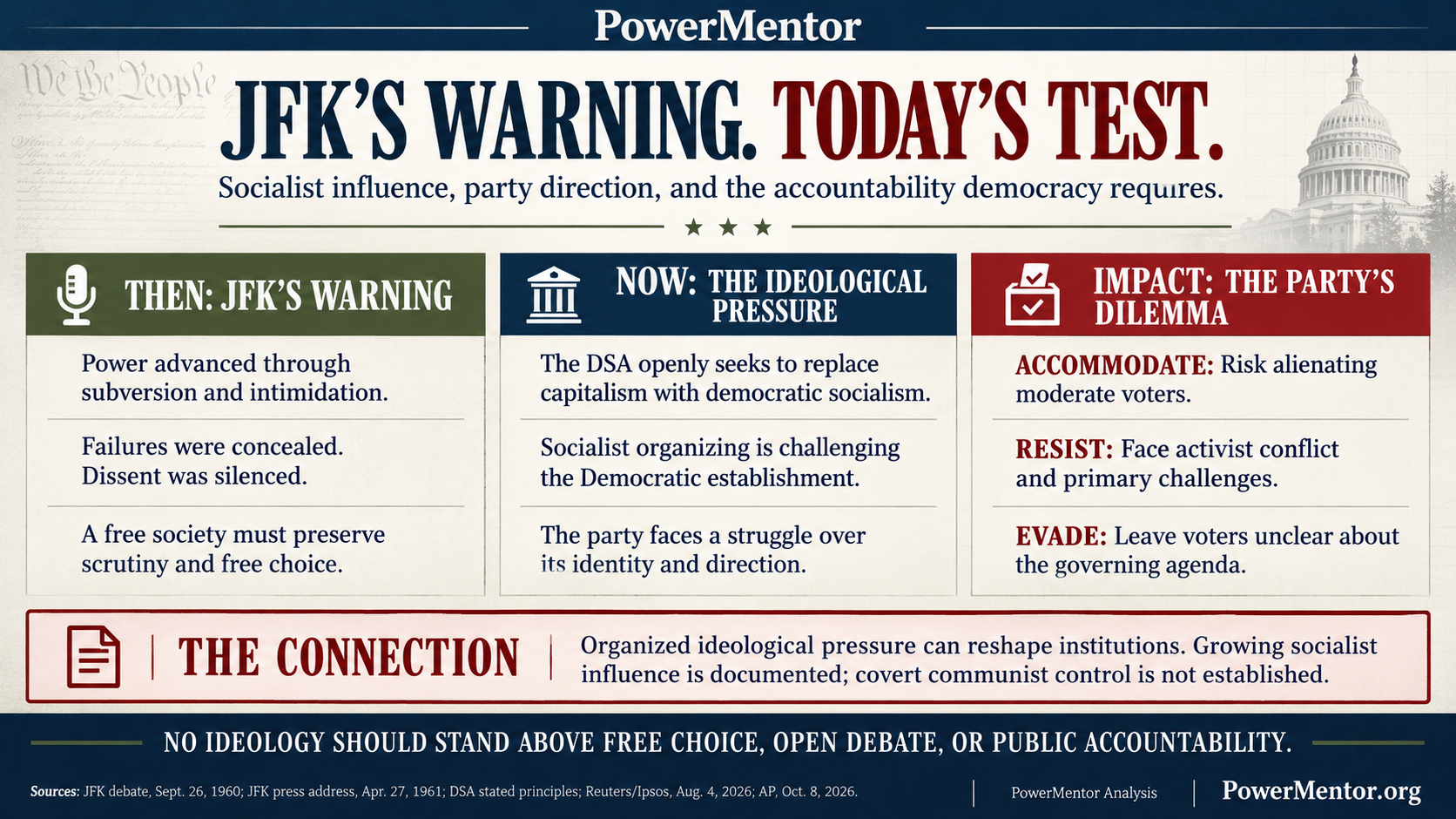
The connection with John F. Kennedy’s speech in 1961 warning about ideological movements gaining power through institutions, controlling information, and weakening free choice—and today an explicitly socialist movement is working to reshape the Democratic Party from within its electoral coalition. That connection deserves serious examination. The evidence supports a strong comparison that cannot be overlooked.
1. Kennedy took the internal ideological threat seriously.
In the opening exchange, Kennedy supported vigilance against communist subversion and enforcement of laws protecting the country. He did not dismiss the possibility that America could be weakened from within. He also stated that the principal threat was external and that only a strong American society could withstand internal threats. These remarks came from the September 1960 presidential debate.
The modern connection is that Americans should examine a movement’s actual objectives rather than assume that participation in familiar institutions makes those objectives harmless.
The Democratic Socialists of America (DSA) explicitly advocates replacing capitalism with socialism and collective ownership of major economic sectors. Concern about that agenda is grounded in what the organization says it wants to accomplish. It does not require speculation about hidden intentions.
2. The struggle over the Democratic Party’s direction is real.
Recent reporting describes expanded DSA organizing and electoral influence, together with opposition from moderate Democrats. Separately, Reuters/Ipsos documented a substantial increase in Democrats identifying as liberal, socialist, or leftist. These findings support the conclusion that the party faces pressure from an organized socialist movement within a broader leftward shift. With the additional funding streams for George Soros and others, this should be even more concerning.
This creates a disciplined faction: it can influence candidate selection, campaign priorities, and the boundaries of acceptable positions without first persuading the entire electorate to endorse its full program.
That is the strongest connection regarding the concern with the DSA “hijacking” the Democratic Party: a faction can acquire influence over a larger institution beyond its numerical size. The level of how far and fast this has happened should be shocking to all Americans.
3. Kennedy’s warning was especially concerned with the methods used to secure power.
His April 1961 speech described a system in which information was controlled, especially now we see this with the press, failures concealed, and dissent suppressed. He contrasted that system with the openness and accountability a democracy must preserve.
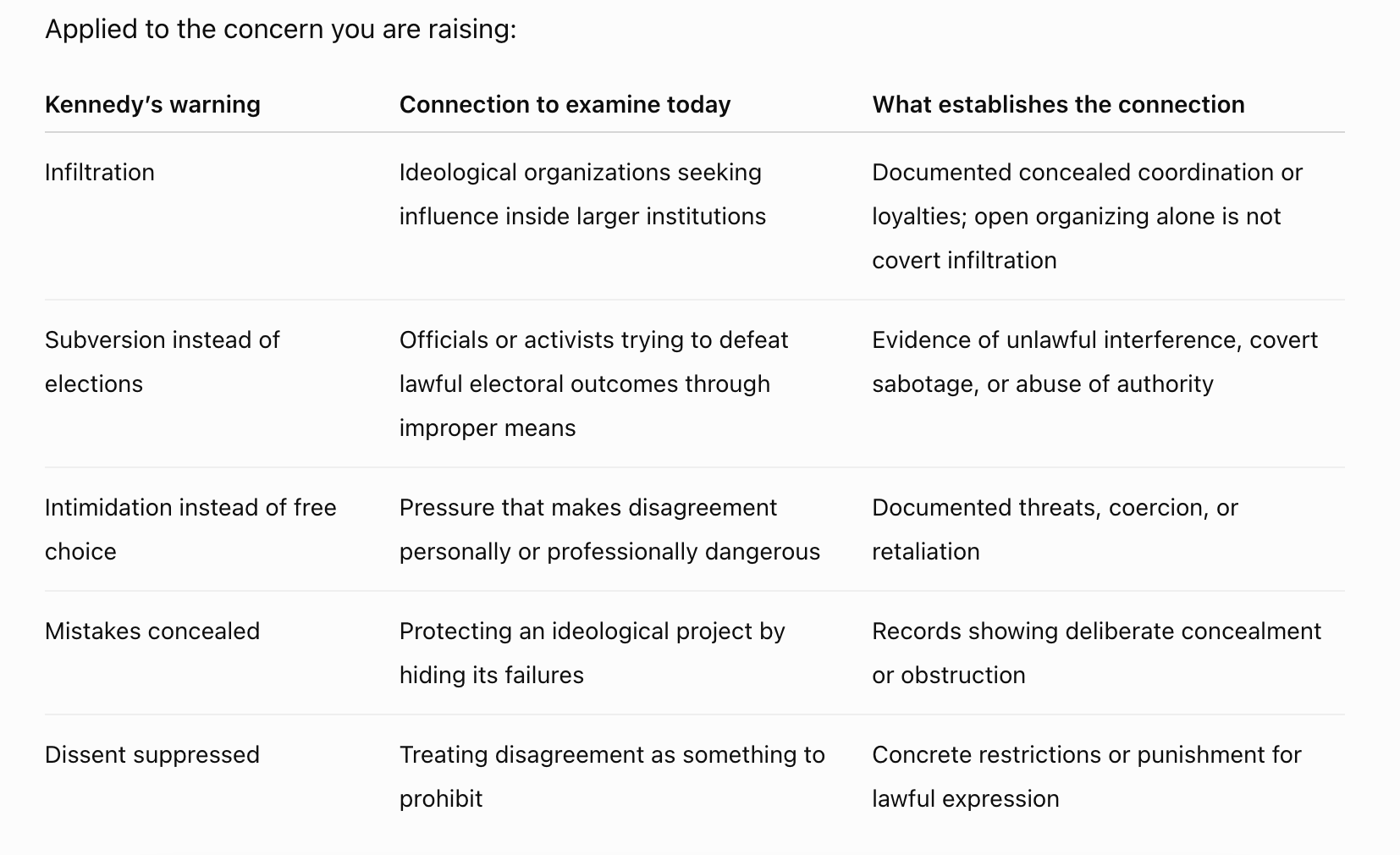
Where those behaviors occur, Kennedy’s warning has direct relevance—even when the people responsible describe their objectives as equality, justice, or protecting democracy. Benevolent language does not excuse coercive conduct.
The speech itself establishes historical concern for future officials or organizations potentially committing those types of acts.
4. The tension between Kennedy’s outlook and the socialist project is substantial.
Kennedy combined support for public programs with explicit opposition to communism. In the 1960 debate, he defended effective government action while rejecting the idea of turning everything over to government. His framework allowed reform within a society containing private enterprise and individual responsibility.
The DSA’s stated ambition to replace capitalism represents a different economic destination. The DSA proposals require serious scrutiny.
5. Kennedy’s defense of dissent makes the critique stronger.
He explicitly warned his own administration against using national security as a justification for censorship or concealing mistakes. His standard required those claiming to defend the country to remain accountable themselves.
Applied today, a movement cannot establish its democratic credentials merely by calling itself democratic. Its willingness to tolerate opposition, accept electoral defeat, disclose failures, and preserve independent institutions is the meaningful test.
What has come to fruition is the emergence of an organized socialist movement seeking—and gaining—political influence in a major American party, producing a consequential struggle over its direction. What we are now seeing in the Democratic Party for many indicates it is becoming the covert communist system Kennedy described.
Kennedy understood that freedom depends on more than holding elections. It depends on preventing any ideology from placing its objectives above free choice, open debate, and public accountability. The socialist movement’s growing influence makes those tests worth applying now, before further power is entrusted to it.
