

America Must Not Be Cornered Into War: Courage, Sovereignty, and the Leadership to Pursue Peace
Leadership carries a responsibility greater than protecting a political position or preserving an established system. It requires the courage to confront dangerous decisions, the discipline to consider their consequences, and the integrity to put human life ahead of institutional power.
When military escalation carries the potential for nuclear confrontation, those responsibilities become unavoidable.
The struggle surrounding Ukraine, British influence, and Donald Trump’s second term raises a fundamental question: Will America retain the freedom to determine its own course, or will escalating events pressure it into decisions made elsewhere?
At PowerMentor, our commitment to faith, family, freedom, and principled leadership gives that question moral weight. Families bear the consequences of war. Communities absorb its losses. Future generations inherit the decisions leaders make today.
No establishment’s desire to preserve influence should outweigh those responsibilities.
Responsibility requires looking beyond the headlines
Ukraine’s Operation Spiderweb brought drone attacks deep into Russian territory on June 1. Bombers and railway-related targets became part of a sequence of attacks that intensified an already dangerous confrontation.
Headlines centered on the damage. Responsible leadership must examine what follows.
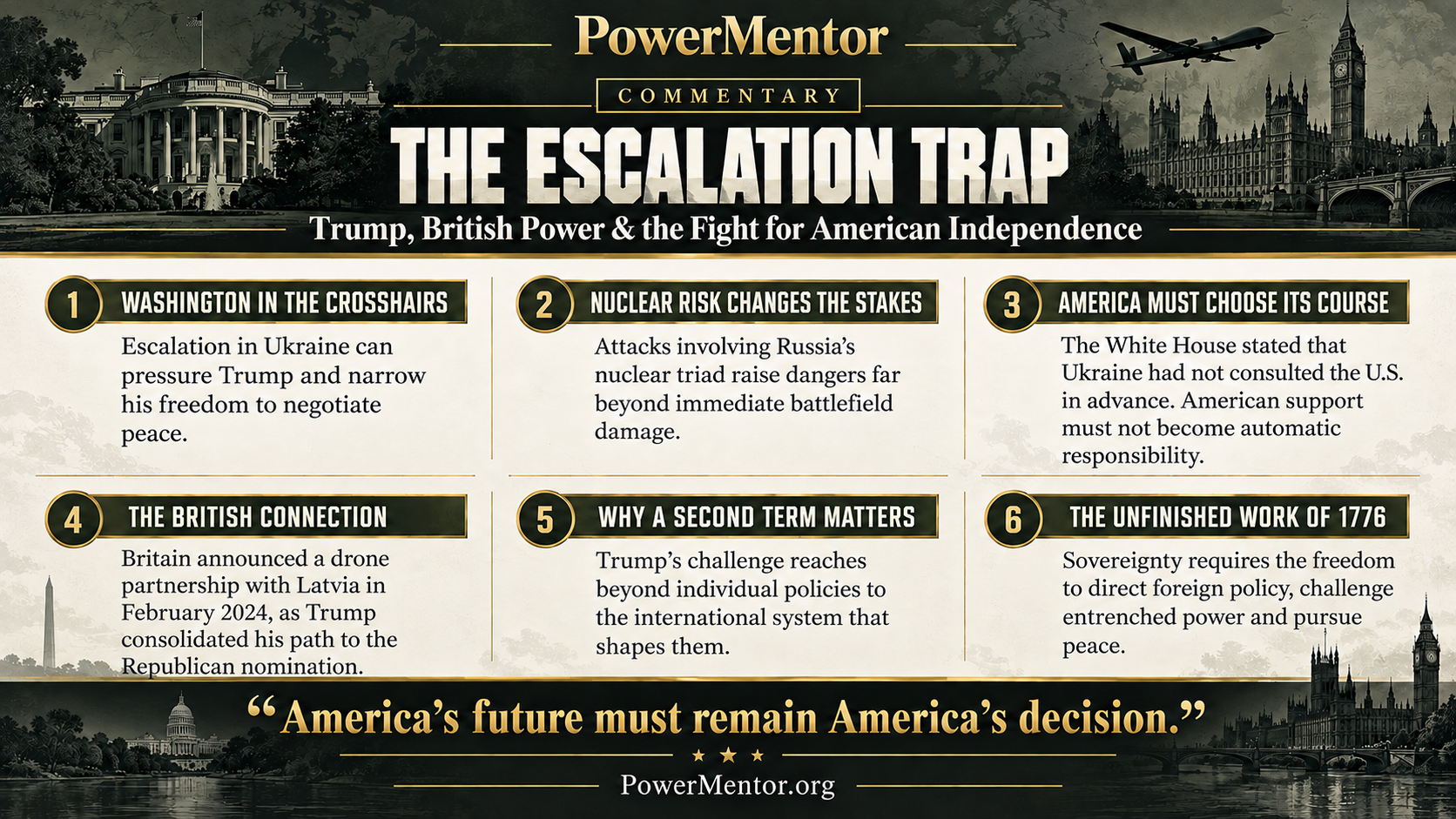
Attacks involving Russia’s nuclear triad introduce risks that extend beyond conventional battlefield calculations. The possibility of crossing a nuclear threshold demands serious judgment, regardless of the immediate tactical achievement.
A successful strike does not automatically produce a successful strategy. Leaders must consider whether an operation advances a political settlement or creates conditions that make one harder to reach.
Who bears the consequences if the response escalates? What happens to the opportunity for negotiations? Does the operation increase security, or increase pressure for a wider confrontation?
These are questions of accountability. Avoiding them does not demonstrate strength.
Washington is a political pressure point
The significance of these operations reaches directly into American decision-making.
Escalation can narrow a president’s options. It can increase demands for support, make restraint politically costly, and turn negotiations into a target for criticism before they begin.
That is the escalation trap.
If military operations seek to force Trump’s hand, then Washington becomes a political target even when the physical attacks occur inside Russia. The objective becomes influencing what the American president can do next.
PowerMentor’s principle of courage over fear applies here. A leader must be willing to withstand pressure, including pressure from partners, when the consequences demand independent judgment.
The president’s responsibility is to weigh America’s interests and the risks to human life. That responsibility cannot be delegated to those conducting operations without prior American consultation.
A relationship built on support must still contain boundaries.
The administration’s boundary matters
The White House publicly stated that Ukraine had not consulted the United States before the operation.
That distinction matters. Prior consultation, authorization, and responsibility are consequential parts of leadership. American support cannot automatically make Washington responsible for every decision another government makes.
The announcement that Defense Secretary Pete Hegseth would not attend the military aid coordination meeting involving 50 other foreign military leaders reinforced the administration’s distance. Because the United States created that group, its absence carried significance.
These actions support a necessary leadership principle: partnership does not require surrendering judgment.
Leaders who accept responsibility must retain the authority to make decisions. They must be able to question an operation, reject an escalation, or pursue negotiations without treating international expectations as binding instructions.
That is the practical meaning of sovereignty.
British influence and the struggle over direction
Britain’s February 2024 partnership with Latvia to expand first-person-view drone production and deliveries to Ukraine sits within this broader confrontation.
That initiative coincided with Trump consolidating his path to the Republican presidential nomination and with the planning period connected to Operation Spiderweb.
The political question is whether the capacity to escalate also creates the capacity to constrain an American administration determined to change direction.
That concern reaches back to the December 2018 House of Lords foreign-policy report and its defense of globalization, liberal democracy, and the rules-based international order. The warning surrounding a second Trump term reveals the depth of the conflict over that system’s future.
A president who challenges individual decisions creates policy disputes. A president committed to dismantling the arrangements behind those decisions threatens institutional continuity.
Trump’s second term therefore represents a more consequential challenge: the opportunity to turn resistance to an established order into lasting change.
PowerMentor’s commitment to independent judgment demands that institutions face scrutiny proportional to their influence. Longevity does not exempt them from accountability. Prestigious language does not place their decisions beyond examination.
Integrity requires examining who benefits
The broader imperial question concerns how power survives when its methods change.
Influence can operate through institutions, economic arrangements, and expectations about how governments should behave. Formal independence means little if a nation cannot exercise meaningful control over its choices.
That makes the relationship between American sovereignty and international pressure a legitimate subject of scrutiny.
Who benefits when negotiations become harder? Whose influence depends on preserving existing arrangements? Who assumes the risk when leaders choose escalation?
Those questions should apply consistently.
At PowerMentor, integrity over convenience means refusing to exempt powerful institutions from the standards expected of everyone else. Accountability must reach the people who shape decisions as well as those who carry them out.
It also requires disciplined reasoning. The strongest case rests on clear events, identifiable decisions, and a serious examination of consequences. Conviction carries greater weight when paired with precision.
Faith and family give leadership its moral purpose
Faith reminds us that political authority carries moral obligations. Human beings possess dignity that no strategic calculation should erase.
Family makes those obligations personal.
Behind every decision about war are parents, children, service members, and communities whose futures may change irreversibly. Their lives cannot become abstractions in a contest over international influence.
PowerMentor’s principle of service over status demands that leaders remember whom they serve.
Preserving an institution’s standing is never sufficient justification for exposing families to unnecessary danger. Protecting a political reputation cannot take priority over confronting the consequences of a decision.
Strength includes the ability to resist coercion. It also includes the discipline to pursue peace when the pressure to escalate becomes intense.
Negotiation requires courage when powerful interests oppose a change in direction.
The unfinished responsibility of 1776
American independence established a continuing obligation to defend self-government.
Each generation must preserve the freedom to determine the nation’s course. That includes foreign policy, economic direction, and the authority to challenge arrangements that no longer serve the republic.
The economic dimension of Trump’s challenge belongs within that larger struggle over who controls the system and whose interests it serves.
PowerMentor’s principle of mission over comfort applies directly. Meaningful change often requires confronting entrenched expectations and accepting the criticism that follows.
The mission is larger than securing approval from an international establishment. It includes defending constitutional freedom, protecting the nation’s ability to decide, and preserving the opportunity for peace.
Independence must remain something Americans can exercise.
The leadership this moment demands
PowerMentor stands for leaders who carry responsibility with courage, integrity, and purpose.
In this confrontation, those standards require the resolve to examine escalation, demand accountability, and defend the president’s freedom to negotiate. They require concern for the families who would bear the consequences of failure. They require independent judgment when institutional pressure becomes overwhelming.
Trump must retain the freedom to pursue peace and challenge an international system he was elected to change.
America should never be maneuvered into accepting a wider war as an unavoidable obligation.
The responsibility of leadership is to protect the freedom to choose before escalation takes that freedom away.
No institution’s influence is worth humanity’s future. America’s course must remain America’s decision.
