

POWERMENTOR APPLAUDS U.S. SANCTIONS AGAINST THE ICC: YEARS OF CORRUPTION CONCERNS, POLITICAL BIAS, AND FAILED ACCOUNTABILITY CAN NO LONGER BE IGNORED
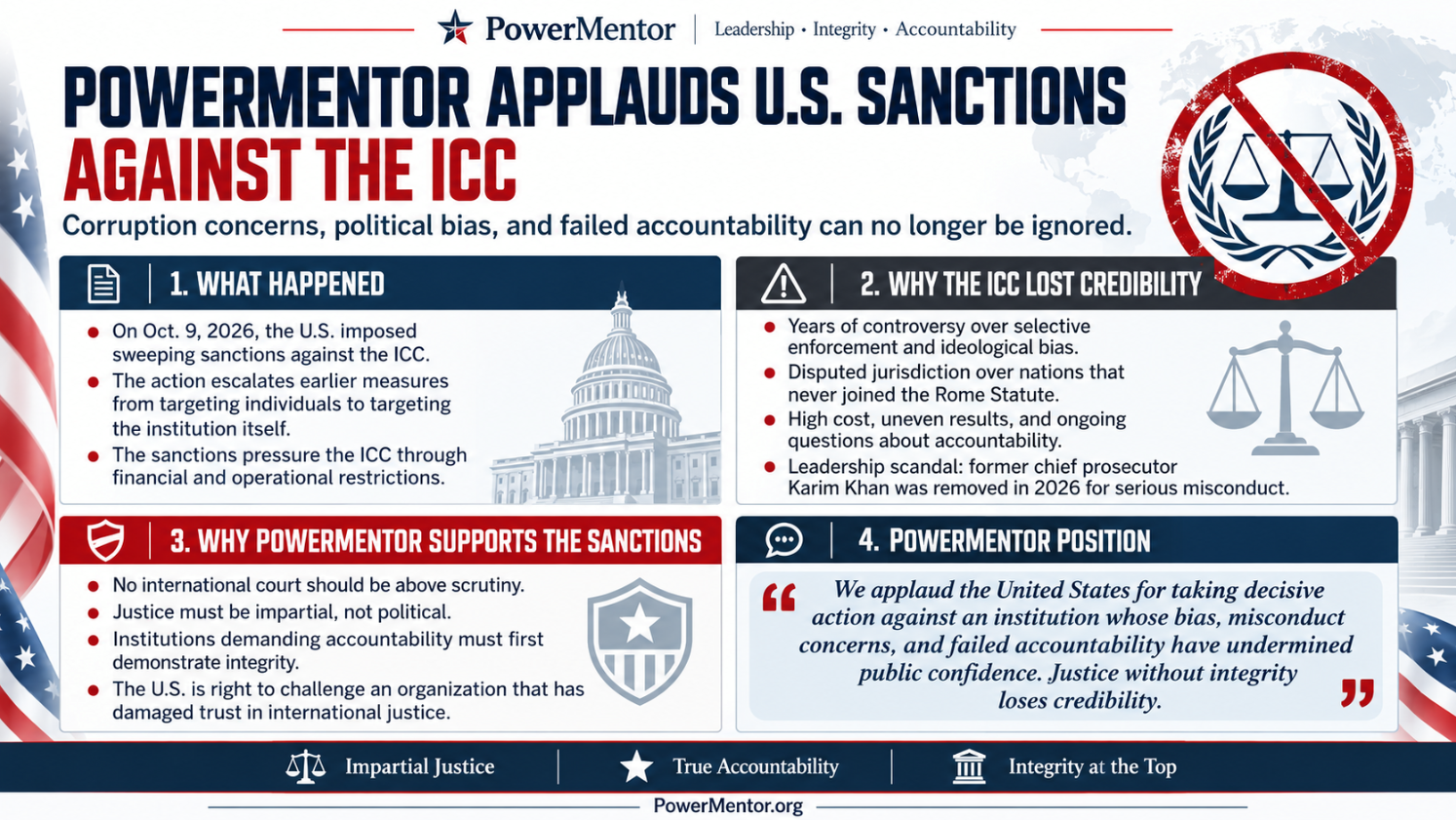
The Trump administration takes decisive action against an international court whose leadership scandals, selective enforcement, ideological controversies, and institutional failures have severely damaged public confidence in impartial justice.
An institution that demands accountability from the world must first demonstrate integrity within its own leadership. The International Criminal Court has given the world compelling reasons to question whether it has met that standard.
For years, PowerMentor has challenged the credibility of the International Criminal Court (ICC), raising concerns about political bias, ideological influence, inconsistent application of international law, questionable prosecutorial priorities, and institutional accountability.
Today, PowerMentor applauds the United States and the Trump administration for taking decisive action through sweeping sanctions against the ICC.
This is not simply about a disagreement over international law. It is about a powerful international institution that has repeatedly generated controversy while claiming the moral authority to judge governments, military personnel, and national leaders.
The ICC's history deserves examination, including its leadership misconduct, perceived selective enforcement, controversial jurisdictional decisions, and struggles to deliver meaningful results despite substantial financial resources.
The fundamental question is simple: Who holds the International Criminal Court accountable when the institution entrusted with pursuing justice becomes the subject of serious misconduct and integrity concerns?
The October 9, 2026, sanctions put that question at the center of an international confrontation.
A Court Claiming Moral Authority While Its Own Leadership Collapses
Perhaps no recent development better illustrates the ICC's internal accountability problems than the extraordinary removal of its chief prosecutor, Karim Khan.
On July 24, 2026, the ICC's Assembly of States Parties voted to remove Khan after finding that he had committed serious misconduct and a serious breach of duty.
The decision was supported by 82 member states.
The proceedings followed allegations of sexual misconduct involving a junior colleague, which Khan denied. His dismissal was an official disciplinary finding, not merely an accusation from the court's political opponents.
Consider the significance.
The chief prosecutor of an institution charged with investigating some of humanity's gravest crimes was removed by that institution's own governing body for serious misconduct.
This scandal was not simply an embarrassment. It exposed serious concerns about leadership integrity, workplace protections, internal oversight, and accountability at the highest levels of the court.
The governing assembly stated that these disciplinary findings did not concern Khan's handling of prosecutions. They therefore do not prove that particular cases were corrupt.
Nevertheless, the scandal illustrates why public confidence cannot rest solely on the ICC's repeated declarations of independence and integrity.
How can the ICC demand the highest ethical standards from the world's governments when its own chief prosecutor was removed for serious misconduct?
PowerMentor believes the United States is justified in demanding much greater institutional accountability.
Political Bias and Selective Justice: A Longstanding Pattern of Controversy
The ICC's credibility challenges did not begin with Karim Khan.
For years, critics have questioned whether the court applies international law consistently or allows political considerations to influence prosecutorial priorities.
During much of its early existence, the ICC concentrated its investigations on African nations.
African leaders questioned why their countries appeared to receive disproportionate scrutiny while powerful nations elsewhere faced fewer proceedings.
Some of those investigations originated from referrals by African governments themselves, and the ICC's jurisdictional limitations partly explain the pattern.
But those explanations did not eliminate concerns about inconsistent enforcement.
The Afghanistan investigation generated another controversy.
After examining alleged crimes involving the Taliban, ISIS affiliates, and American personnel, the ICC prosecutor announced in 2021 that investigations involving Taliban and ISIS-K conduct would receive priority.
The explanation involved limited resources and ongoing atrocities.
Still, the decision demonstrated the considerable discretion ICC prosecutors possess in determining which alleged perpetrators receive attention.
That discretion makes transparency essential.
When an international prosecutor can determine whose alleged crimes receive priority, the public deserves assurance that those decisions are based on evidence and consistent legal standards rather than political convenience.
PowerMentor's longstanding concern is that ideological influence and political narratives can shape international institutions in ways that undermine public trust.
That is why prosecutorial consistency should be demonstrated through transparent decisions, not accepted solely on institutional assurances.
The ICC's Actions Against Israel Further Exposed the Sovereignty Dispute
The ICC's November 2024 arrest warrants against Israeli Prime Minister Benjamin Netanyahu and former Defense Minister Yoav Gallant intensified international controversy.
The warrants alleged war crimes and crimes against humanity arising from the Gaza conflict. The ICC also pursued Hamas leaders over alleged crimes associated with the October 7, 2023, terrorist attacks.
Israel rejected the allegations and challenged the court's authority.
Neither Israel nor the United States has ratified the Rome Statute establishing the ICC.
The ICC nevertheless maintains that the treaty permits jurisdiction over certain crimes committed on the territory of states subject to its jurisdiction, regardless of the accused person's nationality.
That legal position remains central to the dispute.
But the controversy raises important questions about sovereignty, consent, the limits of international judicial power, and the treatment of countries that never joined the court.
The existence of an arrest warrant is not proof of guilt. Neither is disagreement with an arrest warrant, by itself, proof of judicial corruption.
What PowerMentor questions is whether the ICC has consistently demonstrated the independence, restraint, and impartiality necessary to exercise such consequential international authority.
Justice cannot become a mechanism through which international institutions advance disputed political agendas while expecting national governments to surrender legitimate questions about sovereignty and due process.
The United States has a longstanding responsibility to protect its constitutional institutions and lawful national interests.
PowerMentor applauds the administration for confronting these sovereignty concerns directly.
Financial Accountability and the Failure to Deliver Consistent Results
The ICC operates with an annual budget approaching €200 million.
Its operations encompass investigations, prosecutions, witness protection, administration, legal assistance, and judicial proceedings.
Despite these substantial resources, numerous ICC arrest warrants remain outstanding, and the institution continues to face serious enforcement limitations.
Unlike national governments, the court has no independent police force. It relies on cooperation from member states to apprehend suspects.
This creates genuine operational constraints.
However, substantial budgets and complex missions should never eliminate the obligation to demonstrate results.
The court has also experienced major prosecutorial setbacks.
Proceedings involving Kenya's post-election violence, for example, were undermined by witness interference and evidentiary difficulties. Charges against prominent defendants were ultimately vacated or withdrawn.
The problems revealed weaknesses in the court's ability to protect investigations and sustain complex prosecutions.
Although these failures do not establish financial embezzlement or bribery, they underscore broader questions about governance, performance, resource management, and institutional effectiveness.
The world should not be expected to fund an international institution indefinitely without rigorous scrutiny of how it uses its authority, resources, and public trust.
PowerMentor believes financial transparency, independent auditing, stronger oversight, and measurable outcomes should be nonnegotiable requirements for international institutions.
Corruption Is Not Limited to Financial Theft
When discussing institutional corruption, many people immediately think of bribery, embezzlement, or the misuse of funds.
But concerns about institutional integrity can extend beyond financial misconduct.
An organization can suffer serious failures when its leadership abuses authority, when internal accountability mechanisms are ineffective, when decisions lack transparency, or when political considerations threaten impartial judgment.
The ICC's leadership scandal is an established example of serious individual misconduct.
Its controversial prosecution priorities and jurisdictional decisions raise different questions about institutional independence and consistency.
These distinctions matter. Allegations that the ICC systematically manipulates cases for ideological purposes require evidence; the documented misconduct findings do not, by themselves, establish such a scheme.
Nevertheless, PowerMentor believes these concerns collectively justify an independent, comprehensive examination of the institution.
An international court should welcome scrutiny rather than treat every challenge to its authority as an attack on justice.
The greater the power an institution claims, the greater its responsibility to demonstrate integrity.
U.S. Sanctions: A Decisive Response to Years of ICC Controversy
Against this backdrop, the Trump administration's October 9 sanctions represent a significant escalation.
Previous American measures largely targeted individual ICC officials.
The new sanctions target the ICC as an institution, restricting its access to U.S.-linked assets, financial transactions, and commercial relationships. American entities have been granted a six-month period to wind down covered activities.
Secretary of State Marco Rubio announced the measures as part of the administration's efforts to challenge what it considers the ICC's illegitimate assertion of jurisdiction and politicized conduct.
The ICC responded by condemning the sanctions, arguing that they threaten judicial independence and the pursuit of accountability for serious international crimes.
That objection should be acknowledged: disruption of court operations can affect investigations involving victims who have no involvement in disputes between Washington and The Hague.
But PowerMentor believes the administration's decision has brought overdue attention to questions the ICC must answer about its governance, institutional integrity, and exercise of authority.
We applaud the United States for using its lawful economic and diplomatic authority to challenge an institution that, in our assessment, has failed to adequately address longstanding concerns about its impartiality and accountability.
Sanctions alone cannot establish whether the ICC acted improperly in any particular case. Their effectiveness should be measured by whether they produce meaningful reforms and stronger safeguards.
The larger principle remains important: International organizations should not assume they are exempt from oversight simply because they operate across national borders.
An International Court Must Never Become an Ideological Institution
PowerMentor has consistently maintained that ideology has no legitimate place in the administration of justice.
International courts should not favor countries because of their political relationships.
They should not change their standards based on public sentiment, international pressure, or ideological preferences.
They should not allow personal beliefs to displace evidentiary standards.
And they should never confuse political advocacy with judicial independence.
Those principles apply equally to governments that support the ICC and governments that oppose it.
If the ICC wishes to restore confidence among its critics, it must demonstrate the consistency, transparency, and independence that its mission requires.
That includes independent oversight of senior officials, clear prosecutorial standards, public financial accountability, respect for legal jurisdictional boundaries, and credible mechanisms to prevent improper political interference.
The ICC cannot credibly demand accountability from others while treating its own institutional shortcomings as secondary concerns.
PowerMentor Applauds the United States for Demanding Accountability
PowerMentor supports the pursuit of justice for victims of genocide, war crimes, crimes against humanity, and other grave atrocities.
But justice cannot exist without integrity.
We have long questioned whether the ICC has faithfully upheld the principles of impartiality, consistency, and accountability upon which its legitimacy depends.
The removal of its chief prosecutor for serious misconduct, its record of controversial prosecutorial priorities, recurring sovereignty disputes, and continuing enforcement challenges reinforce our concerns.
These problems demand serious examination, not automatic institutional deference.
That is why PowerMentor applauds the Trump administration's October 9, 2026, sanctions against the International Criminal Court.
We view this action as a forceful challenge to an institution whose leadership failures and contested exercise of authority have damaged confidence in its mission.
We also recognize that genuine accountability requires evidence, due process, and consistent standards—including when evaluating the ICC itself.
The objective should never be to shield actual perpetrators of atrocities from justice. It should be to ensure that international justice is pursued by institutions worthy of the authority entrusted to them.
No court should be above accountability. No prosecutor should be beyond ethical scrutiny. No international institution should be immune from questions about political bias or abuse of authority.
And no institution should claim to stand for justice while failing to confront serious problems within its own leadership.
Justice without integrity loses credibility. Authority without accountability invites abuse. And political ideology must never replace the impartial rule of law.
PowerMentor applauds decisive American action to demand accountability from the ICC.
The pursuit of justice is too important to entrust to any institution unwilling to demonstrate the standards it demands from the rest of the world.
