

Venezuela’s Shockwave: The Domino Effect That Could Rattle Cuba—and Rewire the Iran–Russia–China Axis
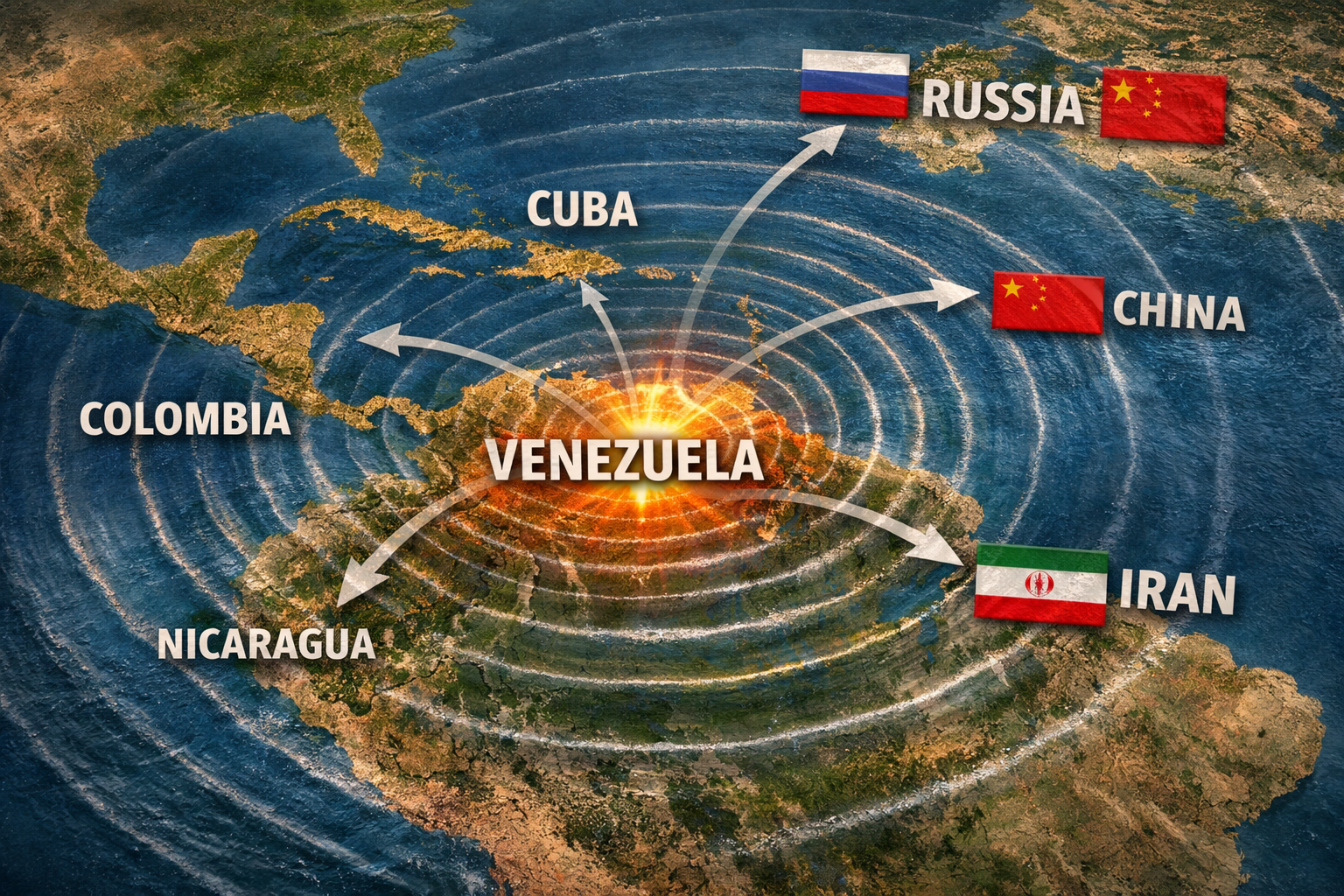
On January 3, 2026, the United States launched a raid in Caracas—part of an operation publicly described as “Operation Resolve”—and captured Venezuelan leader Nicolás Maduro and his wife, moving them into U.S. custody. That single event has already triggered rapid aftershocks inside Venezuela, across the Caribbean, and among the extra-hemispheric powers that treated Caracas as a strategic foothold.
What happens next isn’t just a Venezuelan transition story. It is a regional stress test—and potentially a global one.
1) Why Venezuela is the keystone domino
For years, Venezuela functioned as more than a troubled petrostate. It became an operational hub where aligned governments could trade oil, move money, share intelligence methods, and test how far influence could reach inside the Americas.
The capture of Maduro doesn’t automatically produce stable democracy or immediate economic recovery. But it does disrupt the architecture that made Venezuela useful to other regimes—especially those that benefited from sanctions-dodging networks, security cooperation, and politically protected oil flows.
2) The Cuba domino: oil, electricity, and political survival
The most immediate regional domino is Cuba, which has long depended on Venezuelan energy support. Multiple analyses now describe Havana as acutely exposed if Venezuelan oil arrangements are interrupted or restructured under new power realities.
Cuba is already in an extraordinary internal crisis—marked by collapsing services and a historic wave of emigration—meaning it has far less shock-absorption capacity than in prior decades.
If Venezuelan oil flows tighten, the effect in Cuba is not abstract:
less fuel for power generation → more blackouts
less diesel for transport → distribution breakdowns
less hard currency flexibility → fewer imports
more public pressure → more coercion or more concessions
That’s why several outlets are openly discussing Cuba as “next” in line for destabilization—not because of symbolism, but because of energy math and regime finance.
3) Columbia’s Sudden Calibration
Colombia’s response to the Venezuela shockwave has been just as revealing. President Gustavo Petro initially struck a defiant tone toward President Trump, publicly signaling that Colombia would not align itself with U.S. pressure on Caracas and would pursue an independent regional path. Yet within a remarkably short period of time after Maduro’s removal and the rapid escalation of U.S. influence in the hemisphere, that posture changed. Petro shifted from confrontation to conciliation, quietly opening channels to Washington and repositioning Colombia as a cooperative partner rather than a resistant one. The speed of this pivot underscores how powerful the Venezuela domino truly is—regional leaders are recalculating their survival strategies in real time as the balance of power visibly tilts back toward U.S. dominance in the Americas.
4) Nicaragua and other aligned governments: “survival mode” gets harsher
The Venezuela event also changes the risk calculus for governments that have leaned on the same political playbook and the same external patrons. Regional outlook work has already framed Cuba and Nicaragua as operating in “survival mode,” especially under heightened U.S. attention.
Here’s the domino logic:
Venezuela’s old model (oil money + security apparatus + foreign backing) becomes less reliable
neighboring regimes must tighten internally or seek new external lifelines
both options raise volatility: tighter control fuels dissent; new lifelines invite backlash and sanctions exposure
5) China: credibility hit in the hemisphere—and a strategic warning shot
One of the clearest signals from the U.S. operation was directed at China’s regional footprint. Reuters reporting frames the raid as partly intended to show that Beijing’s influence and investments in Latin America do not equal real protection when the U.S. decides to act decisively.
That matters because China’s approach in the region has not been primarily ideological; it’s been strategic-economic:
energy infrastructure ties
port and logistics interests
technology and satellite cooperation
financing relationships
If regional elites conclude that China can fund projects but can’t shield partners in a crisis, Beijing’s deterrence-by-association weakens—even if its economic presence remains.
6) Russia: prestige, leverage, and the cost of “far-field influence”
Russia has used relationships like Venezuela to demonstrate it can project influence close to U.S. shores. But the Maduro capture spotlights a hard limitation: distance and escalation risk constrain Moscow’s ability to respond meaningfully in the Americas.
Public reporting before the raid indicated Venezuela sought additional Russian support as U.S. pressure mounted. The fact that the operation still succeeded is being interpreted by many analysts as a prestige wound—and a reminder that Russia’s best tools here are asymmetric: information operations, covert facilitation, and political disruption—not direct defense.
At the same time, any major reshaping of Venezuelan oil production and flows could create knock-on effects for global crude markets that interact with Russia’s export position—potentially squeezing leverage in some scenarios while creating opportunities in others depending on timing and constraints.
7) Iran: networks, sanctions evasion, and the “distance problem”
Iran’s strategic interest in Venezuela has historically been less about the Western Hemisphere for its own sake and more about:
sanctions workarounds
dispersed partnerships
symbolic resistance to U.S. dominance
and (according to multiple analyses) access to logistics and influence channels far from the Middle East
If Venezuela’s internal order shifts, Iran risks losing an enabling environment where friendly state structures can help move resources discreetly. And like Russia, Iran faces the “distance problem”: it cannot protect a partner in the Americas the way it can build pressure networks in its near abroad.
8) Inside Venezuela: instability is still the main accelerant
Even with Maduro in U.S. custody, Venezuela remains internally fragile. Recent reporting describes prisoner releases amid upheaval, ongoing security concerns, and a tense environment where militias and armed actors are still relevant.
That’s the key point for the “domino effect” thesis:
Dominoes fall fastest when the center is unstable.
If Venezuela enters a messy, contested transition, it can export instability (migration pressure, illicit networks, criminal spillover). If it stabilizes and reopens economically, it can export something else: proof that the old model failed—which is politically dangerous for neighboring authoritarian systems.
The bottom line
Venezuela’s rupture is already functioning as a strategic earthquake:
Cuba is the most immediately vulnerable domino because energy dependence collides with an already severe internal crisis.
Nicaragua and aligned governments face a harsher survival environment with fewer reliable backstops.
China, Russia, and Iran each take a different kind of hit—credibility, reach, and network durability—while also looking for ways to adapt without escalating into direct confrontation.
If Venezuela becomes the first domino, the next question is not whether others feel it—they already are—but whether the shock produces collapse, crackdown, or recalibration across the region and beyond.
References
Al Jazeera. (2026, January 9). Petro says Colombia cooperating with US “despite insults, threats”.
Al Jazeera. (2025, December 11). ‘He’ll be next’: Donald Trump threatens Colombian President Gustavo Petro.
Associated Press. (2026, January 10). Trump signs executive order meant to protect the money from Venezuelan oil.
CBS News. (2026, January 9). Colombian president says Venezuela “will implode” if U.S. oversees it for years.
Politico. (2025, December 10). ‘He’s going to be next’: Trump threatens Colombian president.
Reuters. (2026, January 3). Mock house, CIA source and Special Forces: The US operation to capture Maduro.
Reuters. (2026, January 11). With Venezuela raid, US tells China to keep away from the Americas.
Reuters. (2026, January 11). Cuba defiant after Trump says island to receive no more Venezuelan oil or money.
