

The Silent Strike: How a High-Tech Operation in Venezuela Changed Modern Warfare
A Raid That Shook the World
On January 3, 2026, an unprecedented United States military operation unfolded in the heart of Caracas, Venezuela. In a predawn raid code-named Operation Absolute Resolve, U.S. forces captured Venezuelan President Nicolás Maduro and his wife Cilia Flores, flying them to New York to face federal charges in U.S. courts. The action stunned global audiences and marked one of the boldest uses of U.S. special operations since the post-9/11 era.
The raid involved elite U.S. units, including Delta Force and other Special Operations forces, backed by months of intelligence, drone surveillance, and a coordinated air and ground assault. Although U.S. officials described the mission as a decisive blow against narcotics trafficking and authoritarian rule, the scale and technology displayed have ignited intense debate worldwide.
Beyond Bullets: Claims of Sci-Fi-Like Directed-Energy Use
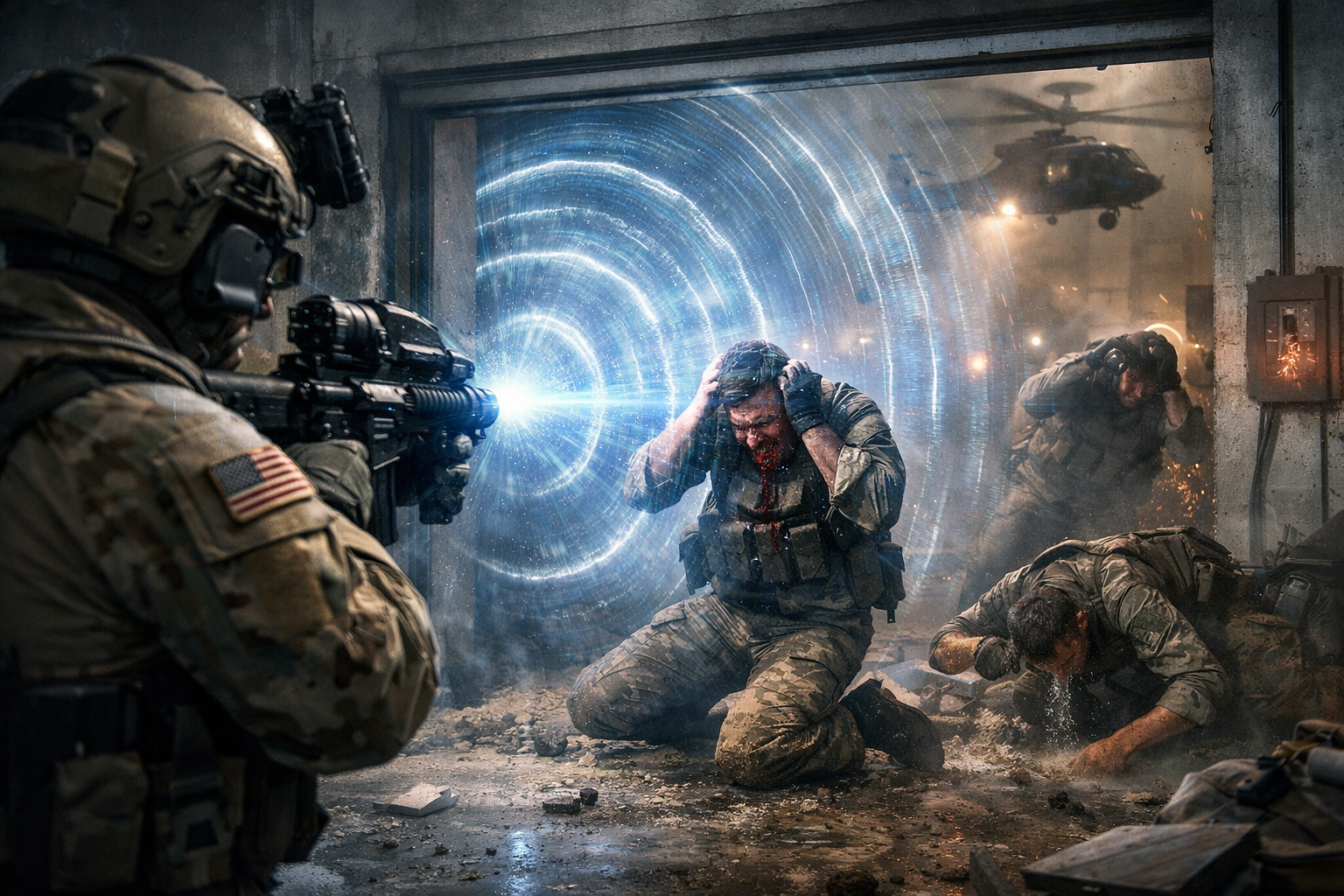
Amid official accounts of precision strikes and helicopter insertions, witness reports and some media outlets have claimed that the operation employed high-tech directed energy or sonic devices to incapacitate Venezuelan defenders before traditional engagement began. According to these unverified accounts, defenders were left disoriented, collapsing with nosebleeds and vomiting, unable to resist—a result described as “bringing soldiers to their knees” with what sounded like a mystery energy weapon.
A Venezuelan guard quoted in these accounts suggested that radar systems shut down and that small swarms of drones and a few helicopters overwhelmed hundreds of personnel. He described the unforeseen technology as the reason resistance collapsed so quickly, emphasizing that the attackers suffered no casualties.
While these claims have circulated in the press, U.S. officials have not confirmed the use of any sonic or directed-energy weapon in the operation. Independent verification remains limited, and analysts caution that such reports may blend rumor with real but classified capabilities.
The Strategic Impact: Rapid Victory, Lingering Controversy
The operation succeeded quickly and at comparatively low cost to U.S. forces, but the toll was significant on the ground:
Venezuelan and allied security forces suffered dozens of reported fatalities, including members of Cuba’s military contingent who had been protecting Maduro.
Multiple Venezuelan security officers and civilians were killed during the assault, according to local and international reporting.
The raid triggered domestic backlash and geopolitical reverberations, with pro-Maduro militias (colectivos) mobilizing across Caracas, creating a volatile security environment.
Internationally, the intervention sparked a firestorm of debate over sovereignty, international law, and U.S. military authority, with critics labeling the mission a violation of international norms, while the U.S. government defended it as a necessary act against narco-terrorism.
The Tech Angle: Reality vs. Speculation
The idea of non-kinetic weapons—such as directed-energy systems (lasers, microwaves, acoustic devices)—is not science fiction. Militaries around the world have invested in Directed Energy Weapons (DEWs) for decades. These technologies can disrupt electronics, dazzle sensors, or emit powerful sound waves, and are often discussed in defense circles as the next frontier in warfare. However, publicly acknowledged operational use of such systems in a raid of this nature remains unconfirmed.
Claims of sonic waves causing immediate whole-body incapacitation echo speculative narratives around acoustic weapons—systems like LRAD (Long Range Acoustic Devices) that can cause discomfort and disorientation at shorter ranges, but which have no verified track record of causing systemic bodily collapse at scale during combat operations.
In expert analyses, acoustic and directed energy systems are acknowledged as real but often limited in practical battlefield effectiveness compared to traditional weapons, especially in open engagements involving trained combatants.
The Broader Geopolitical Ripples
The raid has sent shockwaves far beyond Venezuela’s borders:
Global powers are reassessing their strategic calculations. For example, analysts have discussed how the operation could influence Chinese and Russian regional strategies, especially in areas where the U.S. might project similar force.
International law scholars and governments have criticized the legal basis for unilateral military action without U.N. authorization.
Inside Venezuela, the power vacuum has spurred armed groups to assert control, raising fears of prolonged instability.
What This Means for the Future of Conflict
Whether or not futuristic weapons played a role, Operation Absolute Resolve highlights several trends shaping 21st-century warfare:
Highly trained special operations forces remain a potent tool for rapid decapitation missions.
Intelligence dominance, including signal disruption and aerial surveillance, can tilt engagements before kinetic action begins.
Geopolitical confrontation increasingly blends military precision, technological speculation, and media narratives in shaping public perception.
This raid will likely be studied for years—not just for its geopolitical implications, but for what it reveals about the evolving interface between technology and force projection in modern conflict.
