

VA Disability Is Exploding: Compassion for Veterans Must Coexist With Accountability
When the Numbers Change This Dramatically, We Should Ask Why!
America has a moral obligation to care for the men and women who were injured, became ill, or suffered lasting psychological harm while defending this country. Veterans who legitimately sacrificed their health in military service should receive the benefits they earned—without unnecessary bureaucracy, delay, or suspicion.
But honoring veterans does not require us to stop asking difficult questions.
The extraordinary growth in VA disability compensation—particularly the explosion in veterans receiving 100% disability ratings—has reached a level that deserves serious independent investigation.
The issue is not whether fraud exists. We know fraud occurs in federal benefit programs. The more important question is whether the dramatic growth we're witnessing can be adequately explained by legitimate changes in health, eligibility, demographics, legislation, and improved recognition of service-connected conditions—or whether incentives, weak controls, exaggeration, improper claims, or fraud are contributing to the increase.
A statistical trend is not proof of fraud. But an extraordinary statistical trend can be a warning signal that deserves investigation.
From Roughly 1 in 7 Veterans to More Than 1 in 3
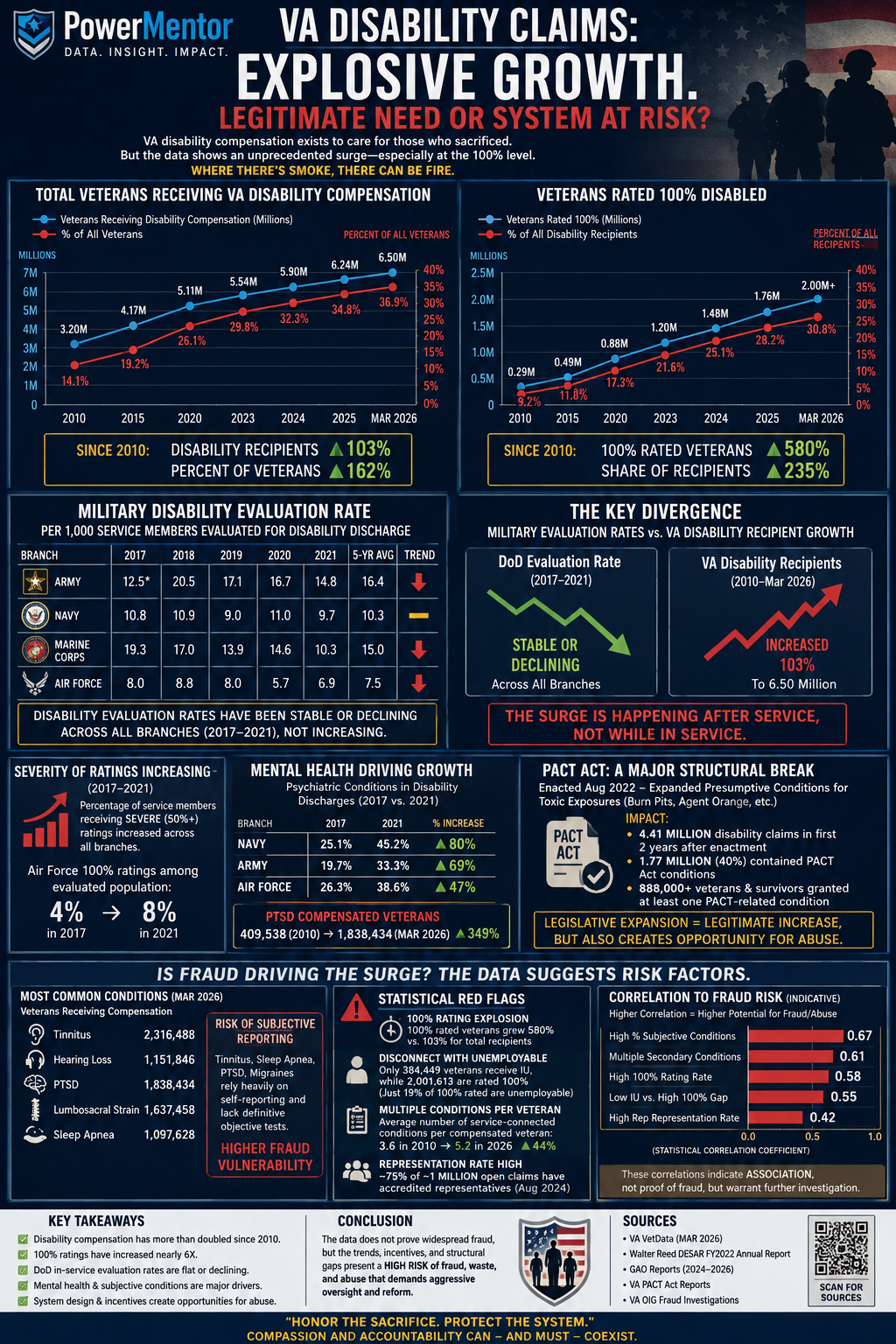
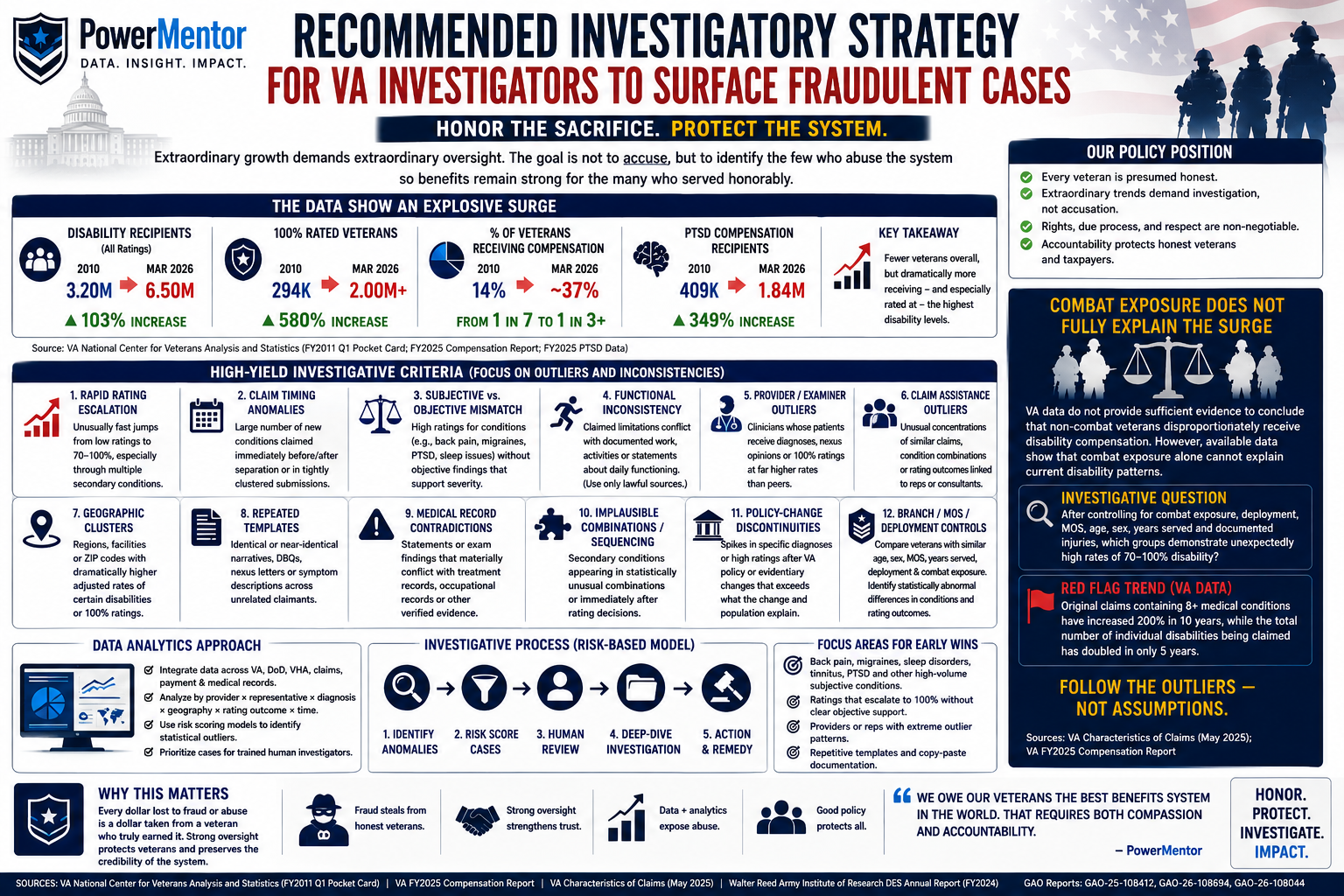
Around 2010, approximately 3.2 million veterans were receiving VA disability compensation, representing roughly 14% of the veteran population.
By March 2026, the number had reached approximately 6.5 million.
That represents an increase of roughly 103% in disability recipients while the overall American veteran population was declining.
The prevalence increase is even more significant. The percentage of veterans receiving disability compensation appears to have climbed from approximately 14% in 2010 to roughly 37% by early 2026.
This means America has moved from approximately one disability-compensated veteran for every seven veterans to more than one for every three.
That does not establish wrongdoing.
It does establish that something fundamental has changed.
And policymakers should determine precisely what that something is.
The 100% Disability Numbers Demand Even Greater Scrutiny
The most striking trend involves veterans carrying a 100% VA disability rating.
In 2010, approximately 294,000 veterans were rated 100% disabled.
By March 2026, the number had surpassed 2 million.
That is an increase approaching 580% in only sixteen years.
The increase becomes even more remarkable when considered against the shrinking veteran population. The veteran population fell from approximately 22.7 million around 2010 to roughly 17.6 million in early 2026.
Yet during essentially the same period, the population rated 100% disabled increased almost sevenfold.
The country therefore has fewer veterans overall but dramatically more veterans carrying the highest VA disability rating.
Again, correlation does not establish fraud. Legislative changes, aging veterans, accumulated conditions, PTSD recognition, toxic exposures, improved diagnosis, expanded presumptive conditions and the PACT Act unquestionably explain part of the increase.
But a nearly 580% increase in the highest disability rating is sufficiently extraordinary that simply accepting it without rigorous analysis would be irresponsible.
The Most Interesting Clue: What Happened Inside the Military
One of the strongest reasons for further investigation comes from comparing VA trends with military disability evaluation trends.
Walter Reed data examining service members evaluated for disability discharge between 2017 and 2021 show something unexpected.
The disability evaluation rate was generally stable or declining across the services, rather than exploding upward.
Army evaluations declined after their 2018 peak. Marine Corps disability evaluation rates fell substantially. Air Force rates declined. Navy remained comparatively stable.
That creates an important divergence:
The military was not experiencing anything resembling the enormous increase in disability evaluations that later appeared in the VA compensation population.
The explosive growth is occurring primarily in the post-service compensation environment.
That distinction matters.
If military disability evaluations were increasing at approximately the same rate as VA disability compensation, worsening injuries or medical conditions within the active-duty population would provide a straightforward explanation.
But that isn't what the available data show.
When one measurement remains relatively stable while a related downstream measurement accelerates dramatically, researchers should investigate the mechanisms producing the divergence.
This Is a Red Flag—Not a Verdict
Statistics cannot tell us that an individual veteran is lying.
They can, however, identify populations and processes deserving closer examination.
Imagine an insurance company discovering that claims had doubled while its insured population was declining—and that claims at the maximum payout level had increased almost sevenfold.
No competent actuary, auditor or fraud investigator would immediately conclude that fraud had occurred.
But neither would they say:
"Nothing to see here."
They would investigate.
They would examine changes in eligibility.
They would study diagnostic patterns.
They would identify geographic clusters.
They would examine physicians and evaluators producing unusually high ratings.
They would analyze conditions dependent heavily upon subjective reporting.
They would compare service branches, occupations, deployments and years of service.
They would examine organizations assisting applicants.
And they would search for statistically unusual concentrations of claims.
That is exactly the kind of data-driven program-integrity analysis the VA disability system deserves.
There Are Powerful Financial Incentives
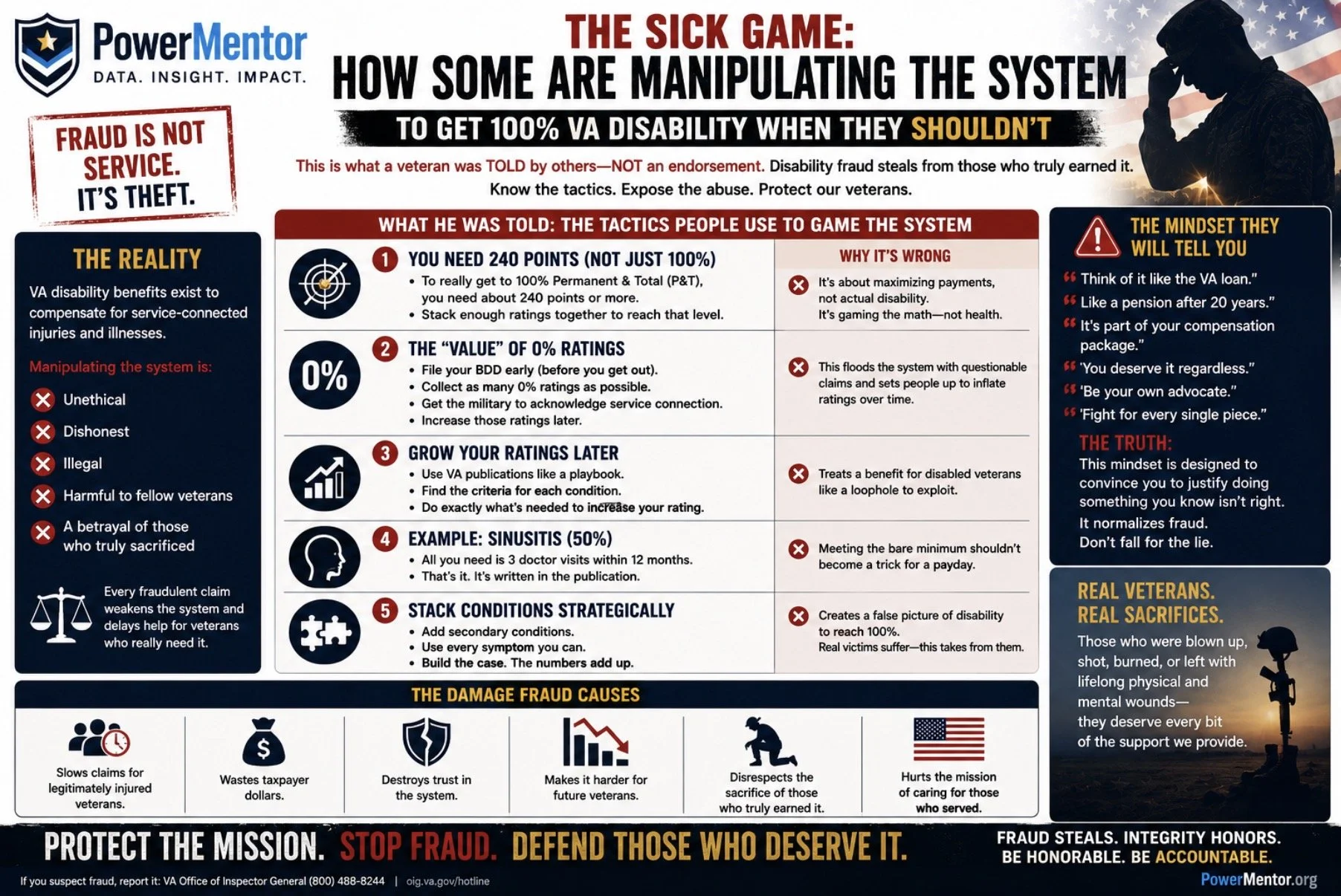
The financial difference between disability ratings can be substantial.
Under the 2026 VA compensation schedule, a veteran without dependents receives approximately $180 per month at 10% disability. Compensation rises dramatically as the rating increases, with additional compensation potentially available depending upon rating and dependent status.
That creates a basic economic reality:
Higher ratings produce substantially higher lifetime financial benefits.
Acknowledging that incentive is not disrespectful to veterans. Incentives exist in virtually every compensation, insurance and government-benefit system.
Good public policy recognizes incentives and designs controls around them.
The overwhelming majority of veterans may act completely honestly while a relatively small percentage exploiting a very large system can still produce enormous taxpayer losses.
That is why verification matters.
Subjective Conditions Deserve Particular Attention
Another important research question concerns the extent to which rapidly growing disability categories can be independently and objectively verified.
A broken bone can be demonstrated radiographically. Significant hearing loss can be measured. Certain neurological injuries can be objectively documented.
Other conditions necessarily depend much more heavily upon symptoms reported by the patient.
That does not mean conditions such as PTSD, migraines, chronic pain or other symptom-based disorders aren't real. They unquestionably are.
It means the verification challenge is different.
Whenever substantial financial benefits depend partly upon subjective symptoms, a well-designed system needs safeguards capable of distinguishing genuine disability from exaggeration or fabrication without unfairly burdening legitimate claimants.
That protects veterans as much as taxpayers.
The PACT Act Explains Part of the Increase—And That's Important
Any credible analysis must acknowledge another enormous change.
The PACT Act of 2022 deliberately expanded eligibility for veterans exposed to burn pits, Agent Orange and other toxic substances.
Congress established additional presumptive service connections, making it easier for many veterans to demonstrate eligibility.
Millions of claims followed.
Therefore, some of the recent acceleration is exactly what policymakers intended.
That makes it intellectually dishonest to attribute the entire increase to fraud.
But the opposite conclusion would be equally unwarranted: assuming that legislative expansion explains every unusual trend without testing that assumption.
The appropriate response is analysis.
Fraud Exists—but We Should Not Manufacture a Fraud Rate
Federal investigators routinely identify fraud throughout government benefit systems. GAO estimates federal fraud across government programs costs taxpayers hundreds of billions of dollars annually and defines fraud as obtaining something of value through willful misrepresentation.
But improper payments, administrative errors and fraud are different things.
We should therefore resist inventing a percentage of VA disability recipients who are fraudulent when reliable evidence establishing such a percentage does not exist.
Doing so would unfairly stigmatize millions of disabled veterans and weaken the credibility of legitimate program-integrity concerns.
Instead, the extraordinary growth itself should become the hypothesis-generating event:
Why did this happen?
Follow the Data
A serious independent analysis should examine several variables simultaneously: disability rating by year, branch of service, military occupation, combat deployment, length of service, age at first claim, time between separation and first claim, number of claimed conditions, increases from lower ratings to 100%, geographic concentration, diagnostic category, medical examiner, representation, secondary conditions, PACT Act eligibility and employment status.
Investigators should then look for statistical outliers.
For example, are certain regions producing dramatically higher 100% ratings after controlling for age and service history? Are particular examiners associated with unusually high approval rates? Are some conditions increasing far faster than epidemiological expectations? Are certain combinations of secondary conditions appearing disproportionately? Are particular organizations associated with unusual rating outcomes?
Those would be meaningful fraud-risk indicators.
They still would not prove fraud. They would tell investigators where to look.
Technology Makes Better Oversight Possible
The federal government now possesses analytical tools capable of identifying anomalies across millions of records.
GAO has specifically discussed the potential for artificial intelligence and advanced data analytics to identify anomalous patterns associated with fraud and improper payments across government programs.
The VA could use similar approaches to identify unusual provider patterns, improbable claim combinations, geographic anomalies, repeated documentation, sudden rating clusters and other statistical deviations—while maintaining human review and due process.
The objective should not be to deny legitimate veterans their benefits. It should be to make sure those benefits remain available for the people who genuinely earned them.
Compassion Without Accountability Ultimately Hurts Veterans
There is sometimes an assumption that scrutinizing veterans' disability benefits is inherently anti-veteran.
I believe the opposite.
Every dollar fraudulently obtained from a veterans' program is a dollar that was intended for someone who legitimately sacrificed for this country.
Every fraudulent claimant damages public confidence in millions of honest veterans.
And every weakness that government refuses to investigate eventually threatens the sustainability and credibility of the program itself.
GAO continues to warn that fraud and improper payments represent significant risks throughout federal programs. In FY2025 alone, federal agencies reported approximately $186 billion in improper payments, although improper payments must not be equated automatically with fraud.
Strong oversight isn't anti-veteran. Strong oversight protects veterans.
The PowerMentor Position: Honor the Sacrifice. Protect the System.
The evidence does not justify declaring millions of disabled veterans fraudulent.
But neither should Americans ignore what the numbers are telling us.
Disability recipients have more than doubled. The veteran population has declined. The number of veterans carrying 100% ratings has increased nearly sevenfold. And military disability-evaluation rates did not demonstrate a comparable explosion.
These trends have legitimate explanations—but their combined magnitude makes deeper investigation reasonable.
The correct response isn't accusation.
It is accountability.
Protect legitimate veterans. Prosecute deliberate fraud. Strengthen objective verification. Use advanced analytics to identify anomalies. Audit unusual patterns. And continually evaluate whether financial and regulatory incentives are producing unintended consequences.
America owes its veterans an enormous debt.
We also owe them something else:
A disability system credible enough that when an injured veteran says, "I earned this," the American people have every reason to believe it.
References
U.S. Department of Veterans Affairs. (2010).VA benefits & health care utilization: FY2011 Q1 pocket card. National Center for Veterans Analysis and Statistics. This is particularly important because it establishes the baseline: 3.20 million veterans receiving disability compensation, 294,361 rated 100%, 409,538 compensated for PTSD, and a projected veteran population of 22.658 million.
VA FY2011 Q1 Pocket Card
Walter Reed Army Institute of Research. (2026).Disability Evaluation System Annual Report, Fiscal Year 2024. Statistics and Epidemiology Branch, Medical Standards Analytics and Research. This is the strongest source for examining military disability evaluation patterns and differences among the Army, Navy, Marine Corps, and Air Force.
Walter Reed Disability Evaluation System Annual Report
Walter Reed Army Institute of Research. (2021).Disability Evaluation System Annual Report 2021. This report provides the historical military disability-evaluation data used to examine trends preceding the recent acceleration in VA compensation.
Walter Reed 2021 DES Annual Report
U.S. Government Accountability Office. (2006).Military disability system: Improved oversight needed to ensure consistent and timely outcomes for Reserve and Active Duty service members (GAO-06-362). This provides useful historical context on longstanding concerns regarding consistency, reliability of disability data, ratings, benefit decisions, and oversight across military services.
GAO Military Disability System Report
U.S. Department of Veterans Affairs. (2026).Current Veterans disability compensation rates. This establishes the financial structure of the system and confirms that compensation increases substantially with disability rating. The current basic payment for a veteran rated 10% is $180.42 per month, with progressively larger compensation at higher ratings.
VA 2026 Disability Compensation Rates
U.S. Government Accountability Office. (2025).Fraud and improper payments: Data quality and a skilled workforce are essential for unlocking the benefits of artificial intelligence (GAO-25-108412). This is especially useful for supporting the article's recommendation that government use advanced analytics to identify anomalies. GAO specifically says AI and machine learning can help identify anomalous patterns and relationships associated with potential fraud and improper payments, while cautioning about false positives.
GAO-25-108412 Fraud and AI Report
U.S. Government Accountability Office. (2026).Payment integrity: Agencies' estimated improper payments increased to $186 billion in fiscal year 2025 (GAO-26-108694). GAO reports approximately $186 billion in improper payments across 64 federal programs during FY2025, including approximately $153 billion in overpayments. Importantly, this is government-wide data and should not be represented as $186 billion in VA disability fraud.
GAO-26-108694 Payment Integrity Report
U.S. Government Accountability Office. (2026).Improper payments: Agency actions needed to help save taxpayer dollars (GAO-26-108044). This provides additional evidence supporting stronger federal controls, transparency, oversight, and identification of programs experiencing persistent payment-integrity problems.
GAO-26-108044 Improper Payments Report
U.S. Government Accountability Office. (n.d.).Fraud & improper payments. This is a useful methodological reference because GAO explicitly distinguishes the two concepts: fraud involves willful misrepresentation, whereas an improper payment does not necessarily involve fraud. That distinction strengthens the credibility of the PowerMentor argument.
GAO Fraud and Improper Payments Resource
