

KAREN STATE’S CYBER-SCAM EMPIRE: The Evidence Now Crosses Armed-Group Lines
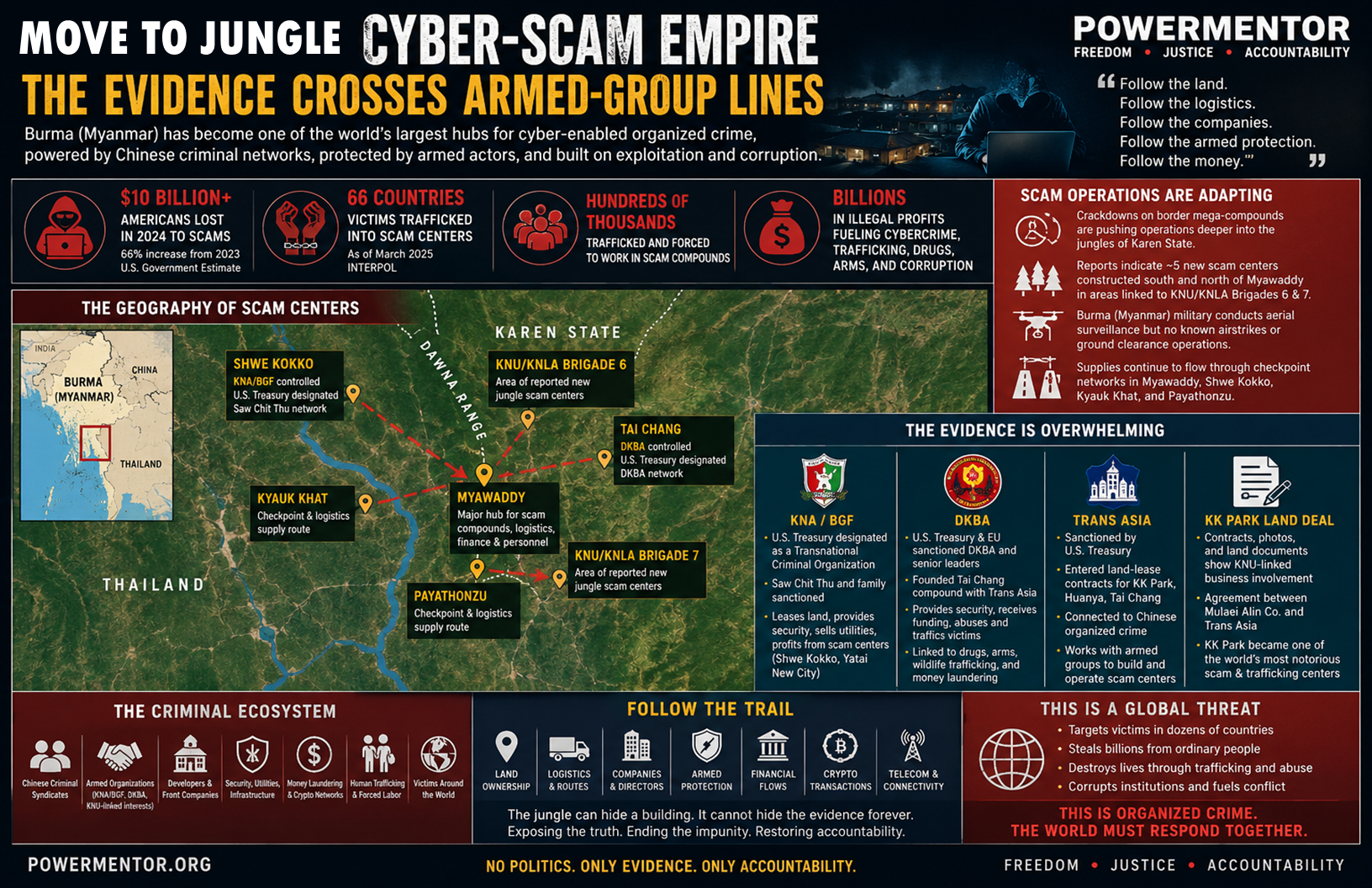
The cyber-scam industry operating across Karen State in Burma (Myanmar) has grown into a multibillion-dollar transnational criminal enterprise involving Chinese criminal networks, human trafficking, armed organizations, land agreements, security arrangements and sophisticated financial infrastructure.
The evidence no longer points toward a single criminal compound or one isolated armed organization. Shwe Kokko, KK Park, Tai Chang and Huanya, along with the KNA/BGF, DKBA, KNU-linked business interests and Chinese organized-crime networks, form pieces of a much larger criminal ecosystem.
Now the industry appears to be evolving again.
Recent reporting indicates scam syndicates facing increasing international pressure are relocating operations away from highly visible locations along the Thai border and deeper into Karen State, where compounds are harder to observe and disrupt.
The important story is no longer whether the scam industry exists. The evidence establishes that it does. The question now is how extensive the network has become and who has enabled its expansion.
THE MONEY IS ENORMOUS
The United States government estimates that Americans alone lost at least $10 billion in 2024 to Southeast Asia-based scam operations, a 66 percent increase from the previous year.
These are sophisticated criminal organizations targeting victims through fraudulent cryptocurrency investments, fake romantic relationships, social-media approaches and other confidence schemes. The financial victims are only half of the story because thousands of workers inside scam compounds have themselves been trafficked.
INTERPOL reported that by March 2025, victims from 66 countries had been trafficked into online scam centers. Criminal organizations lure workers with legitimate-looking employment opportunities and then force many into criminal activity.
This is simultaneously cybercrime, organized crime and human trafficking on an industrial scale.
SHWE KOKKO: THE KNA/BGF CONNECTION
The evidence surrounding Shwe Kokko is extensive.
In May 2025, the U.S. Treasury designated the Karen National Army (KNA), formerly the Karen Border Guard Force (BGF), as a transnational criminal organization and sanctioned its leader, Saw Chit Thu, along with his sons Saw Htoo Eh Moo and Saw Chit Chit.
Treasury stated that the KNA leases land to organized-crime groups, provides security to scam compounds, facilitates trafficking and smuggling and profits from selling utilities to the operations.
In September 2025, Treasury expanded its actions against the network and described Yatai New City at Shwe Kokko as a prominent scam-center complex created by She Zhijiang and Saw Chit Thu. According to Treasury, the development evolved into an ecosystem associated with gambling, drug trafficking, prostitution and international cyber scams.
These are formal findings underlying U.S. government sanctions, not allegations circulating on social media.
KK PARK: THE LAND DEAL THAT CANNOT BE ERASED
KK Park presents another critical part of the evidence.
Investigative reporting by The Irrawaddy reported obtaining contracts, photographs and land documents showing KNU-linked involvement in the land arrangements behind the development that became KK Park.
The documents included an agreement involving Mulaei Alin Co. and Trans-Asia International Holding Group.
This history matters because KK Park subsequently became one of the world's most notorious scam and trafficking centers.
The connection between Trans Asia and KK Park was later independently reinforced by the U.S. government. In November 2025, the U.S. Treasury sanctioned Trans Asia International Holding Group Thailand Company Limited and stated that Trans Asia had entered into land-lease contracts to develop scam compounds including Huanya and KK Park in Myawaddy, Burma (Myanmar).
Treasury also connected Trans Asia with Chinese organized crime.
The documented land history behind KK Park therefore belongs at the center of any serious examination of Karen State's scam economy.
DKBA: THE EVIDENCE GOES FURTHER
The Democratic Karen Benevolent Army (DKBA) represents another documented component of the scam-center ecosystem.
On November 12, 2025, the U.S. Treasury sanctioned the DKBA and four senior leaders for supporting cyber-scam centers targeting Americans.
Treasury identified the Tai Chang compound near Myawaddy, Burma (Myanmar), as operating within DKBA-controlled territory and stated that DKBA Brigadier General Sai Kyaw Hla and Trans Asia founded Tai Chang.
Treasury further reported that the DKBA provided security for the compound and received funding from scam operations.
The findings also documented disturbing human-rights abuses. Trafficking victims described electric shocks, being suspended by their arms in dark rooms and other abuse, while Treasury stated that DKBA soldiers had been filmed beating handcuffed scam workers.
Treasury additionally linked the DKBA's criminal partnerships with drug trafficking, human trafficking, arms trafficking, wildlife trafficking and money laundering.
These findings formed part of formal U.S. government sanctions against the organization and its leadership.
THE NETWORKS OVERLAP
Perhaps the most revealing evidence is how these organizations and businesses intersect.
Treasury identified Trans Asia as connected to Chinese organized crime and stated that it worked with the DKBA and other armed organizations to develop scam centers.
The same company appears in the history of Tai Chang, Huanya and KK Park, demonstrating overlapping relationships among different locations, territorial authorities, developers and criminal networks.
This is significant because Karen State's scam industry cannot adequately be understood by examining individual compounds in isolation.
The evidence increasingly reveals interconnected networks of developers, Chinese criminal organizations, businesses and armed actors operating across Karen State.
THE COMPOUNDS ARE ADAPTING
International pressure has increased dramatically. Thailand has restricted electricity, fuel and telecommunications access, governments have imposed sanctions, victims have escaped, satellite investigators are identifying compounds, journalists have exposed ownership networks and law-enforcement agencies are tracing cryptocurrency.
Yet the scam industry has not disappeared. It has adapted.
Research and reporting during 2026 indicate that operations displaced from exposed border compounds have fragmented and relocated toward less visible areas.
Large compounds directly across the river from Thailand are relatively easy to photograph and monitor. Remote jungle facilities present a different challenge because mountains and forest provide concealment, distance complicates journalism, armed checkpoints restrict access and smaller dispersed facilities are more difficult to identify than enormous casino-style developments.
The criminal model is evolving in response to enforcement pressure.
FOLLOW THE LOGISTICS
Moving into the jungle does not eliminate one fundamental vulnerability: scam centers require enormous logistical support.
Hundreds or thousands of people require food, generators require fuel, computers and telecommunications equipment must be transported, buildings require concrete, steel and construction materials, internet connectivity must be maintained, vehicles must travel established routes, workers must be transported, security must be provided and money must continuously enter and leave the compounds.
Those requirements create a physical and financial trail.
The cyber-scam industry may operate online, but the infrastructure supporting it exists in the physical world through roads, land, checkpoints, electricity, telecommunications, companies, banks, cryptocurrency networks and armed security.
These are the pieces investigators can map.
THE BURMA (MYANMAR) JUNTA IS ALSO PART OF THE STORY
The Burma (Myanmar) military junta has portrayed itself as fighting the scam industry, yet the historical relationship between the junta and some armed organizations associated with scam compounds is well documented.
The KNA previously operated as the Karen Border Guard Force under the Burma (Myanmar) military structure before renaming itself in 2024.
Treasury specifically noted that the KNA leveraged that former relationship to establish control over territory where criminal enterprises subsequently flourished.
The criminal ecosystem developed during years of overlapping military, militia, commercial and cross-border relationships involving territory controlled within Burma (Myanmar).
THIS IS ORGANIZED CRIME ON AN INTERNATIONAL SCALE
The numbers reveal why the world is paying attention.
Americans lost at least $10 billion in 2024 to Southeast Asian scam operations, INTERPOL documented trafficking victims from 66 countries, the United States designated the KNA as a transnational criminal organization, sanctioned the DKBA and senior leaders, sanctioned Chinese organized-crime-linked companies and targeted businesses supporting scam compounds.
Assets are being traced, financial networks are being targeted and international law enforcement increasingly treats these compounds not merely as a Burma (Myanmar) problem but as a global organized-crime threat.
THE EVIDENCE TELLS THE STORY
Strip away the politics and the evidence becomes remarkably straightforward.
The KNA/BGF connection is documented, Saw Chit Thu's role has been documented by the U.S. Treasury, the DKBA connection is documented, Trans Asia's involvement is documented, Chinese organized-crime connections are documented, the KK Park land agreements and KNU-linked business history have been reported from underlying contractual documents, human trafficking inside scam compounds is extensively documented, billions of dollars in losses are documented, and the relocation and fragmentation of scam operations under enforcement pressure is increasingly documented.
No political narrative is necessary.
The evidence itself is powerful enough.
THE NEXT PHASE IS MOVING DEEPER INTO KAREN STATE
This is what makes the latest reports of new compounds deeper inside Karen State so important.
Sources on the ground report that Chinese cyberscam syndicates are relocating operations farther from the Thai border into remote, densely forested areas east of the Dawna Range. Approximately five new scam centers have reportedly been constructed south and north of Myawaddy, including areas associated with KNU/KNLA Brigades 6 and 7.
The reported logistics are equally important. Food, equipment and other supplies continue reaching these facilities through transportation corridors and checkpoints associated with armed groups operating around Myawaddy, Shwe Kokko, Kyauk Khat and Payathonzu.
At the same time, reports describe aerial surveillance by the Burma (Myanmar) military over these locations without corresponding ground-clearance operations against the reported facilities.
The emerging picture is therefore not of an industry being destroyed.
It is an industry changing geography.
The old model relied heavily upon enormous, highly visible border compounds. The emerging model is increasingly dispersed, remote and protected by terrain.
THE MONEY TRAIL DOES NOT DISAPPEAR IN THE JUNGLE
Moving a scam center deeper into Karen State changes its coordinates, but it does not eliminate its vulnerabilities.
Satellite imagery can reveal construction, financial intelligence can identify payments, telecommunications analysis can reveal connectivity, transportation patterns can expose supply corridors, blockchain analysis can follow cryptocurrency and land records can identify ownership and lease relationships.
Most importantly, investigators can continue mapping relationships among Chinese criminal organizations, commercial entities, landholders and armed organizations throughout Karen State.
The history of Shwe Kokko, KK Park, Tai Chang and Huanya already demonstrates how valuable that approach can be.
POWERMENTOR: FOLLOW THE EVIDENCE
There is no reason to embellish this story because the documented evidence is disturbing enough on its own.
Karen State has become one of the world's most important geographic centers for cyber-enabled organized crime. Chinese criminal syndicates established enormous operations there, armed organizations and associated commercial interests became connected with major compounds through land, security and infrastructure relationships, trafficked human beings were forced to scam victims around the world, billions were stolen, and corporate and land arrangements revealed connections among organizations that publicly appeared separate.
Now the industry is adapting.
This story should be investigated through documents, contracts, land records, satellite imagery, sanctions, financial transactions, witness testimony, checkpoint records, corporate ownership, cryptocurrency and telecommunications evidence.
Follow the land, follow the logistics, follow the companies, follow the armed protection and follow the money.
The deeper investigators follow those trails, the clearer the architecture of Karen State's cyber-scam economy becomes.
Moving the compounds deeper into the jungle changes their location. It does not erase their history, their logistics or their financial trail.
PowerMentor Principle
The jungle can hide a building, but it cannot hide the evidence forever.
References:
INTERPOL. (2025, June 30). INTERPOL releases new information on globalization of scam centres. INTERPOL.
Institute for Strategy and Policy–Myanmar. (2026). The analysis of conflict economy in Karen State. ISP-Myanmar.
Institute for Strategy and Policy–Myanmar. (2026). The state of Myanmar: 75 new scam centers detected. ISP-Myanmar.
Karen News. (2025). KNU responds to concerns over scam centers and alleged involvement in KK Park. Karen News.
Myanmar Witness. (2026). How Burma (Myanmar)’s scam compounds work. Centre for Information Resilience.
The Irrawaddy. (2024). Contracts reveal KNU involvement in notorious Burma (Myanmar) scam center. The Irrawaddy.
The Irrawaddy. (2026, February 23). New scam hubs rise in BGF areas near Myawaddy despite crackdown. The Irrawaddy.
U.S. Department of the Treasury. (2025, May 5). Treasury sanctions Burma warlord and militia tied to cyber scam operations. U.S. Department of the Treasury.
U.S. Department of the Treasury. (2025, September 8). Treasury sanctions Southeast Asian networks targeting Americans with cyber scams. U.S. Department of the Treasury.
U.S. Department of the Treasury. (2025, November 12). Treasury sanctions Burma armed group and companies linked to organized crime targeting Americans. U.S. Department of the Treasury.
European Union. (2026, July 30). EU sanctions the Democratic Karen Benevolent Army and senior figures over cyber-scam operations in Burma (Myanmar). Council of the European Union.
ABC News Australia. (2026, July 21). Burma (Myanmar) scam compounds expand and move deeper into jungle areas despite crackdowns. Australian Broadcasting Corporation.
Amnesty International. (2026). Burma (Myanmar) 2025: Human rights and trafficking concerns connected to scam compounds. Amnesty International.
Centre for Information Resilience. (2026). Mapping suspected cyber-scam compounds across Burma (Myanmar) and Southeast Asia. Myanmar Witness.
