

The Correlation Between Totalitarian Rule and Poverty: Why Freedom, Accountability, and Economic Opportunity Matter
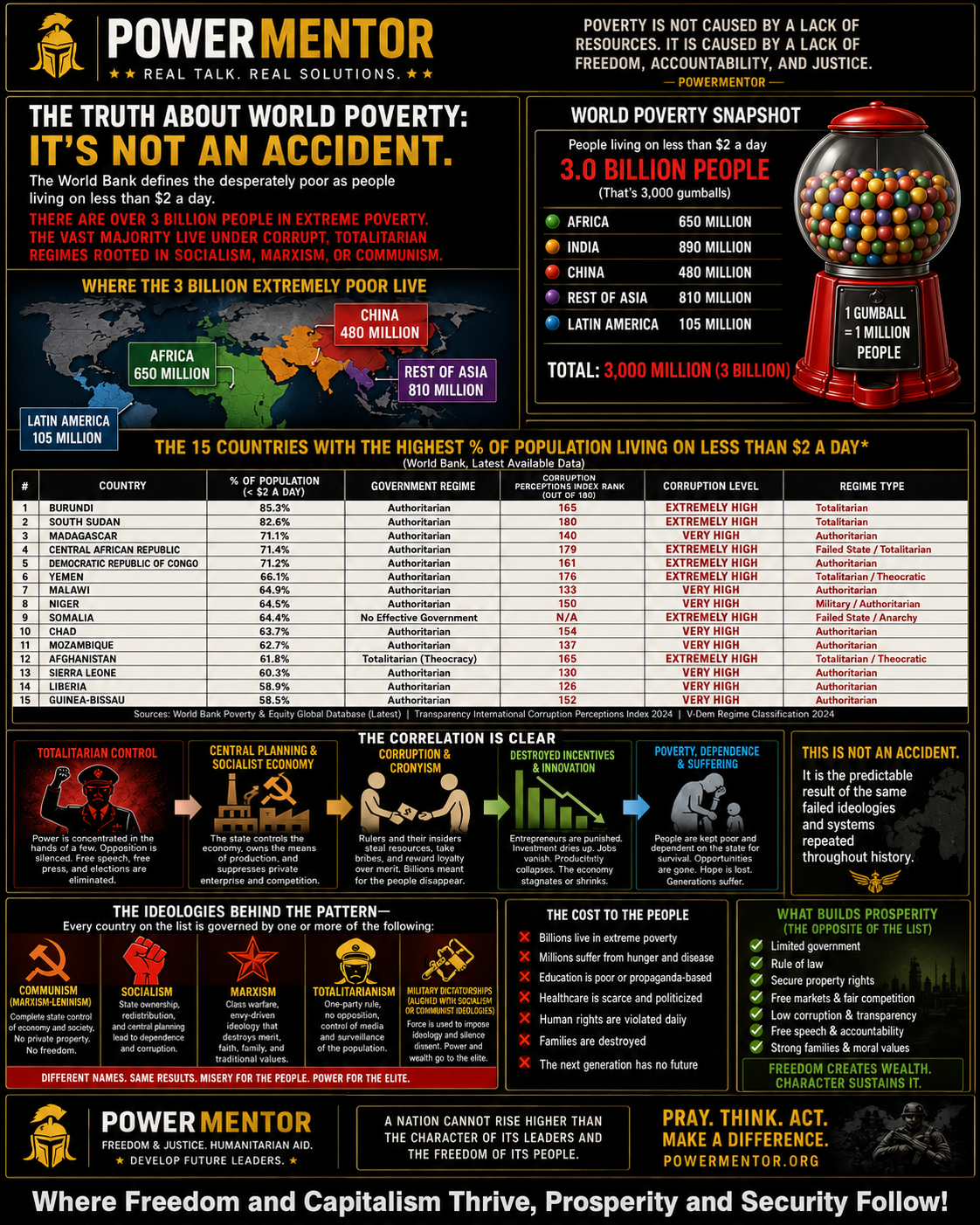
Throughout history, nations have searched for the formula that creates prosperity. While geography, natural resources, culture, and conflict all play important roles, one pattern consistently emerges: countries with concentrated political power, weak institutions, and widespread corruption tend to experience higher levels of poverty and lower economic opportunity.
This is not simply a debate over economics. It is a discussion about freedom, accountability, incentives, and human dignity.
The World's Poor Are Not Distributed Randomly
According to international poverty estimates, billions of people still live in extreme poverty, many surviving on less than $2 per day.
The largest concentrations of extreme poverty are found in regions where governments often struggle with one or more of the following:
Authoritarian or totalitarian rule (Marxism, Communism, Socialism)
Systemic corruption
Weak rule of law
Political instability
Limited economic freedom
Restricted property rights
Poor government accountability
While every nation has its own history and circumstances, these factors frequently appear together.
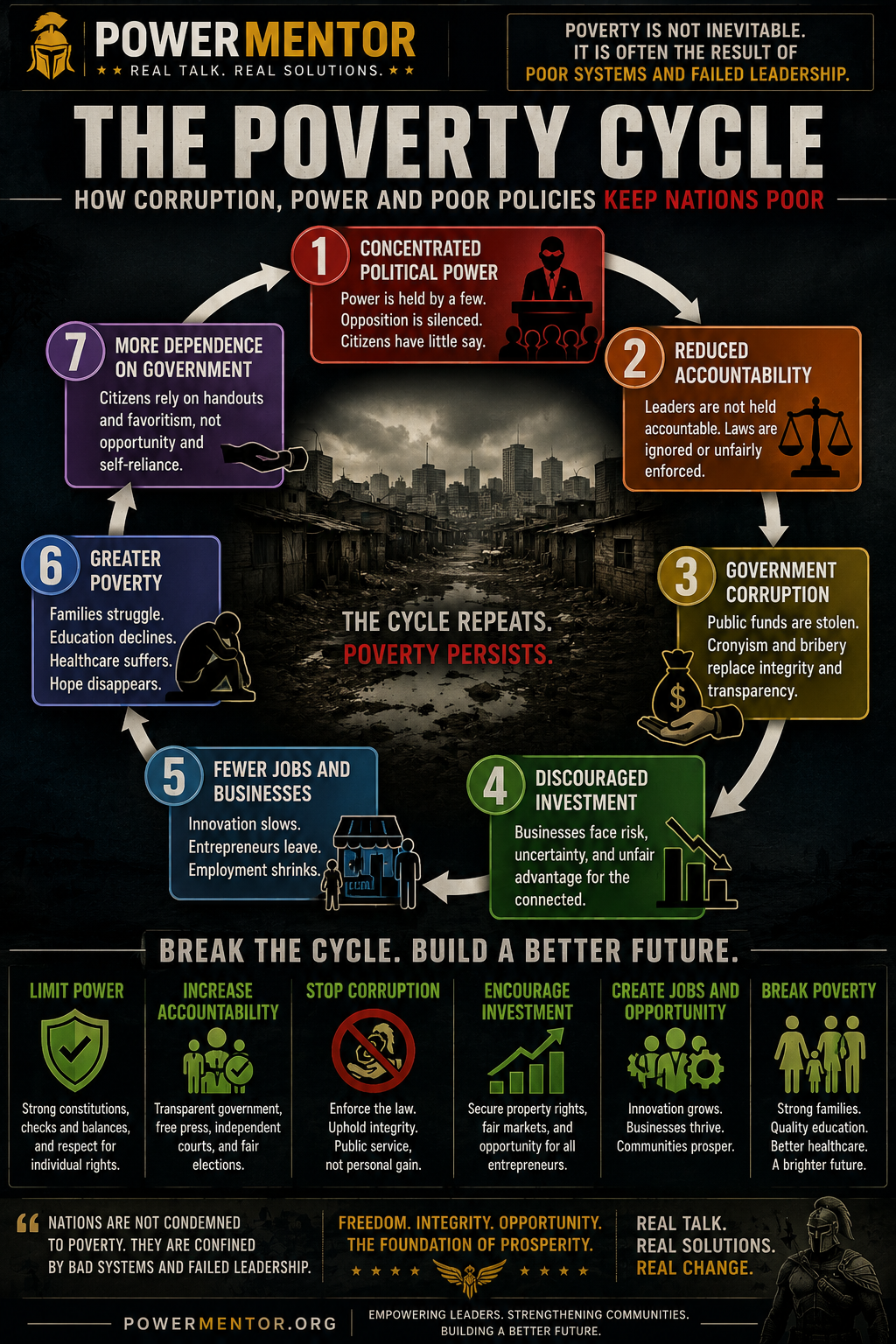
More Dependence on Government
The cycle then repeats.
Why Corruption Matters
Corruption does more than waste money.
It destroys trust.
When corruption becomes institutionalized:
Public funds disappear
Infrastructure deteriorates
Education declines
Healthcare suffers
Businesses avoid investment
Entrepreneurs lose opportunity
Citizens lose confidence
The people who suffer most are almost always the poor.
Economic Freedom Creates Opportunity
History demonstrates that prosperity is generally strongest where people have the freedom to:
Start businesses
Own private property
Keep the rewards of their work
Invest capital
Compete fairly
Innovate
Trade openly
These freedoms encourage investment, productivity, technological advancement, and long-term economic growth.
Freedom and Prosperity Go Together
Countries consistently ranking among the world's most prosperous typically share several characteristics:
Strong rule of law
Independent courts
Protection of private property
Low corruption
Transparent government
Competitive markets
Stable institutions
Political accountability
Prosperity is rarely created by government decree alone. It is usually built when individuals are free to create value for others.
Correlation Is Not the Same as Causation
It is important to distinguish between correlation and causation.
Not every poor nation is authoritarian.
Not every authoritarian nation is equally poor.
War, geography, disease, natural disasters, colonial history, education, and many other factors also influence development.
However, the repeated correlation between concentrated political power, corruption, weak institutions, and persistent poverty is one of the most consistent patterns observed across modern development research.
Lessons From History
History repeatedly reminds us that prosperity flourishes where freedom is protected.
When governments become unaccountable, corruption often expands.
When corruption expands, investment declines.
When investment declines, opportunity disappears.
When opportunity disappears, poverty grows.
The opposite is also true.
When nations strengthen the rule of law, protect individual liberty, encourage entrepreneurship, and safeguard economic freedom, prosperity often follows.
The PowerMentor Perspective
PowerMentor believes lasting prosperity is built upon principles that encourage both freedom and responsibility.
These include:
Individual liberty
Personal responsibility
Honest government
Rule of law
Economic freedom
Strong families
Moral leadership
Opportunity through hard work
While reasonable people may disagree about the best public policies, history suggests that societies prosper when citizens are empowered to innovate, create, invest, and build rather than when power and economic decision-making become concentrated in the hands of a few.
Final Thought
Freedom creates opportunity. Opportunity creates prosperity. Prosperity flourishes where integrity, accountability, and economic freedom are protected.
References
The World Bank. (2024). Poverty, prosperity, and planet report 2024: Pathways out of the polycrisis. World Bank. https://doi.org/10.1596/978-1-4648-2181-7
Transparency International. (2025). Corruption Perceptions Index 2025. https://www.transparency.org/en/cpi
V-Dem Institute. (2026). Democracy Report 2026. University of Gothenburg. https://www.v-dem.net/publications/democracy-reports/
The Heritage Foundation. (2025). 2025 Index of Economic Freedom. https://www.heritage.org/index/
Fraser Institute. (2024). Economic Freedom of the World: 2024 Annual Report. https://www.fraserinstitute.org/studies/economic-freedom
United Nations Development Programme. (2023). Human Development Report 2023/2024. https://hdr.undp.org
Our World in Data. (2025). Corruption. https://ourworldindata.org/corruption
Our World in Data. (2025). Extreme poverty. https://ourworldindata.org/extreme-poverty
International Monetary Fund. (2024). World Economic Outlook. https://www.imf.org/en/Publications/WEO
Organisation for Economic Co-operation and Development. (2024). Government at a Glance 2024. https://www.oecd.org/gov/government-at-a-glance/
Acemoglu, D., & Robinson, J. A. (2012). Why nations fail: The origins of power, prosperity, and poverty. Crown Business.
De Soto, H. (2000). The mystery of capital: Why capitalism triumphs in the West and fails everywhere else. Basic Books.
North, D. C. (1990). Institutions, institutional change and economic performance. Cambridge University Press.
Olson, M. (1993). Dictatorship, democracy, and development. American Political Science Review, 87(3), 567–576.
Sachs, J. D. (2005). The end of poverty: Economic possibilities for our time. Penguin Press.
Easterly, W. (2006). The white man's burden: Why the West's efforts to aid the rest have done so much ill and so little good. Penguin Press.
