

Russia's "Operation Tropical Storm": A Dangerous New Phase in Burma (Myanmar)
POWERMENTOR GLOBAL SECURITY ALERT
For years, Russia's support of Burma's (Myanmar's) military government centered primarily on arms sales, aircraft, and military equipment. That has now changed.
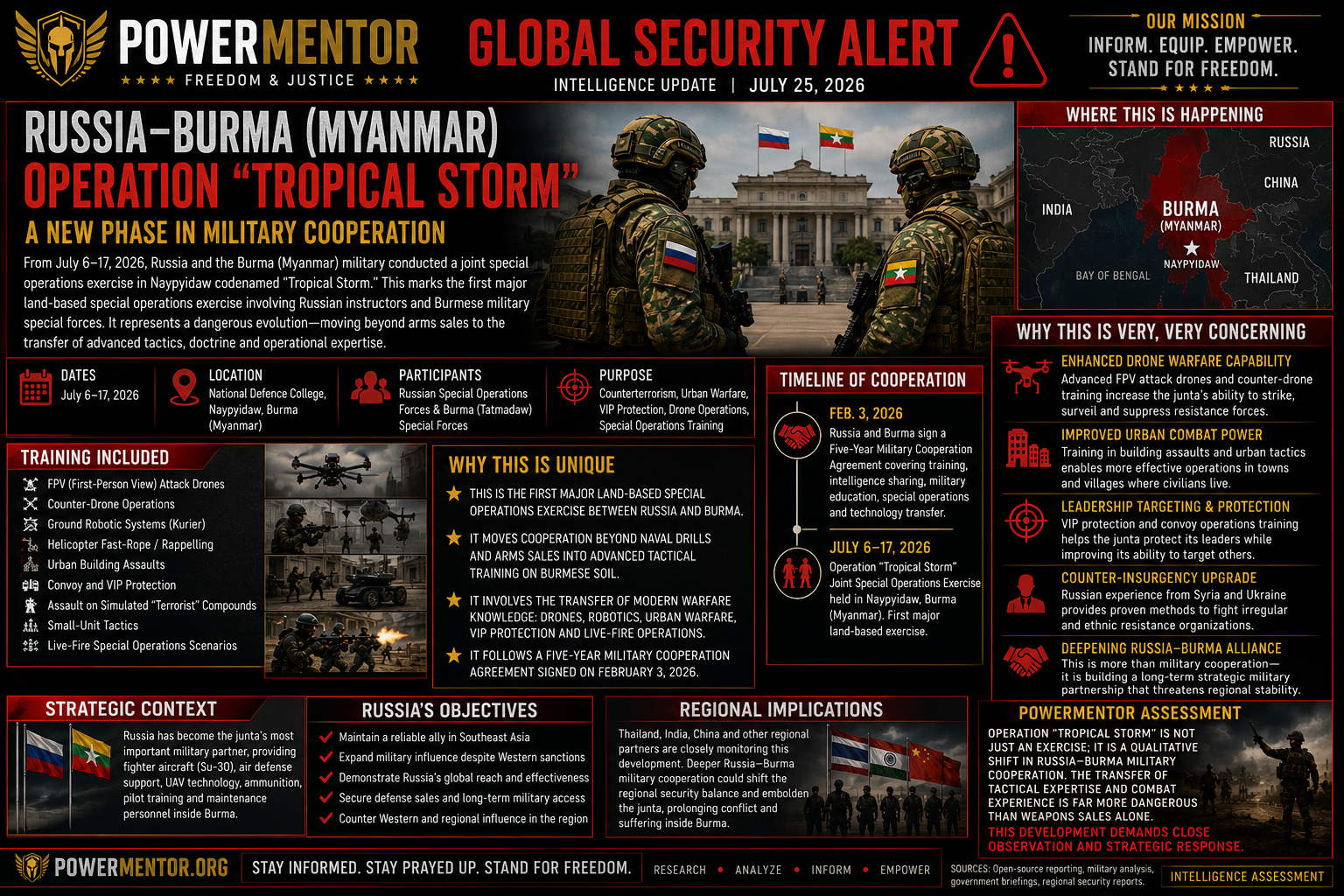
Between July 6–17, 2026, Russia and the Burma (Myanmar) military conducted a joint special operations exercise known as Operation Tropical Storm in Naypyidaw. While military exercises between allies are not uncommon, this event stands apart because it reportedly focused on transferring advanced battlefield tactics and operational expertise, not simply demonstrating military cooperation.
This marks a potentially significant evolution in the relationship between Moscow and Burma's military leadership.
Why This Is Different
Previous cooperation largely involved military hardware, pilot training, and naval exercises. Operation Tropical Storm reportedly expanded that relationship into special operations training, including:
FPV attack drone operations
Counter-drone tactics
Urban combat
Helicopter insertion techniques
Robotic ground systems
Convoy security
VIP protection
Live-fire special operations scenarios
These are capabilities associated with modern warfare and lessons drawn from recent conflicts where Russia has operated.
Why This Matters
The significance is not simply that Russia and Burma trained together—it is what was taught.
Military hardware can be purchased. Combat experience, tactical doctrine, and specialized operational knowledge take years to develop. When an experienced military shares those capabilities with another force, it has the potential to improve that force's effectiveness far more rapidly than equipment purchases alone.
If these publicly reported training objectives are incorporated into future operations, they could improve the Burmese military's ability to:
Conduct coordinated urban operations.
Integrate drones into reconnaissance and strike missions.
Improve command-and-control during combat.
Protect senior leadership and key military assets.
Counter irregular and insurgent forces using modern tactics.
The extent to which these lessons will translate into operational success remains uncertain, but the training itself represents a deeper level of military cooperation than previously observed.
A Strategic Shift
Operation Tropical Storm also follows a broader defense cooperation agreement signed earlier this year between Russia and Burma.
Taken together, these developments suggest the relationship is expanding beyond a supplier-customer model into a more comprehensive military partnership that includes training, doctrine, and professional military education.
For Russia, this strengthens its strategic presence in Southeast Asia.
For Burma's military leadership, it provides access to advanced operational knowledge despite ongoing international isolation.
Regional Implications
Neighboring countries will likely be watching closely.
Enhanced military cooperation between Russia and Burma could influence regional security calculations, particularly if future collaboration expands into additional areas such as intelligence cooperation, electronic warfare, cyber capabilities, or expanded joint exercises.
Whether these developments alter the military balance remains to be seen, but they clearly indicate a relationship that is becoming broader and more sophisticated.
PowerMentor Assessment
Operation Tropical Storm should not be viewed as just another military exercise.
It represents a qualitative shift from weapons transfers toward the sharing of tactical expertise and operational methods.
History has shown that when military partnerships evolve from selling equipment to transferring doctrine, training, and combat experience, the long-term strategic impact can be far greater than the value of the hardware itself.
This development deserves close observation—not because it guarantees a particular outcome, but because it signals a new phase in the Russia-Burma military relationship that could shape regional security for years to come.
PowerMentor will continue monitoring these developments as additional information becomes available.
