
The Globalist Net Is Growing: A Warning About Freedom, Sovereignty, and Centralized Control
We believe every nation and every people should have the right to govern themselves, protect their culture, choose their leaders, and decide their own future. A free nation must be able to control its borders, write its laws, protect its citizens, and preserve its beliefs without being ruled by foreign governments or unelected global organizations.
That freedom is now under growing pressure. Around the world, a system of global control is slowly taking shape. This system is often called globalism. Globalism seeks to place more power in the hands of international groups, foreign regulators, large banks, global companies, and political leaders who are far removed from the people affected by their decisions. Instead of each country making its own choices, nations are being pushed to follow the same global rules.
Supporters often use comforting words to explain this movement. They speak about safety, fairness, equality, peace, online protection, and international cooperation. Some cooperation between nations is needed. Countries should work together to fight human trafficking, terrorism, child exploitation, fraud, and other serious crimes. However, cooperation becomes dangerous when it is used to take power away from sovereign nations and place it in the hands of distant leaders whom the people did not elect.
What Sovereignty Really Means
A sovereign nation is a nation that governs itself. It does not need permission from a foreign court to enforce its laws. It does not allow an international group to decide what its people may say, believe, teach, or support. It may work with other countries, but it does so by choice. It does not surrender its freedom in exchange for money, trade, political approval, or access to global institutions.
A nation that cannot control its own laws cannot control its own future. A country may still have a flag, an anthem, and elected officials, but if outside institutions control its money, laws, trade, technology, or speech, that country is losing part of its sovereignty.
How Global Control Begins
Global control does not usually begin with soldiers marching across a border. It often begins with rules, treaties, technology, and financial pressure. A global organization may create a new standard. A powerful country may demand that other nations follow it. Banks may threaten to withhold funding. Large companies may refuse to provide services. Political leaders may warn that countries that refuse to cooperate will be isolated or punished.
Each step may seem small by itself. Over time, however, these steps can take real power away from the people. Global control often grows slowly, one rule, one agreement, and one new agency at a time.
How Foreign Rules Can Reach Americans
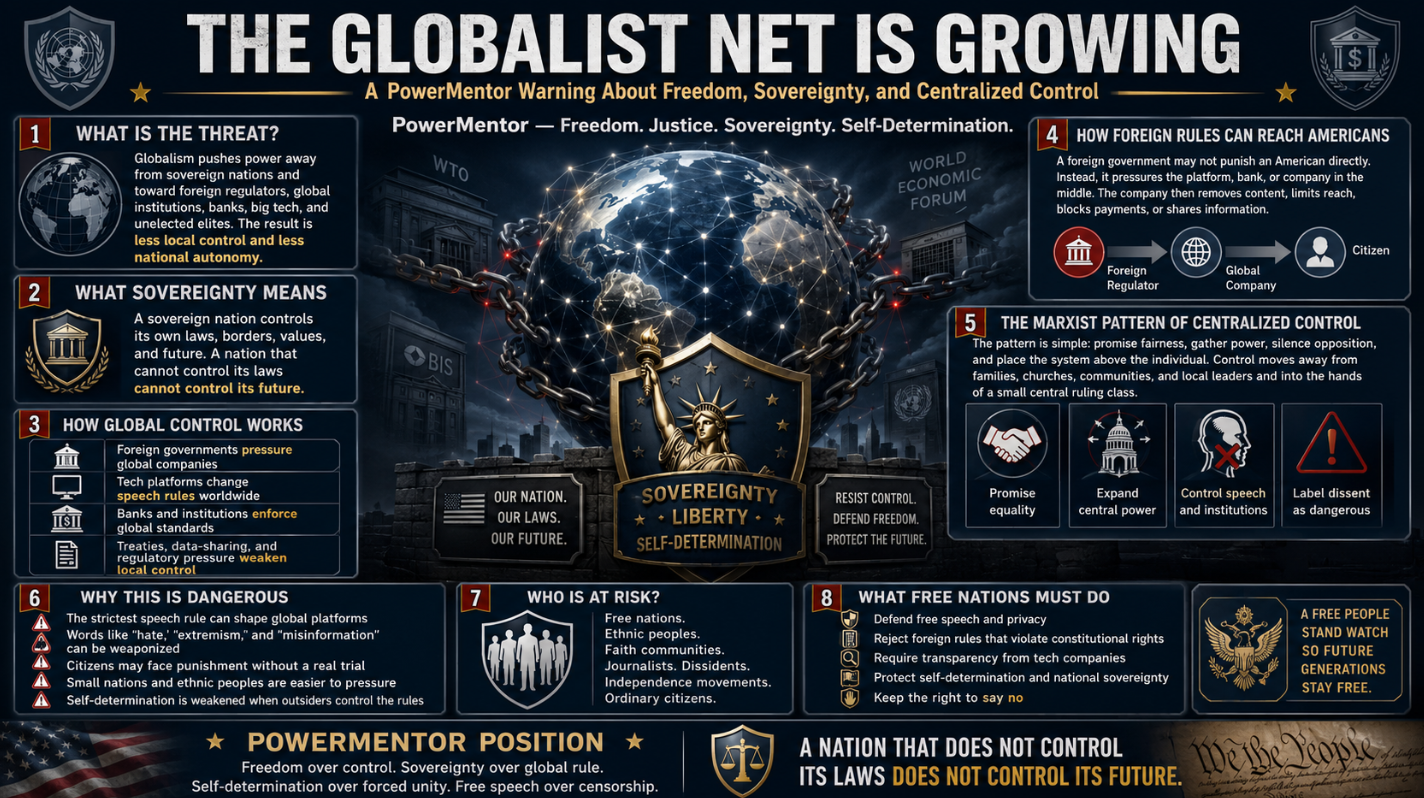
The internet has made it easier for foreign governments to reach beyond their own borders. Large technology companies operate in many nations at the same time. A government can pressure one of these companies to remove a post, block a video, reveal a user’s identity, or change its speech rules. The company may obey because it does not want to lose access to that country’s market or face a large fine.
The foreign government may never directly arrest or prosecute an American citizen. Instead, it pressures the company that carries the person’s message. The company may then close the account, hide the content, stop payments, limit how many people see it, or give private information to officials. The foreign government uses the company as the middleman.
This creates a major danger. The American Constitution limits what the American government may do to silence speech. However, a private company has more freedom to control its own platform. A foreign government may therefore achieve through a company what the United States government could not legally do on its own.
The Strictest Rule Can Affect Everyone
Different nations have very different ideas about free speech. The United States protects many forms of speech that other governments punish. Some countries arrest people for insulting leaders, questioning the government, sharing religious teachings, asking for independence, or reporting government abuse. Others use broad terms such as hate speech, misinformation, extremism, or threats to national unity.
A worldwide company may decide that it is too difficult to follow a different rule in every country. It may choose one strict policy and apply it everywhere. When that happens, a rule created in Europe, China, or another part of the world can affect people living in the United States.
The most restrictive government may not officially control the whole world, but its standards can still shape what people everywhere are allowed to see and say.
The Marxist Pattern of Centralized Control
The Marxist pattern of centralized control is an important part of this warning. Marxist movements have often begun by promising fairness, equality, and protection for ordinary people. They tell the public that society is unjust and that more power must be placed in the hands of the government to correct it. The leaders claim that they need greater control to protect workers, help the poor, and create a fair society.
The problem is what happens after the government receives that power. Control moves away from families, churches, communities, businesses, and local leaders. It moves into the hands of a small central government or ruling party. That ruling group then gains authority over jobs, money, property, schools, news, religion, travel, and speech.
The people are told that this control is needed for the good of everyone. Yet the more power the central government receives, the less freedom remains for the individual. The government begins deciding what is true, what may be taught, what beliefs are acceptable, and which people are considered dangerous. Those who disagree may be labeled selfish, hateful, extreme, or enemies of the people.
This is the central Marxist pattern: promise fairness, gather power, silence opposition, and place the system above the individual.
It Starts With a Promise
This pattern rarely begins with leaders openly saying that they plan to take away freedom. It starts with promises. Leaders may say they want to make everyone equal, stop hate, protect the weak, or create a safer world. They then argue that they need more power to achieve those goals.
Once the power is given to them, they create new rules, agencies, lists, investigations, and punishments. People are told to trust the experts and not question the plan. Anyone who raises concerns may be accused of spreading fear or false information.
Soon, the government is no longer serving the people. The people are being ordered to serve the system.
How Globalism Follows the Same Pattern
Globalism is not exactly the same as the older Marxist governments of the Soviet Union, Communist China, Cuba, or other one-party states. Modern globalism often includes wealthy corporations, international banks, nonprofit groups, technology companies, and political leaders. However, it can follow the same basic pattern of centralized control.
A small group of powerful people believes it knows what is best for the entire world. It seeks shared rules for speech, money, trade, education, health, the environment, and social values. Nations are told that they must give up some of their independence for the good of the world. Citizens are told that global experts understand the problems better than local people do.
The structure may look different from old Marxism, but the danger is similar: power moves upward and farther away from the people.
Decisions are made by leaders whom ordinary citizens cannot easily remove. Local customs, religious beliefs, and national values are treated as barriers to progress. Those who defend national independence may be called backward, dangerous, or extreme.
The deeper concern is that both Marxism and globalism can place the goals of the collective above the rights of the individual. Both can claim that centralized control is necessary to create fairness. Both can treat disagreement as a threat. Both can use the promise of a better future to justify taking freedom away in the present.
The Power to Control Words
Centralized control becomes especially dangerous when those in power are allowed to define important words. Terms such as hate, extremism, misinformation, terrorism, and harmful speech may sound clear, but governments can change their meanings.
A person fighting for freedom may be called a terrorist by the government that controls his homeland. A pastor teaching his faith may be accused of spreading hate. A reporter exposing corruption may be accused of spreading false information. An ethnic nation seeking independence may be accused of threatening unity. A citizen questioning government policy may be labeled an extremist.
Whoever controls the meaning of these words can often control who is punished.
When global institutions control these definitions, they can decide which people deserve protection and which people may be targeted. Small nations, ethnic groups, religious communities, and independence movements may have little voice in the process. Powerful governments may be allowed to define their opponents as criminals while claiming that they are simply protecting peace and order.
The Threat to Self-Determination
This is a serious concern for people seeking self-determination. International organizations often say that they support human rights, but they may place greater value on keeping existing states together. They may protect the borders of powerful governments while ignoring the people suffering inside those borders.
They may call forced unity stability, even when ethnic peoples are denied a true voice in their own future. PowerMentor believes self-determination belongs to the people, not only to central governments.
A central government should not be allowed to speak for an ethnic nation that it has abused, controlled, or excluded. International organizations should not choose weak or self-interested representatives and then claim that the people have been heard. Freedom means that the people themselves must decide their political future.
Technology Makes Central Control Easier
Modern technology gives governments and global institutions powers that past rulers could only imagine. Governments can request names, email messages, phone records, locations, private files, financial records, social media posts, and contact lists. These tools can help stop real criminals, but they can also be turned against innocent people.
The same technology used to locate a human trafficker can be used to locate a political dissident. The same system used to stop terrorism can be used against an independence leader. The same tools used to fight crime can be used to track a pastor, reporter, human-rights advocate, or person exposing government abuse.
The danger is not only the technology. The danger is who controls it, how crimes are defined, and whether the target receives a fair hearing.
When free nations share powerful technology with repressive governments, they risk helping those governments find and punish people whose only crime was speaking for freedom.
Punishment Without a Trial
A person can be harmed without ever being convicted in court. A platform may close an account. A bank may refuse service. A payment company may block donations. A government may place someone on a list. A nation may deny a visa. Search engines may hide the person’s work. Friends and family members living overseas may be questioned or threatened.
In this new system, punishment may come before due process. In some cases, due process may never come at all.
This is one of the clearest warnings of globalized control. People can lose access, money, freedom of movement, or the ability to speak without ever facing their accuser in a fair court.
Small Nations Face the Greatest Risk
Small nations face special danger because they may not have the money or power to resist international pressure. They can be threatened through foreign aid, loans, trade agreements, sanctions, banking rules, technology access, and political isolation.
A small country may be told to change its laws or lose funding. It may be told to change its cultural or religious values or lose trade. It may be warned that it must follow a global standard or be treated as an enemy of progress.
This is not true cooperation. It is control through pressure.
A nation may appear independent on a map while losing the power to make its own choices. When its leaders must satisfy foreign banks, international organizations, or powerful governments before they can serve their own citizens, sovereignty is being weakened.
Sovereignty Does Not Mean Isolation
Defending sovereignty does not mean that nations must stand alone. Free nations can trade, share information, form alliances, and work together against real threats. They can help one another during war, famine, disaster, and disease. They can cooperate against trafficking, terrorism, fraud, and child abuse.
The difference is that cooperation must be voluntary. A sovereign nation must always keep the right to say no.
It must be able to refuse a foreign law that violates its Constitution, culture, faith, or national interest. It must be able to reject an international demand that targets protected speech or political opposition.
A free nation should be able to say: This foreign rule does not apply here. This request violates our rights. This court does not control our citizens. This policy harms our people. We will govern ourselves.
That is not isolation. That is sovereignty.
What Free Nations Must Do
Free nations must act before more authority is surrendered. They should refuse to enforce foreign laws that violate their constitutional rights. They should not help authoritarian governments punish speech that is legal in a free country. They should require strong proof before giving private information to another government.
Technology companies should be required to tell the public when foreign governments demand censorship, user information, or account restrictions. International agreements that affect citizens’ rights should receive open public debate and approval from elected lawmakers.
Free nations must also protect reporters, pastors, political dissidents, human-rights workers, ethnic leaders, and peaceful independence movements from abusive foreign demands. Governments should not be allowed to hide political persecution behind words such as cybersecurity, public safety, misinformation, or national unity.
The defense of sovereignty must include the defense of free speech, faith, privacy, and self-determination.
Freedom Is Lost One Step at a Time
Freedom is rarely taken away all at once. It is usually lost through a series of small steps. One new regulation is created. One international agreement is signed. One new agency is given power. One more type of speech is restricted. One more reason is found to collect private information.
Each step may seem harmless. Together, those steps can create a powerful system of control.
That system is being built now. The laws are being written now. The technology is being connected now. The definitions are being created now. Power is moving farther away from families, communities, voters, and sovereign nations.
This is why the public must pay attention before the system becomes too strong to challenge.
The PowerMentor Position
PowerMentor stands for freedom over control, sovereignty over global rule, self-determination over forced unity, and free speech over censorship. We believe that people should be governed by leaders they can see, question, challenge, and remove.
We reject the idea that a small group of global leaders should control the future of every nation. We reject any system that allows foreign governments to silence people living in free countries. We reject the use of international cooperation to locate and punish people seeking freedom from oppression.
We also reject the Marxist pattern of placing more and more power in the hands of central planners while promising that the loss of freedom is for the good of society. History has shown that once leaders gain control over speech, education, property, money, religion, and political life, they rarely return that power willingly.
Final Warning
Global control often arrives dressed in kind words. It may promise safety, fairness, peace, or equality. But citizens must look beyond the promise and ask who is receiving the power, who is losing freedom, and whether the people can remove those making the decisions.
A free world does not need one global ruler. It needs free nations, strong families, protected faith, honest speech, and people with the courage to resist centralized control.
A nation that does not control its laws does not control its future. A people who cannot govern themselves are not free. Freedom must be protected before it is lost.
APA References
European Parliament and Council of the European Union. (2022). Regulation (EU) 2022/2065 on a single market for digital services and amending Directive 2000/31/EC (Digital Services Act).Official Journal of the European Union, L 277, 1–102.
Office of Communications. (2024, February 27). Online Safety Act compliance guide for providers of online services. Ofcom.
Securing the Protection of Our Enduring and Established Constitutional Heritage Act, Pub. L. No. 111-223, 124 Stat. 2380 (2010).
United Nations General Assembly. (2024). United Nations Convention against Cybercrime: Strengthening international cooperation for combating certain crimes committed by means of information and communications technology systems and for the sharing of evidence in electronic form of serious crimes (A/RES/79/243). United Nations.
United Nations Treaty Collection. (2026). United Nations Convention against Cybercrime: Status of treaties. United Nations.
United Nations Secretary-General. (2024, December 24). Statement attributable to the spokesperson for the Secretary-General on the adoption of the United Nations Convention against Cybercrime. United Nations.
Office of Communications. (2026, June 25). Online safety regulatory documents and guidance. Ofcom.
