

Five Thai Rangers Killed in Narathiwat: The Attack, the Insurgent Network and the Most Likely Perpetrators
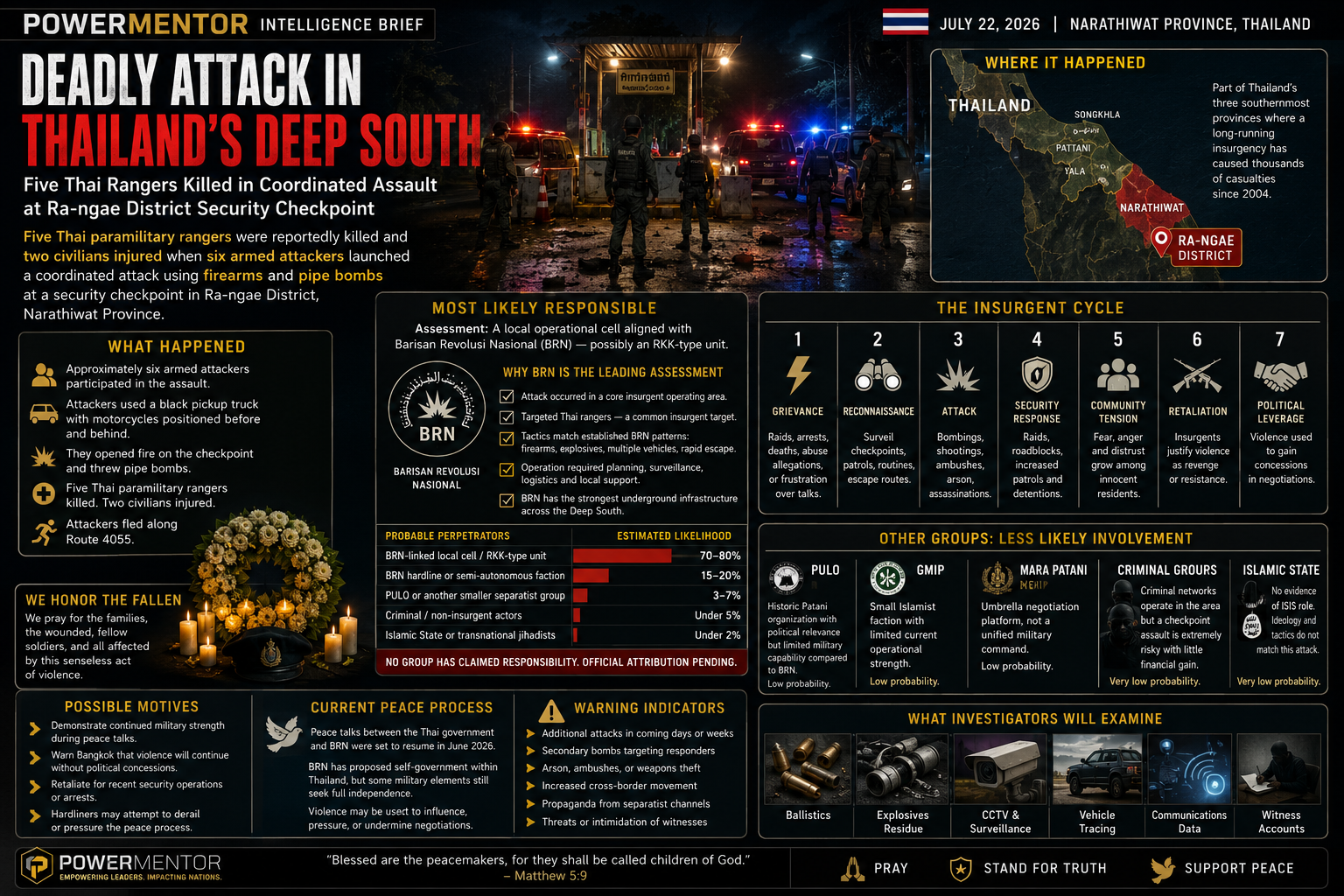
Location: Ra-ngae District, Narathiwat Province, Thailand
Assessment status: Developing story
Analytic confidence: Moderate
Five Thai paramilitary rangers were reportedly killed when a coordinated group of armed assailants attacked a security checkpoint in Thailand’s violence-stricken Deep South.
The deadly assault occurred in Ra-ngae District, Narathiwat Province, an area that has long served as an important operating environment for Malay-Patani separatist militants.
Early reports circulated that as many as 15 people were injured. More detailed reporting subsequently stated that five paramilitary rangers were killed and two civilians were injured when six attackers opened fire and threw pipe bombs at the checkpoint. Because information remains fluid, the final casualty count should be treated as provisional until Thai authorities issue a consolidated official report.
PowerMentor extends its deepest prayers and condolences to the families of those killed, their fellow soldiers, the wounded civilians, first responders and the communities shaken by this attack.
What Happened in Ra-ngae
According to the most detailed publicly available account, approximately six armed assailants attacked a paramilitary checkpoint using a combination of gunfire and improvised explosive devices described as pipe bombs.
The attackers reportedly used a coordinated movement pattern involving:
A black pickup truck carrying the primary assault team;
Motorcycles positioned before or behind the main vehicle;
Concentrated gunfire directed at personnel inside the checkpoint;
Pipe bombs or improvised explosive devices;
A rapid withdrawal along a predetermined escape route.
This was not an impulsive shooting or an ordinary criminal confrontation. The reported use of several attackers, multiple vehicles, explosives, supporting motorcycles and a planned escape route indicates preparation, reconnaissance and division of responsibility.
A direct-assault team of six people may represent only the visible portion of the operation. A successful attack of this nature could also require:
Individuals monitoring the checkpoint beforehand;
Weapons and explosives suppliers;
Bomb makers;
Drivers and motorcycle lookouts;
Safe-house operators;
Communications personnel;
Individuals assigned to dispose of vehicles or weapons afterward.
That broader support structure is one reason the attack appears more consistent with an established insurgent network than with independent criminals.
Why Narathiwat Matters
Narathiwat is one of the three southernmost Thai provinces—along with Pattani and Yala—at the center of the modern Deep South insurgency.
The area differs culturally, linguistically and religiously from much of Thailand. Many residents are ethnic Malay Muslims who speak a Malay dialect and identify historically with the former Patani region.
The conflict has roots extending well beyond the present insurgency, but the current wave of sustained violence intensified in 2004. Since then, the region has experienced thousands of shootings, bombings, assassinations, arson attacks, ambushes and raids.
Government security forces, insurgents and civilians have all suffered casualties.
Verified figures cited by Thai authorities indicate that more than 10,000 security-related incidents occurred in the southern provinces between 2004 and early 2026.
Narathiwat has remained especially important because of its:
Rural and mountainous terrain;
Forested escape routes;
Proximity to Malaysia;
Local clandestine support networks;
History of insurgent attacks;
Smuggling routes;
Areas where authorities have identified weapons movement and bomb-making activity.
Only months before the Ra-ngae attack, Narathiwat experienced a series of seven homemade bomb attacks. In May 2026, three paramilitary rangers were injured when a roadside bomb struck their convoy in Waeng District. A ranger was also killed during a major security operation in Narathiwat in late May or early June.
The July 22 checkpoint attack therefore did not occur in isolation. It followed a continuing pattern of insurgent activity throughout the province.
Who Is Most Likely Responsible?
Thai authorities had not publicly issued a final attribution at the time of publication, and no credible public claim of responsibility had been confirmed.
However, based on location, capability, target selection, tactics and historical operating patterns, the most likely perpetrator is:
A local armed cell connected to or operating within the Barisan Revolusi Nasional Melayu Patani—BRN—network.
The tactical attackers may be described as an RKK-type operational cell, although the relationship between BRN and the term “RKK” requires careful explanation.
This remains an intelligence assessment, not a confirmed legal finding.
Preliminary probability assessment
BRN-linked local operational cell or RKK-type unit: 70–80%
BRN hardline or semi-autonomous faction acting without clear political-wing approval: 15–20%
PULO or another smaller Patani separatist organization: 3–7%
Criminal, smuggling or personal-conflict actors: Under 5%
Islamic State or another transnational jihadist organization: Under 2%
These percentages are estimates intended to communicate relative likelihood. They are not claims of certainty.
BRN: The Dominant Insurgent Organization
The Barisan Revolusi Nasional, commonly known as BRN, is widely regarded as the most powerful and operationally capable insurgent organization in southern Thailand.
Its broad political objective has historically involved national liberation, independence or meaningful self-determination for the Malay-Patani population of the Deep South.
Unlike a conventional army, BRN does not primarily operate through large uniformed military formations openly holding territory. It relies instead on clandestine and compartmentalized networks embedded within local communities.
These networks may perform separate functions, including:
Political organization;
Recruitment;
Religious or ideological mobilization;
Intelligence collection;
Surveillance of security personnel;
Weapons storage;
Bomb construction;
Transportation;
Assassination;
Ambush operations;
Communications;
Escape and concealment.
BRN’s decentralized structure has made it difficult for security agencies to penetrate the entire organization. Arresting or killing individual operatives may disrupt one cell without necessarily dismantling the broader network.
BRN is also the principal insurgent organization participating in the current peace process with the Thai government. Formal discussions were scheduled to resume in June 2026 despite a recent increase in violence.
What Is the RKK?
The term RKK comes from Runda Kumpulan Kecil, commonly translated as “small patrol group” or “small action group.”
RKK is frequently described as an armed wing of BRN or as a designation for its small clandestine combat units.
However, the label is sometimes applied very broadly by officials and media. It does not always identify a separate organization with its own transparent command structure, political platform or publicly known national leadership.
In practice, an RKK-type unit may be a small group of trained militants operating under a local or district-level BRN structure.
Such a unit could divide responsibilities among:
Reconnaissance personnel;
Lookouts;
Bomb makers;
Gunmen;
Drivers;
Motorcycle escorts;
Safe-house operators;
Weapons custodians;
Local intelligence supporters.
The reported Ra-ngae operation—small assault team, pickup truck, motorcycle support, explosives, gunfire and rapid escape—is strongly compatible with this type of cellular organization.
That does not prove RKK involvement, but it makes a BRN-associated small action group the strongest working hypothesis.
Why BRN or an RKK-Type Cell Is the Leading Assessment
1. The attack occurred in a core insurgent operating area
Narathiwat is not a peripheral or unusual location for Patani separatist operations. It is one of the conflict’s principal provinces and has experienced repeated bombings and armed attacks throughout 2026.
The probability that an organized checkpoint assault in this area is connected to the existing insurgency is therefore high.
2. The target fits BRN-linked priorities
The attackers targeted Thai paramilitary rangers at a security checkpoint.
Rangers are a visible extension of state authority and frequently operate in high-risk communities, conduct patrols, support raids, protect infrastructure and respond to suspected militant activity.
Attacking a ranger checkpoint can serve several objectives simultaneously:
Kill or injure state personnel;
Demonstrate insurgent capability;
Undermine confidence in government security;
Intimidate local auxiliary forces;
Potentially seize weapons;
Draw additional forces into vulnerable response routes;
Generate political and media attention.
3. The weapons and tactics fit the established pattern
The use of gunfire combined with improvised explosive devices is a recurring feature of the Deep South conflict.
Southern insurgents have repeatedly used:
Roadside bombs;
Pipe bombs;
Motorcycle bombs;
Ambushes;
Drive-by shootings;
Coordinated attacks on checkpoints;
Arson;
Assassinations;
Secondary explosives intended for responders;
Small mobile teams using motorcycles or pickup trucks.
The Ra-ngae assault reflects this established tactical repertoire.
4. The operation required organization
A coordinated assault by six attackers is unlikely to have been improvised at the last minute.
The perpetrators would probably have needed to understand:
The number of personnel stationed at the checkpoint;
Shift changes;
Response times;
Nearby patrol locations;
Road conditions;
Lighting;
Surveillance cameras;
Possible escape routes;
Civilian traffic patterns.
This suggests advance surveillance and local knowledge—both consistent with an embedded insurgent network.
5. BRN possesses the necessary infrastructure
Smaller organizations may retain individual supporters or historical relevance, but BRN is the movement most consistently credited with maintaining a functioning clandestine infrastructure across the Deep South.
BRN is therefore the actor most capable of organizing, supporting and concealing an operation of this complexity.
Did BRN’s Political Leadership Order the Attack?
That is far less certain.
The most important intelligence question is not merely whether the attackers were BRN-associated. It is whether the operation was:
Ordered by senior BRN leadership;
Authorized by a regional or provincial military commander;
Conducted by a local BRN cell under broad standing guidance;
Carried out by military hardliners without approval from political negotiators;
Intended to pressure or disrupt the peace process.
BRN is not necessarily a perfectly centralized organization in which every attack is personally approved by the political figures appearing at negotiations.
Its underground military networks may have substantial operational autonomy. Political representatives may favor dialogue while armed commanders remain committed to continued attacks or full independence.
A March 2026 analysis noted that BRN had publicly outlined an envisioned political “end state” involving self-government within Thailand, an important shift in its negotiating position. At the same time, internal differences may remain between negotiators willing to discuss self-government and militants who continue to demand complete independence.
Therefore, a BRN-linked attack would not automatically prove that BRN’s diplomatic delegation ordered it.
The Peace-Talk Context
The timing of this attack is highly significant.
Formal peace discussions between the Thai government and BRN were expected to resume in June 2026.
On July 5, BRN reportedly reaffirmed its commitment to the peace process while arguing that slow progress in negotiations was contributing to an increase in violence.
This creates several possible interpretations of the Ra-ngae assault.
Violence as bargaining leverage
Militant organizations sometimes escalate attacks before or during negotiations to demonstrate that they retain the ability to impose costs.
The message can be:
The government cannot restore peace without making political concessions.
Hardliners attempting to derail negotiations
A militant faction opposed to compromise may conduct a deadly operation to provoke a government crackdown, destroy trust and make continued negotiations politically difficult.
Pressure on BRN negotiators
Local commanders may use violence to prevent political representatives from agreeing to terms viewed as too weak.
Retaliation
The attack may have been revenge for:
Arrests;
Raids;
Deaths of suspected militants;
Seizure of weapons;
Detention of community members;
Alleged abuse by security forces.
Demonstration of relevance
The attackers may have wanted to show that the armed underground—not only political negotiators—remains capable of determining events on the ground.
Alternative Groups and Actors
PULO
The Patani United Liberation Organisation is one of the historic separatist movements associated with the Patani struggle.
PULO retains symbolic and political importance, but it is generally considered less operationally dominant than BRN.
Individual PULO-linked militants or splinter elements cannot be completely excluded. However, there is currently no public evidence directly connecting PULO to the Ra-ngae attack.
Assessment: Possible, but unlikely.
GMIP
Gerakan Mujahidin Islam Patani has also been associated historically with militant activity in the Deep South.
Its current independent operational capability is less clear, and there is insufficient evidence to identify it as the leading suspect.
Assessment: Low probability.
MARA Patani-associated organizations
MARA Patani has served as an umbrella or negotiating platform for several separatist factions.
It should not be viewed automatically as a unified military organization capable of centrally commanding every militant cell.
Individual members or affiliates may have armed connections, but BRN remains the more plausible operational network.
Assessment: Low probability as a centrally directed MARA Patani operation.
Islamic State or transnational jihadist actors
The Deep South insurgency is primarily a local Malay-Patani separatist conflict, not a branch of the global Islamic State campaign.
Religion plays an important role in identity and mobilization, but the primary conflict centers on territory, political authority, history, ethnicity, language and self-determination.
The Ra-ngae attack lacked the most common indicators of an Islamic State operation:
No known suicide attacker;
No immediate global propaganda claim;
No apparent attempt to maximize indiscriminate mass casualties;
No global-jihadist messaging;
No evidence of outside command.
Assessment: Very unlikely.
Criminal or smuggling networks
Southern Thailand contains criminal, smuggling and illicit-trafficking networks. Some may overlap with insurgent personnel or use instability for profit.
However, a direct assault on an armed checkpoint presents extreme risk and offers little obvious financial benefit to an ordinary criminal group.
Assessment: Highly unlikely as a purely criminal attack.
The Insurgent Cycle in Southern Thailand
Violence in the Deep South frequently follows a recurring pattern.
Stage One: Grievance or trigger
The cycle may begin with:
A security raid;
An arrest;
A militant death;
Alleged mistreatment in custody;
A historic anniversary;
Frustration over peace negotiations;
A perceived attack on Malay identity or Islamic institutions.
Stage Two: Reconnaissance
Insurgents observe:
Patrol times;
Security routines;
Checkpoint staffing;
Road access;
Camera placement;
Response times.
Stage Three: Attack preparation
Weapons, explosives, vehicles, safe houses and escape routes are arranged.
Stage Four: Assault
The operation may involve bombing, gunfire, assassination, arson or a coordinated multi-location attack.
Stage Five: Security response
Authorities establish roadblocks, increase patrols, conduct raids and detain suspects.
Stage Six: Community tension
Aggressive or poorly targeted security operations can deepen fear and resentment among innocent residents.
Stage Seven: Recruitment and retaliation
Insurgents use anger surrounding raids, deaths or detentions to justify further violence and recruit additional supporters.
The cycle then begins again.
This does not excuse insurgent violence. It explains how an unresolved political conflict can continually reproduce new attacks, crackdowns, grievances and retaliatory operations.
What Investigators Will Need to Determine
A credible attribution will require more than geographic assumptions.
Thai investigators will likely examine:
Spent cartridge casings and ballistic matches;
Explosive residue;
Bomb construction style;
Triggering mechanisms;
CCTV footage;
Vehicle registration and ownership;
Mobile-phone data;
Communications before and after the attack;
Known insurgent movement in the district;
Fingerprints and DNA;
Witness accounts;
Escape-route surveillance;
Whether abandoned vehicles are discovered;
Connections to recent arrests or security operations.
The design of an improvised explosive device can sometimes reveal whether it was produced by a bomb maker already connected to earlier incidents.
Ballistic evidence may similarly link recovered cartridge casings to weapons used in previous attacks.
Critical Intelligence Gaps
Several major questions remain unanswered:
Who were the six direct attackers?
Did they belong to a known BRN district network?
Was the operation ordered locally or regionally?
Did senior BRN military leaders authorize it?
Was it intended to influence peace negotiations?
Was it retaliation for a specific security operation?
Did the attackers attempt to steal weapons?
Were secondary explosives placed for responding forces?
Did any perpetrators cross into Malaysia?
Were local civilians coerced into providing vehicles or support?
Will a credible organization claim responsibility?
Until those questions are answered, any attribution should remain probabilistic.
Warning Indicators to Watch
The risk of additional violence may be elevated following the attack.
Authorities and observers should watch for:
Follow-up attacks within several days;
Bombs targeting funeral or memorial-related security movements;
Secondary devices aimed at investigators;
Retaliatory attacks on officers involved in raids;
Coordinated incidents in Pattani, Yala or nearby Narathiwat districts;
Attempts to steal weapons from isolated outposts;
Arson against government or commercial property;
Abandoned or burned vehicles;
Propaganda statements from separatist channels;
Increased arrests or military deployments;
Cross-border movement into Malaysia;
Threats against witnesses or village leaders.
A major insurgent operation is sometimes followed by smaller attacks intended to stretch security resources or exploit the concentration of forces around the original scene.
PowerMentor Intelligence Assessment
Based on currently available information, the most likely perpetrators were members of a local BRN-associated militant network, potentially operating as an RKK-type small action cell.
This assessment rests on five primary indicators:
Geography: The attack occurred in a core insurgent province.
Target: Thai paramilitary rangers are recurring insurgent targets.
Tactics: Coordinated gunfire and improvised explosives match established patterns.
Organization: The operation required reconnaissance, transportation and escape support.
Capability: BRN possesses the strongest underground infrastructure in the region.
Most likely attribution
BRN-linked local operational cell or RKK-type unit
Confidence
Moderate
Officially confirmed
No
Likelihood of an ordinary criminal motive
Low
Likelihood of transnational jihadist involvement
Very low
Near-term security risk
Elevated
The strongest remaining uncertainty is whether the attack was centrally authorized by BRN leadership, conducted by a provincial commander, initiated by a local cell or carried out by hardliners seeking to pressure or undermine negotiations.
PowerMentor Perspective
Political grievances, cultural differences and failures in negotiation may help explain why an insurgency continues, but they can never justify deliberately killing soldiers or endangering innocent civilians.
The five rangers who died were human beings with families, friends and fellow service members now facing devastating loss.
Their deaths should not be reduced to statistics or political messaging.
Thailand has the right and responsibility to protect its people, investigate the attack, identify the perpetrators and bring them to justice through lawful and evidence-based action.
At the same time, lasting security will require more than repeated cycles of attack and retaliation. It will require credible leadership, community trust, justice, political courage and a serious process capable of addressing the underlying conflict without rewarding terrorism.
Honor the Fallen
PowerMentor honors the five Thai paramilitary rangers who reportedly lost their lives while serving at their post.
We pray for:
Their grieving families;
Their fellow soldiers;
The wounded civilians;
The child reportedly injured;
Emergency personnel;
Investigators pursuing the attackers;
The people of Narathiwat;
Wisdom for Thailand’s leaders;
Protection for innocent communities;
An end to the cycle of violence.
May the fallen be remembered with honor.
May their loved ones receive comfort.
May the wounded recover.
May justice be pursued with courage and truth.
And may peace one day prevail throughout southern Thailand.
Empowering Leaders. Impacting Nations.
