

US Burma (Myanmar) Talks and the Fight Against Scam Networks
Washington’s outreach to Burma’s (Myanmar) military leadership deserves a serious examination of what it can accomplish. Americans need protection from overseas fraud networks. People trafficked into scam compounds need freedom and a safe future. Those who organize, finance, protect, and profit from these operations need to face consequences. Diplomacy should be judged by whether it advances those objectives.
The emerging picture includes direct political contacts, an established American enforcement campaign, and a specific investigation by FBI San Diego with the FBI’s office in Bangkok. That combination creates an opportunity. It also creates a leadership test: can Washington secure useful cooperation while maintaining pressure on the people and institutions enabling exploitation?
PowerMentor supports purposeful engagement when it produces measurable protection and accountability. Enforcement that reaches beyond the individual scammer to the organizers and financial beneficiaries can have significant impact. However, promises, meetings, and publicized raids must be tested against what happens afterward.
What the recent talks establish
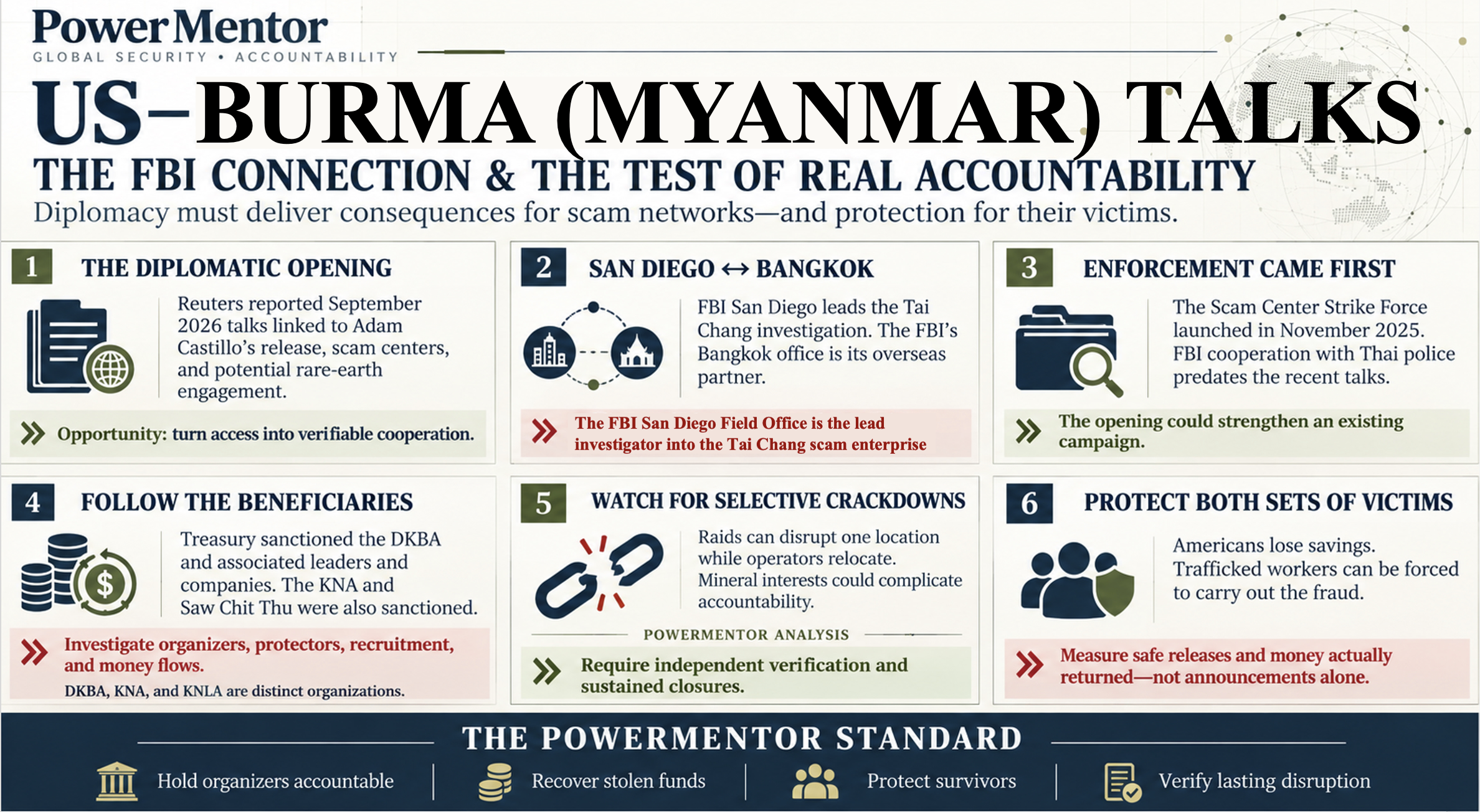
Reuters reported on October 8 that U.S. official Michael Vance participated in September 15–16 talks with Min Aung Hlaing connected to Adam Castillo’s release. The outreach included scam centers and potential rare-earth engagement. Reuters also reported FBI contact with Burma (Myanmar) authorities and U.S. contacts with opposition and ethnic armed groups. Min Aung Hlaing remained under U.S. sanctions. [2]
The policy question is therefore broader than whether American officials should speak to an objectionable counterpart. Leaders sometimes need contact with people who control access, territory, detainees, or information. The practical question is what Washington obtains, what it offers, and how independently it can verify compliance.
Direct engagement can create leverage if cooperation is tied to specific actions. It can also be exploited if diplomatic access is granted in return for vague commitments. Our standard should be consistent: conversations are useful when they help protect people, disrupt criminal activity, or recover stolen assets. Access to American officials should never become an unlimited reward for repeatedly promising the same crackdown.
The enforcement campaign began before these talks
On November 12, 2025, the Justice Department announced the Scam Center Strike Force, bringing together prosecutors and federal investigators to pursue Southeast Asian scam networks. Its announced approach included targeting senior criminal figures, disrupting infrastructure and finances, and deploying FBI agents to Bangkok to work alongside the Royal Thai Police. [3]
The potential advantage is coordination. Diplomatic officials may be able to obtain access or cooperation that investigators need. Investigators may be able to identify concrete demands that make diplomacy more effective. Financial authorities can focus pressure on the companies and individuals that keep an operation functioning. Each function has value, but their connection must be demonstrated through results.
FBI San Diego is working with Bangkok
The FBI San Diego Field Office is the lead investigator into the Tai Chang scam enterprise around Kyaukhat in Burma (Myanmar). Its April 30, 2026 announcement identified the FBI Legal Attaché in Bangkok as an investigative partner and describes a related complaint seeking seizure of $30 million in cryptocurrency. [4]
The Bangkok office provides the overseas partnership connection; the FBI describes its international cyber attachés as working with foreign law-enforcement counterparts. [5] San Diego’s role is the lead investigative responsibility in this case. Treasury’s November 12, 2025 sanctions announcement explicitly credits collaboration with FBI San Diego.
Follow the organizers and the money
Treasury’s November 2025 action designated the Democratic Karen Benevolent Army (DKBA), four senior leaders, Trans Asia International Holding Group Thailand Company Limited, Troth Star Company Limited, and Chamu Sawang over their roles in supporting or developing scam operations. The same announcement referenced earlier sanctions against the Karen National Army (KNA) and Saw Chit Thu. These are official sanctions findings, not a substitute for criminal convictions. [6]
These names should be handled precisely. The DKBA, KNA, and KNLA are distinct organizations. Conduct attributed to one organization or particular leaders should not be assigned indiscriminately to another, or to the Karen people as a whole. Accountability is strongest when it identifies the responsible actor, the conduct, and the supporting evidence.
PowerMentor’s position is that responsibility must extend to the people who make exploitation possible. An investigation should ask who controls the premises, supplies protection, recruits workers, moves money, and ultimately receives the proceeds. Those are investigative questions requiring evidence about specific people and transactions.
Arresting a replaceable operator may interrupt activity. Reaching the financial beneficiary or protector can change the incentives that keep the business alive. That is why financial investigations deserve the same attention as dramatic images of compound gates opening.
How evidence from a compound becomes a criminal case
The Shunda investigation provides a documented example. DOJ says the KNLA seized that compound in November 2025. FBI personnel subsequently deployed to Thailand, reviewed thousands of recovered devices, and interviewed former workers. The investigation supported charges against two alleged Chinese managers, Huang Xingshan and Jiang Wen Jie. DOJ reported their arrest in Thailand on immigration charges in early 2026. The U.S. charges remain allegations unless proven in court. [7]
The significance is the pathway from access to evidence to an identifiable defendant. A survivor’s account can help explain how a compound functioned. Devices and transaction records can help test that account and connect activity to particular operators. Investigators must establish those connections rather than assume them.
This helps explain why anti-trafficking organizations may be valuable sources of information. People assisting survivors may encounter witnesses with direct knowledge of recruitment, confinement, supervisors, and abuse.
Survivors must remain people with needs and choices, not merely sources of evidence. Support should protect their safety and autonomy while preserving opportunities for properly conducted investigations.
Two sets of victims belong in the same picture
Official descriptions of these scams identify both financial victims and trafficked workers. People abroad can be deceived into transferring savings, while people inside compounds can be coerced into carrying out the deception. The FBI describes recruitment through false employment promises, confiscated documents, and threats of violence. [4]
A serious response must recognize both forms of harm. Protecting Americans from theft is a legitimate national priority. Protecting people forced to participate in that theft is compatible with that priority. When coercion is established, a person sitting at a scam workstation may also be a victim of the organization directing the operation.
That is why raw arrest totals can be misleading as a measure of success. Authorities should distinguish organizers, willing participants, and people acting under coercion. The goal should be accurate responsibility, safe exits, and lasting disruption.
The same care applies to financial recovery. Identifying funds, freezing them, obtaining forfeiture, and returning money to victims are different stages. A large enforcement headline should make clear which stage has actually been reached. Families cannot rebuild their finances with a number that exists only in an announcement.
The opportunity and the risk in engaging the Burmese generals
The strongest argument for engagement is practical: officials who can facilitate access or influence local actors may be able to help remove obstacles to enforcement. A negotiated channel could potentially support evidence sharing, releases, or action against particular sites. These are possible benefits, not confirmed achievements of the recent talks.
The danger is that cooperation becomes selective. A counterpart could offer visible action against convenient targets while leaving more valuable relationships untouched. Washington should therefore require evidence that the people benefiting from the industry face consequences, including where that evidence creates political discomfort.
Rare-earth discussions introduce an additional policy consideration. Since they appear in the reporting on the outreach, scrutiny should include whether commercial objectives could weaken demands for accountability. That possibility does not establish a secret bargain. It establishes a reason to insist on clarity about concessions and performance.
Engagement should retain room for independent voices. People living near compounds, survivors, and credible local organizations may be able to identify gaps between official claims and conditions on the ground. Their evidence should be evaluated carefully, with protection for those who could face retaliation.
A raid is only the beginning of the test
A July 2026 WIRED investigation reported satellite evidence of at least 25 suspected scam sites newly built or substantially expanded around Myawaddy during the first half of the year. Its findings raised a direct concern about operations growing or relocating despite earlier crackdowns. [8]
This creates an obvious measurement problem. Closing one address can look successful even if the same operators resume work elsewhere. Demolishing buildings can produce compelling images while leaving ownership, recruitment, and financial channels intact.
A credible assessment should follow the organization over time. Who stopped operating? Who moved? Were workers released into safety or transferred? Did the financial network lose access to funds and infrastructure? Did the people financing the operation face legal consequences?
The same standard should apply regardless of which government or armed organization claims credit. An actor’s preferred narrative is not a performance measure. Independent verification and sustained changes in behavior are.
The accountability standard PowerMentor supports
First, require specific commitments. Any cooperation framework should identify the action expected, the responsible authority, and a realistic completion date. General assurances about opposing crime are too easy to repeat without changing conditions.
Second, pursue responsibility beyond the compound floor. Investigations should follow ownership, protection arrangements, recruitment, and money flows where evidence supports doing so. Political convenience should not determine which credible leads are examined.
Third, measure survivor outcomes. Safe release should include appropriate support and a viable route forward. Moving someone from one form of confinement into another should not automatically be celebrated as rescue.
Fourth, report financial outcomes precisely. Public accounting should distinguish assets restrained, assets forfeited, and funds actually returned to eligible victims. Investigative confidentiality can coexist with honest descriptions of progress.
Fifth, test whether disruption lasts. Follow-up assessments should examine reopening, relocation, changes in operators, and continued recruitment. Early claims of success should be revisited after enough time has passed to detect adaptation.
Sixth, tie benefits to verified conduct. Any proposed concession should be justified by what has actually been delivered, with a way to respond when commitments are broken. Accountability loses force when cooperation becomes an entitlement.
Seventh, protect the integrity of the evidence. Separate direct observations from secondhand accounts, record dates and locations accurately, and avoid public accusations that outrun the available documentation. Strong evidence is more useful than a longer list of suspicions.
Leadership will be measured by what changes
PowerMentor believes sustained action against the networks exploiting Americans and trafficking people into forced criminal work is key. The established San Diego FBI–Bangkok investigation shows that this issue already has a concrete enforcement dimension. The diplomatic opening should be assessed by how effectively it strengthens that work.
We should give credit when investigators build cases, authorities disrupt operations, survivors reach safety, and stolen money is recovered. We should demand better when public commitments produce little durable change. Both positions follow the same principle: leadership carries responsibility for outcomes.
Every party seeking recognition for fighting this industry should be prepared to demonstrate whose freedom was restored, whose criminal capacity was reduced, and whose stolen money was returned. That is the accountability this moment requires.
Sources and reporting scope
Public sources reviewed through October 11, 2026. Numbered references support the factual passages; policy judgments and proposed standards are PowerMentor commentary. No access to the full paid On Myanmar article is claimed.
[1] On Myanmar. User supplied excerpt from A different way to read the US-junta talks. Full paid article not reviewed. Publication homepage Read source
[2] Reuters. US opens direct talks with Myanmar’s generals reversing years of isolation — October 8, 2026 Read source
[3] U.S. Department of Justice. New Scam Center Strike Force Battles Southeast Asian Crypto Investment Fraud Targeting Americans — November 12, 2025 Read source
[4] FBI San Diego. Investigation Leads to Up to 10 Million Dollar State Department Reward for Information on Tai Chang — April 30, 2026 Read source
[5] FBI. The Cyber Threat — description of international cooperation Read source
[6] U.S. Treasury. Treasury Sanctions Burma Armed Group and Companies Linked to Organized Crime Targeting Americans — November 12, 2025 Read source
[7] U.S. Department of Justice. Scam Center Strike Force Takes Major Actions Against Southeast Asian Scam Centers Targeting Americans — April 2026 Read source
[8] WIRED. Satellite Images Reveal How Suspected Scam Compounds Appear Out of Nowhere — July 24, 2026 Read source
