

The Far Left Network Behind France’s Student Protest Narrative
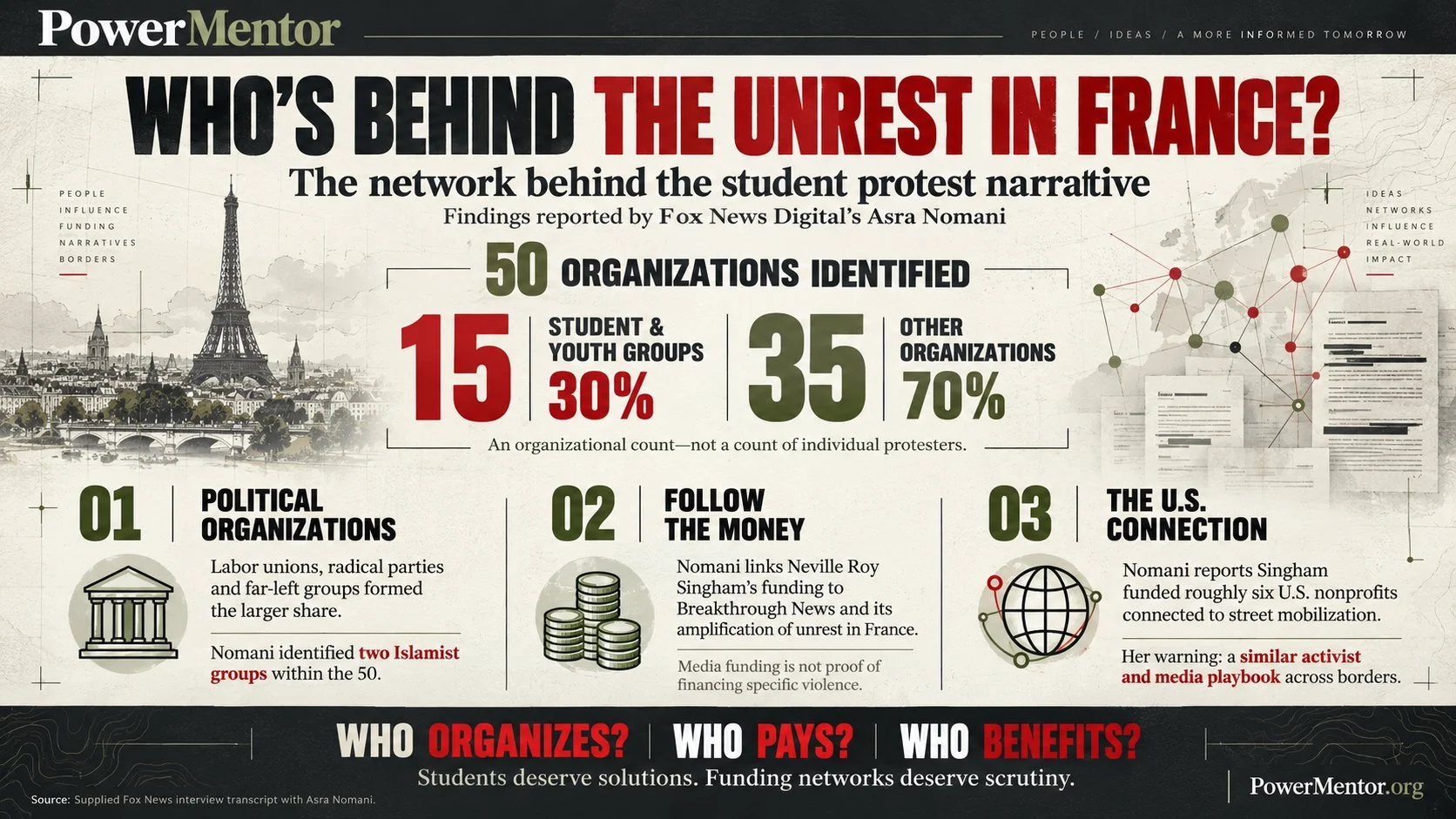
Fifteen student and youth organizations. Thirty-five other organizations. That breakdown is the starting point for understanding the network behind the unrest in France examined by Fox News Digital’s Asra Nomani. Of the 50 organizations she identified, just 30 percent were student or youth groups. The remaining 70 percent included labor unions, political parties, and other adult organizations, many she identified as communist, socialist, or far left.
Calling this simply a student uprising leaves the public with an incomplete picture of who was involved. Young people’s concerns may provide the movement’s public face, while established political organizations bring their own agendas, infrastructure, and ambitions. The accountability question is straightforward: Who is speaking for students, and who is using students to advance a separate political project?
The numbers expose the limits of the student narrative
The 15-to-35 split concerns organizations, not a headcount of people in the streets. Its significance is organizational: student and youth groups were a minority of the identified coalition. A description centered exclusively on students obscures the larger political apparatus operating alongside them.
Nomani identified the French Communist Party among the political forces that became involved. Her investigation describes established actors moving quickly to exploit youth concerns and turn them into a broader campaign against President Emmanuel Macron and his government, with approaching elections adding political incentive.
Students deserve answers about their education and their future. Those concerns should not become disposable material for parties seeking leverage. When political actors join a student movement, the public deserves to know what they control, what they demand, and whether their involvement helps resolve the original grievance.
An alliance organized around shared opposition
Within the same 50 organizations, Nomani identified two as strongly Islamist. She described an alignment between the far left and Islamist organizations, using the terms red and green to distinguish the ideological currents. Her concern was a coalition capable of working together against shared targets despite differences in its members’ broader beliefs.
That distinction matters: this is a claim about particular organizations and their political cooperation. Muslim identity, immigrant background, and membership in an Islamist political organization are not interchangeable. Accountability requires identifying the actual actors, their conduct, and their relationships.
Following the money into the information campaign
The investigation’s funding trail leads to Neville Roy Singham and a network Nomani links to money coming out of China. In the interview, she specifically connects Singham’s funding to Breakthrough News, which she describes as a propaganda outlet spreading images and videos of France in flames.
This part of the investigation concerns the power to amplify unrest. A confrontation can occur on one street, but its images can be distributed internationally to create a much larger political impression. Nomani identifies that impression as the West in chaos: democratic societies presented as unstable, failing, and unable to govern themselves.
The reported link to Breakthrough News is a funding and media-amplification claim. The supplied interview does not establish that Singham directly paid all 50 French organizations or financed particular acts of violence. Keeping the financial trail precise strengthens the demand for accountability: identify each recipient, document each transfer, and establish what the money supported.
For PowerMentor, the information campaign belongs at the center of this story. Audiences need to understand who finances the outlets shaping their interpretation of events. A video may show a real incident while its selection, repetition, and framing serve a wider political objective. Financial transparency helps the public evaluate that objective.
Why the American connection matters
Nomani draws a direct comparison with activism in the United States. She says Singham funded roughly half a dozen American nonprofits connected to street mobilization, and she points to demonstrations involving Palestine, opposition to Israel, and an ICE-related incident in New York City.
Her central warning is that France and the United States should not be viewed as isolated cases. The interview describes overlapping funding, nonprofit, activist, and media networks that can mobilize around different controversies while advancing a broader ideological agenda.
The significance for Americans is the structure she describes: organizations capable of moving from issue to issue, attracting participants with immediate grievances, and carrying the resulting confrontations into an international media campaign. Understanding that structure requires looking beyond a demonstration’s slogan to the organizations coordinating it and the funders sustaining their work.
A sympathetic cause does not exempt its organizers from scrutiny. The public can take a grievance seriously while demanding an honest account of the people and institutions claiming to represent it.
Communities should not become political instruments
The interview also addresses participation by people from migrant communities, including young people born in France. Nomani’s argument is that legitimate community concerns can be exploited by political organizations whose objectives extend beyond solving those concerns.
That makes outcomes an essential measure of leadership. What specific remedy is being sought? Who can deliver it? What progress would allow organizers to declare success? When demands remain open-ended and escalation becomes the recurring result, communities have reason to ask whose interests are being served.
Follow the money and establish the conduct
The interview raises possible investigative avenues involving foreign funding, money laundering, bank fraud, wire fraud, and tax compliance. Those are proposed areas of scrutiny, not criminal findings established by the supplied transcript. A serious accountability effort must connect evidence to specific people, transactions, and conduct.
PowerMentor supports a rigorous examination of funding arrangements and organizational relationships. Investigators should establish where money originated, which entities received it, how it moved between organizations, and whether spending matched the purposes represented to donors and regulators. They should also determine whether financial or operational links connect particular actors to unlawful conduct.
The same discipline should apply to media coverage. Reporters should identify the organizations behind demonstrations, explain their political affiliations, and disclose documented financial connections. Calling a coalition student led should require evidence of student leadership, especially when most identified organizations fall outside the student and youth category.
Political ideology alone does not establish criminal responsibility. Neither does attendance at a protest. The standard must remain documented conduct and applicable law. That standard makes accountability credible and prevents organizers from dismissing legitimate financial scrutiny as an attack on speech.
The PowerMentor position
We reject the exploitation of students and vulnerable communities as instruments of ideological power. Their grievances deserve practical answers, and their participation should never become a shield against scrutiny of the adults, political organizations, and funding networks operating around them.
We support transparency about who organizes, who pays, and who shapes the message. Where evidence establishes unlawful conduct, we support accountability for those responsible. Where political organizations claim to represent a community, we expect them to explain what measurable improvement their strategy will deliver.
Nomani’s investigation gives that demand a concrete starting point: 50 identified organizations, only 15 of them student or youth groups, a substantial presence of established political actors, and a reported funding connection to international media amplification. Each element deserves attention on its own terms. Together, they challenge the adequacy of a simple student protest narrative.
The question for the public is no longer merely what the crowd is demanding. It is who is organizing around that demand, who is financing the message, and whether the people whose concerns launched the protest will benefit from what follows.
Students deserve solutions. Communities deserve honest representation. The organizations claiming to speak for them must answer for their actions.
