
Underground Church in China Under Attack: The Chinese Communist Party's Long Campaign to Eliminate Christianity
When Faith Is Viewed as a Threat
The detention of pastors and ministry leaders from China's underground Zion Church is more than an isolated criminal case. It reflects a longstanding policy by the Chinese Communist Party (CCP) to bring every aspect of religious life under state supervision. According to reports, authorities accused church leaders of illegally distributing religious content online after new regulations tightened restrictions on internet-based religious activities. Human rights organizations argue that the underlying issue is not merely online content but the government's insistence that religious organizations remain subject to Communist Party oversight.
For Christians who worship outside the government's officially approved religious system, the choice has often been stark: submit to state control or risk surveillance, detention, fines, or imprisonment.
The Bible: A Book Under Government Control
One of the clearest examples of the Chinese Communist Party's control over Christianity is its regulation of the Bible itself.
Unlike many nations where Scripture can be purchased freely in bookstores or online, Bible printing and distribution in China are tightly controlled by the state. Legal printed Bibles are generally available only through government-approved churches affiliated with the Three-Self Patriotic Movement (TSPM). They are not sold through ordinary bookstores, and since 2018, online Bible sales have been prohibited.
For believers who worship in China's vast underground house church movement, obtaining a Bible can be significantly more difficult. Because many refuse to register with state-controlled churches, they often rely on existing personal copies, discreet sharing among believers, or unofficial distribution networks. Christian ministries have documented efforts over several decades to provide Bibles to believers through clandestine means, particularly during periods when legal access was extremely limited. One of the most well-known examples was Project Pearl in 1981, when Open Doors delivered approximately one million Chinese-language Bibles to believers in a single nighttime operation on the southern Chinese coast.
Today, while legally printed Bibles do exist in China, government restrictions on distribution, censorship of religious publishing, regulation of online sales, and continuing pressure on unregistered churches mean that many underground Christians still face substantial barriers to obtaining Scripture through ordinary legal channels.
For millions of believers around the world, the Bible is an everyday possession. For many Christians worshiping outside China's state-approved system, access to Scripture can still require extraordinary courage, sacrifice, and perseverance.
Who Are China's House Churches?
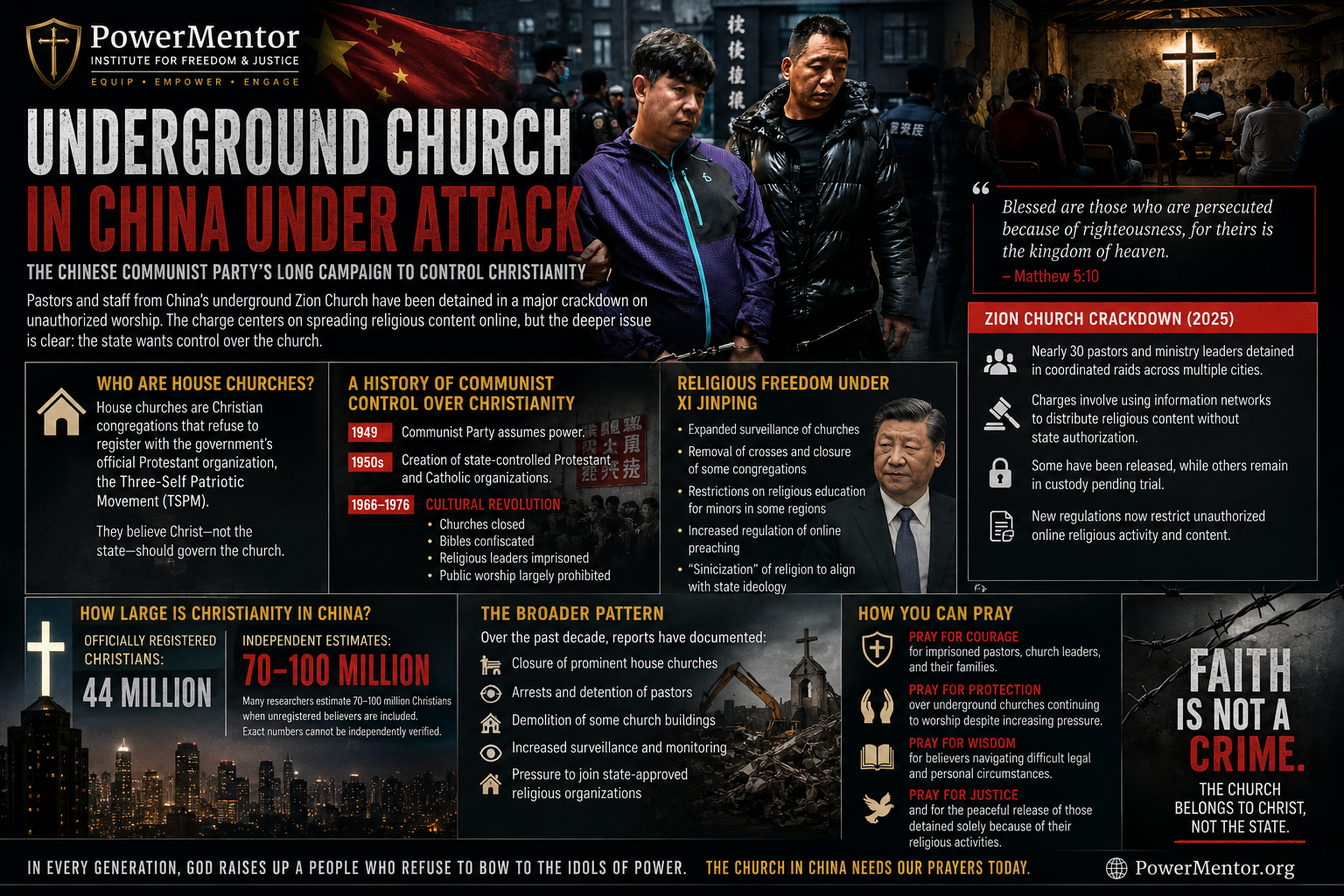
House churches—often called underground churches—are Christian congregations that choose to worship independently rather than register with the government's official Protestant organization, the Three-Self Patriotic Movement (TSPM).
Many believers maintain that Christ, rather than the state, should govern the church's doctrine, leadership, preaching, and ministry. As a result, thousands of congregations continue meeting in homes, businesses, and small gatherings despite increasing government pressure.
Why Zion Church Was Targeted
Reports indicate that Zion Church had grown into one of China's largest and most influential house church networks.
Authorities alleged that church leaders violated regulations governing online religious communication. However, observers note that the crackdown occurred shortly after China introduced stricter rules prohibiting unauthorized online preaching and expanding state oversight of religious activities to suppress and eliminate Christianity.
According to available reporting:
Nearly 30 pastors and ministry leaders were detained in coordinated raids.
Arrests occurred across multiple cities.
Some detainees were later released, while others remained in custody pending criminal proceedings while enduring interrogations and abuse.
Charges reportedly involve the use of information networks to distribute religious content without state authorization.
A History of Communist Control Over Christianity
The CCP has sought to regulate religious organizations since the establishment of the People's Republic of China in 1949.
Major developments include:
1949 — Communist Party assumes power.
1950s — Creation of state-controlled Protestant and Catholic organizations intended to separate churches from independent leadership.
1966–1976 (Cultural Revolution)
• Churches closed
• Bibles confiscated
• Religious leaders imprisoned
• Public worship largely prohibited
After the Cultural Revolution, some churches reopened under government supervision, while many Christians continued worshiping independently, leading to the growth of today's house church movement.
Religious Freedom Under Xi Jinping
Since Xi Jinping became China's top leader, analysts and human rights organizations have documented expanded efforts to increase government oversight of religion.
Measures have included:
• Expanded surveillance of churches
• Removal of crosses and closure of some congregations
• Restrictions on religious education for minors in some regions
• Increased regulation of online preaching
• Campaigns promoting the "Sinicization" of religion, encouraging religious practice to align with state ideology
How Large Is Christianity in China?
Reliable figures are difficult to establish because many believers worship outside officially registered churches.
Frequently cited estimates indicate:
• Officially registered Christians: approximately 44 million.
• Independent estimates: many researchers and analysts estimate 70–100 million Christians in China when unregistered believers are included, although exact numbers cannot be independently verified.
If these higher estimates are accurate, Christianity represents one of China's largest religious communities.
The Broader Pattern
The Zion Church case is not the first major action against independent churches.
Over the past decade, reports have documented:
• Closure of prominent house churches
• Arrests of pastors
• Demolition of some church buildings
• Increased surveillance
• Pressure to join state-approved religious organizations
Observers differ on the motivations behind these policies. Human rights organizations argue they are intended to restrict independent religious practice, while Chinese officials maintain they are enforcing laws governing religion and social stability.
Why This Matters
For many Christians, the central issue is not simply registration paperwork but whether the church remains free to determine its own preaching, leadership, discipleship, and ministry without political direction.
The arrests of Zion Church leaders have become a prominent example in the broader international discussion about religious liberty, state authority, and the treatment of independent faith communities in China.
How You Can Pray
Pray for courage for imprisoned pastors, church leaders, and their families.
Pray for protection over underground churches continuing to worship despite increasing pressure.
Pray for wisdom for believers navigating difficult legal and personal circumstances.
Pray for justice and for the peaceful release of those detained solely because of their religious activities.
"Blessed are those who are persecuted because of righteousness, for theirs is the kingdom of heaven." — Matthew 5:10
PowerMentor Institute for Freedom & Justice
"Equipping leaders to defend freedom, justice, and human dignity around the world."
