

Thailand's Vision for a Stronger Future: A Historic Path Toward Opportunity, Self-Reliance, and Shared Prosperity
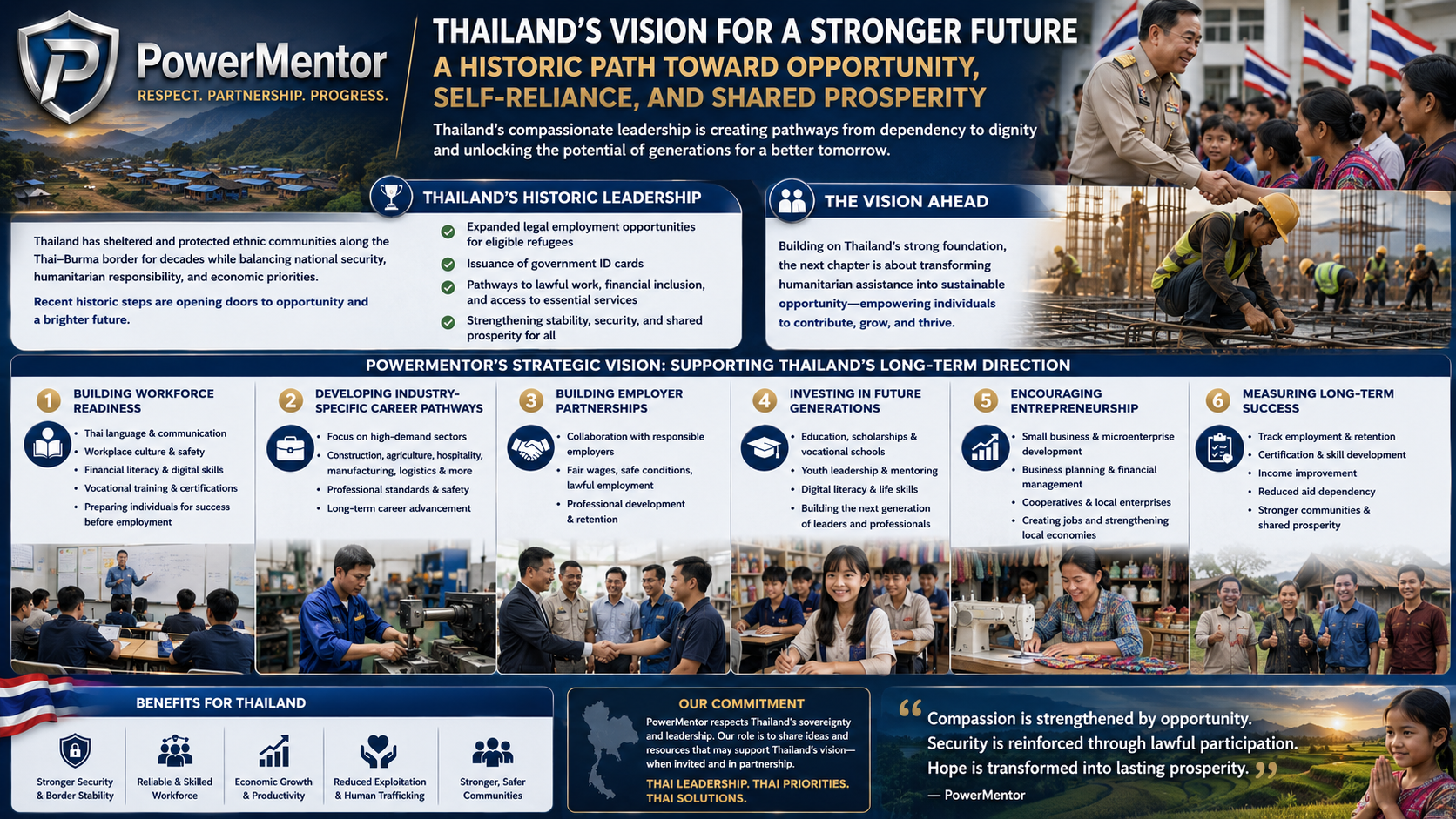
For more than four decades, the Royal Thai Government has carried one of Southeast Asia's most significant humanitarian responsibilities by providing refuge to hundreds of thousands of people displaced by conflict in Burma. Throughout changing political environments, Thailand has consistently balanced national security, border stability, humanitarian responsibility, and economic priorities while extending protection to Karen, Karenni, Mon, and other ethnic communities living along the Thai-Burma border.
Today, Thailand is demonstrating a new level of leadership by moving beyond long-term humanitarian assistance toward policies that encourage self-reliance, lawful employment, and economic participation. These initiatives represent an important evolution in public policy—one that recognizes both the dignity of displaced people and Thailand's long-term national interests. PowerMentor commends the Royal Thai Government for taking thoughtful and courageous steps toward solutions that benefit both Thailand and the ethnic communities it has generously hosted for so many years.
A Historic Policy Shift
Thailand's recent decision to expand legal employment opportunities for eligible refugees living in the border camps marks one of the most significant policy developments in decades. Rather than allowing generations of capable individuals to remain dependent upon humanitarian assistance, Thailand is opening pathways that enable qualified individuals to contribute to the nation's workforce while supporting their families with dignity.
Equally significant is the government's initiative to issue official government identification cards to eligible displaced persons. Legal identity is far more than documentation—it is the gateway to lawful employment, financial services, healthcare access, legal protection, and participation in society. These important reforms demonstrate Thailand's commitment to practical solutions that strengthen both humanitarian outcomes and national development.
Building on Thailand's Vision
PowerMentor believes Thailand has established an outstanding foundation upon which future initiatives can continue to build. The government's current direction reflects an understanding that well-documented, well-trained, and lawfully employed individuals strengthen society rather than burden it.
The next chapter naturally moves from documentation to workforce development, from work authorization to career preparation, and from temporary assistance to long-term economic contribution. These are opportunities that can strengthen Thailand's economy while helping thousands of families achieve greater independence and stability.
PowerMentor's Strategic Vision: Supporting Thailand's Long-Term Direction
PowerMentor's vision is not to change Thailand's direction, but rather to identify practical ideas that could complement the remarkable foundation the Royal Thai Government has already established should future opportunities for dialogue arise.
Phase One: Building Workforce Readiness
The issuance of legal identification creates the essential first step. The next opportunity is preparing individuals to become successful participants in Thailand's workforce. PowerMentor envisions comprehensive Workforce Readiness Centers located near the border regions that would focus on practical preparation before employment begins.
Training could include Thai language instruction, workplace communication, cultural orientation, financial literacy, digital skills, labor rights, workplace safety, ethics, and vocational certifications aligned with Thailand's labor market. By investing in workforce readiness before employment, both workers and employers benefit from greater success and long-term retention.
Phase Two: Developing Industry-Specific Career Pathways
Thailand continues to experience labor shortages across multiple sectors. PowerMentor envisions structured workforce pathways that prepare qualified participants for industries where demand already exists.
Programs could focus on construction, agriculture, food processing, hospitality and tourism, elder care, manufacturing, logistics, textiles, community health support, and technical trades. These career pathways would emphasize professional standards, safety, certification, and long-term career advancement rather than temporary employment.
Phase Three: Building Employer Partnerships
Strong partnerships with responsible employers are essential to long-term success. Future initiatives could encourage collaboration between government agencies, employers, vocational institutions, and community organizations to ensure workers are properly prepared before entering the workforce.
PowerMentor believes employer participation should include commitments to fair wages, safe working conditions, lawful employment practices, professional development, and respect for Thailand's labor regulations. Such partnerships benefit employers through a reliable workforce while providing workers with stability and opportunity.
Phase Four: Investing in Future Generations
Long-term prosperity depends upon preparing the next generation. Workforce development should be complemented by investments in education, vocational schools, leadership development, entrepreneurship training, digital literacy, scholarships, and youth mentoring.
Young people who have spent much of their lives in refugee camps possess tremendous untapped potential. By providing educational and professional pathways, Thailand has an opportunity to cultivate future workers, entrepreneurs, community leaders, and skilled professionals who contribute positively to the nation's continued growth.
Phase Five: Encouraging Entrepreneurship
Not every individual will pursue traditional employment. PowerMentor believes entrepreneurship can become another avenue for economic participation. Small business development, vocational cooperatives, agricultural enterprises, artisan production, and family-owned businesses can create additional opportunities while strengthening local economies.
Training in business planning, financial management, marketing, cooperative development, and microenterprise can help individuals build sustainable livelihoods while contributing to Thailand's economic vitality.
Phase Six: Measuring Long-Term Success
One of Thailand's greatest opportunities is demonstrating measurable success through outcomes. Future initiatives could evaluate progress by tracking employment rates, workforce retention, vocational certification, language proficiency, employer satisfaction, reductions in aid dependency, household income, and educational advancement.
Documenting successful outcomes would help guide future policy while demonstrating Thailand's leadership in developing practical and responsible humanitarian solutions.
A Vision Rooted in Respect
PowerMentor recognizes that every decision concerning refugee policy belongs solely to the Royal Thai Government. Thailand has demonstrated remarkable leadership by carefully balancing humanitarian compassion with national security, economic priorities, and responsible governance.
Our purpose is simply to share ideas that may complement Thailand's existing vision should they ever prove useful. We deeply respect Thailand's sovereignty and believe the most enduring solutions are those developed through Thai leadership, Thai priorities, and Thai decision-making.
A Future Built on Opportunity
The Royal Thai Government has already demonstrated that humanitarian responsibility and national development can move forward together. The recent expansion of legal employment opportunities and government identification represents far more than administrative reform—it signals a future built upon opportunity, responsibility, dignity, and shared prosperity.
PowerMentor is honored to recognize these historic achievements and remains encouraged by the positive direction Thailand has chosen. We believe the continued development of education, workforce readiness, professional training, entrepreneurship, and responsible employment can further strengthen Thailand while creating new opportunities for Karen, Karenni, Mon, and other ethnic communities to contribute productively to the nation that has provided them refuge for generations.
Thailand's leadership is helping write a new chapter—one where compassion is strengthened by opportunity, security is reinforced through lawful participation, and hope is transformed into lasting prosperity.
