

SCEF's Greatest Challenge: Can a Coalition Built on Federalism Legitimately Speak for Ethnic Nations Seeking Self-Determination?
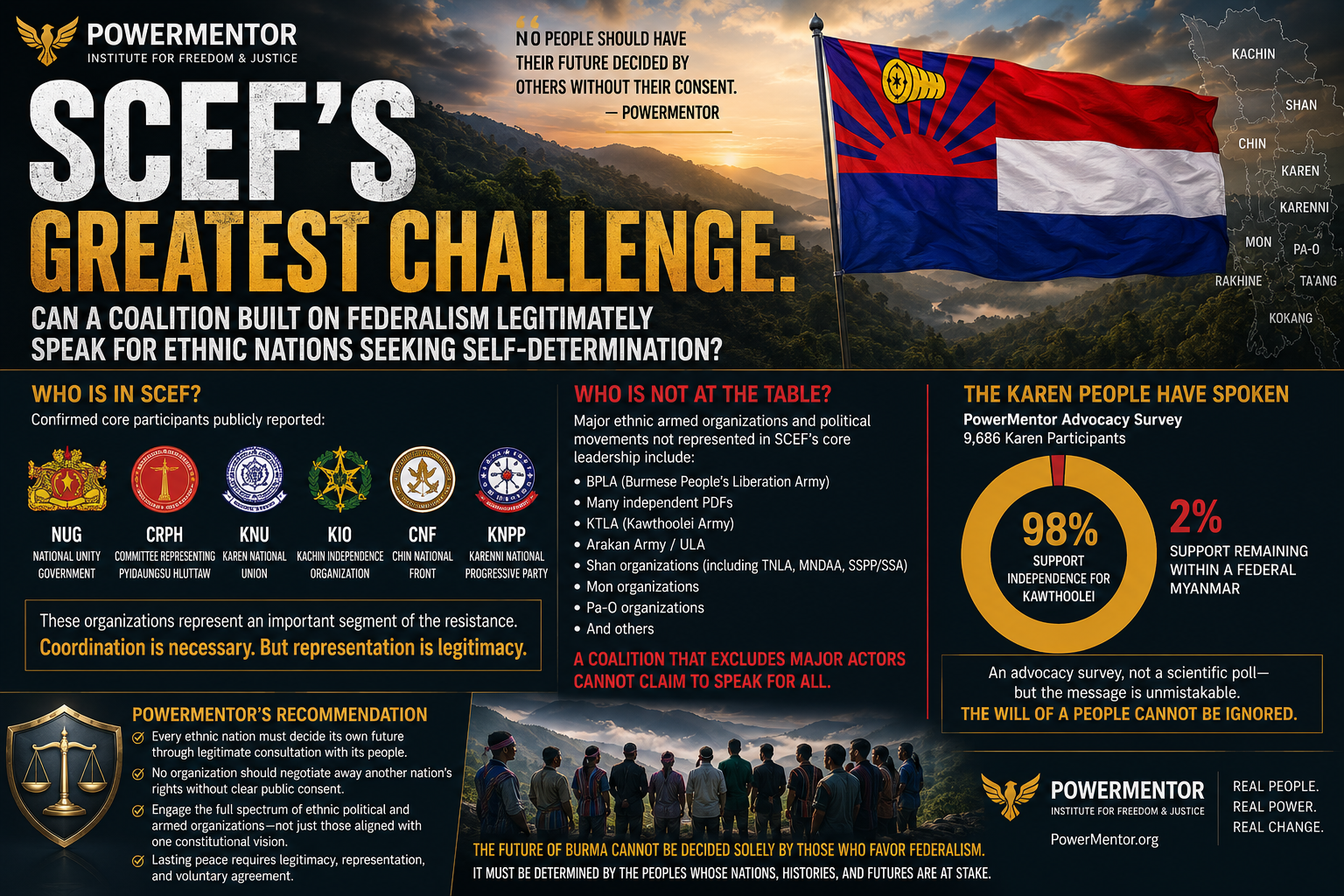
The creation of the Steering Council for the Emergence of a Federal Democratic Union (SCEF) has been presented by many observers as an important milestone in Burma's resistance movement. At first glance, the initiative appears promising. It seeks to strengthen coordination among resistance forces, improve political unity, and develop a common strategy against the military regime.
Its founding members include the National Unity Government (NUG), Committee Representing the Pyidaungsu Hluttaw (CRPH), Karen National Union (KNU), Kachin Independence Organization (KIO), Chin National Front (CNF), and Karenni National Progressive Party (KNPP), along with associated leadership structures. Collectively, these organizations represent an important segment of the resistance.
Their commitment to greater coordination should be recognized as a positive development.
However, coordination alone does not resolve the most fundamental political question confronting Burma today:
Who has the legitimate authority to determine the constitutional future of Burma's ethnic nations?
That question deserves far greater attention than it has received.
The Fundamental Assumption Behind SCEF
The very name "Steering Council for the Emergence of a Federal Democratic Union" reveals an important reality.
SCEF is not simply coordinating military operations. It is coordinating around a predetermined constitutional objective—the establishment of a Federal Democratic Union.
For many participants, federalism represents the preferred future.
But federalism is not the only vision being pursued across Burma's ethnic landscape.
Numerous ethnic organizations, political movements, and community leaders advocate varying degrees of self-determination, enhanced autonomy, confederation, or complete independence. These competing constitutional visions have existed for decades and continue to shape political realities throughout the country.
A durable political settlement cannot simply presume that every ethnic nation shares one constitutional objective.
Representation Is the Foundation of Legitimacy
One of SCEF's greatest challenges is not military capability—it is political legitimacy.
Although its membership includes several influential organizations, many significant armed movements and political actors remain outside its core structure.
Publicly available information indicates that organizations such as the Kawthoolei Army (KTLA) and numerous independent People's Defence Forces (PDFs) are not represented within SCEF's principal leadership. Likewise, important actors from Rakhine, Shan, Mon, Pa-O, Ta'ang, Kokang, and other ethnic communities are either absent or not publicly identified as equal decision-makers within the council.
These omissions do not diminish the importance of SCEF's participating members.
They do, however, raise legitimate questions about whether any coalition can negotiate the constitutional future of ethnic nations that are not fully represented at the table.
The Karen Example Illustrates the Larger Challenge
Perhaps nowhere is this question more visible than within the Karen movement itself.
International observers often speak as though the Karen National Union (KNU) represents a unified Karen political position.
The reality is considerably more complex.
The Karen political landscape includes multiple organizations, military commands, political leaders, civil society organizations, diaspora communities, and emerging movements that do not necessarily share identical constitutional objectives or political strategies.
While the KNU has chosen to participate in SCEF and continues to support a future federal democratic union, other Karen organizations advocate significantly greater levels of Karen self-government, including full independence for Kawthoolei.
This diversity of opinion demonstrates why no single organization should automatically be presumed to speak on behalf of every Karen citizen.
PowerMentor's Survey Raises an Important Question
Recognizing the need to better understand Karen public sentiment, PowerMentor conducted an advocacy survey involving 10,686 Karen participants living both inside Burma and throughout the global Karen diaspora.
The findings were striking:
98% supported independence for Kawthoolei.
2% supported remaining within a federal Burma (Myanmar).
As an advocacy survey, these findings reflect the views of the participants who chose to respond and should not be interpreted as a scientifically representative poll of every Karen citizen.
Nevertheless, the overwhelming preference expressed by participants raises an important question that deserves serious consideration:
If substantial numbers of Karen people favor independence rather than federalism, who has the authority to negotiate a federal constitutional settlement on their behalf?
That question should not be dismissed simply because it is politically inconvenient.
Peace Cannot Be Built on Assumptions
History demonstrates that lasting peace agreements are built upon consent, not assumptions.
Federalism cannot become durable merely because influential organizations endorse it.
Likewise, independence cannot become legitimate simply because others advocate it.
The constitutional future of each ethnic nation must ultimately rest upon the freely expressed will of its own people.
Any political framework that bypasses that principle risks creating future instability regardless of how successful it appears diplomatically.
PowerMentor's Recommendation
PowerMentor believes the international community should welcome efforts to improve coordination among resistance organizations while remaining cautious about assuming that any single coalition represents the constitutional aspirations of every ethnic nation.
Future negotiations should be guided by several principles:
• Every ethnic nation should have the opportunity to determine its own constitutional future through legitimate consultation with its own people.
• No organization should presume authority to negotiate away another nation's right to self-determination without clear public consent.
• International governments should engage the full spectrum of ethnic political and armed organizations—not solely those aligned with one constitutional vision.
• Lasting peace requires legitimacy, representation, and voluntary political agreement rather than predetermined constitutional outcomes.
The Road Ahead
SCEF represents an important effort to improve resistance coordination, and its participating organizations have made significant sacrifices in the struggle against military rule.
Yet coordination and representation are not synonymous.
Until the constitutional aspirations of all major ethnic communities are meaningfully heard—and until those communities themselves determine the future they wish to pursue—the question of legitimacy will remain unresolved.
The future of Burma cannot be determined solely by those who favor federalism.
It must ultimately be determined by the peoples whose nations, histories, and futures are at stake.
