

Myitsone Dam Returns: Why Many Ethnic Peoples See More Than a Hydropower Project
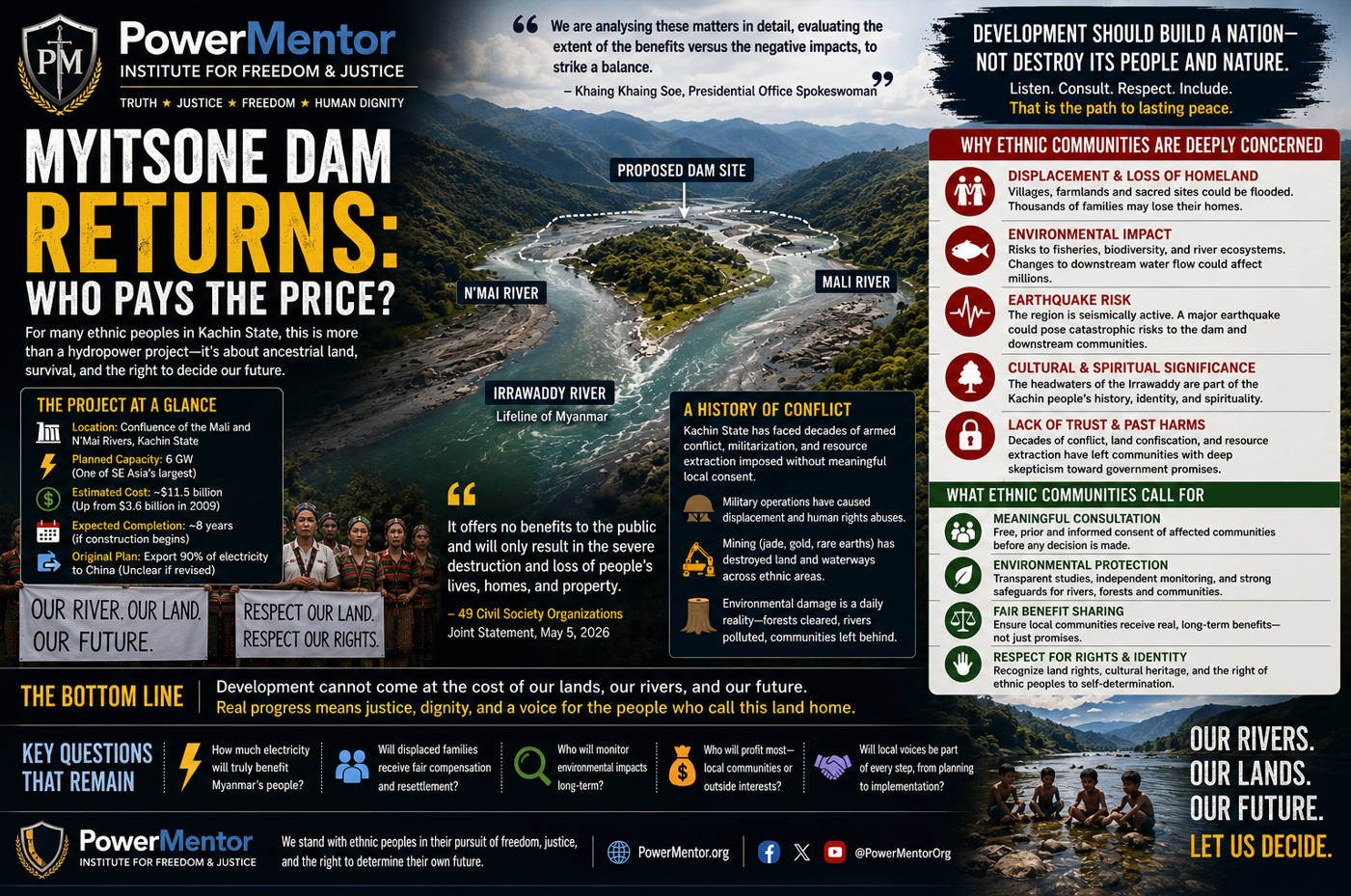
After nearly 15 years of suspension, Burma (Myanmar)'s government has announced plans to revive the Myitsone Hydropower Project in Kachin State—a massive China-backed development that could become one of Southeast Asia's largest hydroelectric dams. Supporters view the project as a solution to Burma's ongoing electricity shortages and a catalyst for economic growth. Yet for many ethnic communities, particularly the Kachin people, the announcement revives decades of unresolved concerns over land rights, environmental stewardship, cultural preservation, and self-determination.
At PowerMentor, we believe that understanding the perspectives of all stakeholders is essential to achieving lasting peace and sustainable development. While governments may view Myitsone through the lens of national infrastructure, many ethnic peoples view it through the lens of history, lived experience, and the future of their ancestral homeland.
A Project Built on Ancestral Land
The proposed Myitsone Dam would be constructed at the confluence of the Mali and N'Mai Rivers, the headwaters of the Irrawaddy River. Beyond its strategic importance, this location holds profound cultural, historical, and spiritual significance for many Kachin communities.
Background
For the ethnic peoples of Burma (Myanmar), the proposed revival of the Myitsone Dam cannot be separated from more than seven decades of conflict between the central military authorities and the nation's ethnic communities. Since Burma's independence in 1948, ethnic regions have experienced repeated military campaigns, village destruction, forced displacement, land confiscation, and allegations of serious human rights abuses including killing, rape, torture, and imprisonment documented by international organizations. Against this historical backdrop, large-scale development projects are often not simply as infrastructure initiatives, but as part of a broader pattern in which decisions affecting ethnic lands are made without the meaningful participation or consent of those who have lived there for generations to further Burmanize the region.
Many ethnic organizations and civil society groups argue that major resource projects—including dams, mining operations, logging concessions, and other extractive industries—have too often resulted in local communities losing their ancestral lands while the economic benefits flow elsewhere. They contend that once communities are displaced, their territories become more accessible for commercial development and natural resource extraction. Whether discussing jade, gold, rare earth minerals, timber, or hydropower, these organizations have consistently called for greater transparency, environmental accountability, and local control over the resources found within their traditional homelands.
The current government's announcement to restart the Myitsone Dam also comes amid continued political controversy. Min Aung Hlaing's administration emerged from the 2026 election, a process that has been widely criticized by numerous governments, international observers, and democracy advocates as lacking credibility, a sham, and genuine political competition. Although the government now operates under civilian institutions, most observers maintain that the Tatmadaw (Burma's military) continues to exercise dominant influence over the country's political system. For many ethnic communities, this reinforces longstanding concerns that centralized decision-making continues to override the voices and aspirations of Burma's diverse ethnic peoples. Previously,
For these reasons, the Myitsone Dam is viewed by many ethnic communities as far more than a hydroelectric project. It represents a broader question of who controls ancestral lands, who benefits from Burma's vast natural resources, and whether the rights, identities, and voices of ethnic peoples will be respected in shaping the country's future.
The Burma military government changed the country's English name from Burma to Myanmar in 1989, a decision that was made without a democratic mandate and remains controversial among citizens, ethnic organizations, and foreign governments. The name change has come to symbolize an effort by successive military regimes to reshape the country's international image, while arguing that the underlying realities of military rule, conflict, and the treatment of the ethnic peoples remains unchanged.
For local residents, the debate is not simply about generating electricity. It is about protecting a homeland that has sustained generations of ethnic families and preserving places that form part of their cultural identity.
A Legacy of Distrust
One of the greatest challenges facing the project is not engineering—it is trust.
For decades, many ethnic communities have experienced armed conflict, land confiscation, displacement, and resource extraction projects that they believe provided limited local benefit while placing significant burdens on surrounding populations. This history has created a deep skepticism toward assurances that new development projects will adequately protect local communities or fairly distribute their benefits.
As a result, government statements that modern engineering can mitigate environmental risks may not fully address the broader concerns of those whose confidence has been shaped by decades of conflict and contested governance.
Environmental Stewardship Remains a Central Concern
Ethnic communities and civil society organizations have long expressed concerns that large-scale infrastructure and resource extraction projects in Burma have contributed to environmental degradation.
Among the concerns frequently raised are:
• Flooding of villages and agricultural land
• Displacement of local families
• Alteration of river ecosystems and fisheries
• Loss of biodiversity
• Long-term impacts on downstream water systems
Independent organizations have also documented environmental challenges associated with resource extraction in various parts of Burma, including mining, deforestation, and pollution. While responsibility for these impacts has been attributed to a range of actors over time, the cumulative effect has reinforced concerns within many ethnic regions about the long-term stewardship of their natural resources.
More Than Electricity—A Question of Self-Determination
Supporters of the project emphasize its potential to help address Burma's electricity shortages. However, many ethnic organizations argue that the central issue extends beyond energy production.
For many local communities, the larger question is:
Who should decide the future of ethnic lands?
This perspective reflects broader discussions about local participation, resource governance, and meaningful consultation regarding projects that directly affect ancestral territories.
Many ethnic leaders have consistently maintained that development initiatives should involve transparent dialogue with affected communities and respect for local voices throughout the decision-making process.
Economic Development and Local Benefit
Large infrastructure projects can bring important economic opportunities, including investment, employment, and expanded energy capacity. However, local communities often ask whether these benefits will be shared equitably.
Questions that remain important include:
• How much electricity will directly benefit Burma's citizens?
• What protections will be provided for displaced families if relocation becomes necessary?
• How will environmental impacts be monitored over time?
• What long-term economic opportunities will remain for local communities after construction is complete?
The answers to these questions will likely shape public confidence as the project progresses.
Peace Requires Partnership
The future of Burma cannot be built solely through large infrastructure projects. Lasting stability depends upon trust, inclusion, transparency, and respect for the rights of all peoples.
For many ethnic communities, sustainable development means ensuring that economic progress does not come at the expense of ancestral lands, cultural heritage, or the ability of local populations to participate meaningfully in decisions that shape their future.
Development and conservation need not be opposing goals. When governments, local communities, and international partners engage in genuine consultation and accountable governance, it becomes possible to pursue both economic advancement and environmental stewardship together.
PowerMentor Perspective
The Myitsone Dam is more than an engineering project—it is a defining test of how development, environmental responsibility, and the rights of ethnic peoples can coexist. We believe that the ethnic people should have independence for freedom and autonomy. Then, and only then, each ethnic group would have the say in whether or not such projects would be permissable.
Infrastructure has the potential to improve lives, but lasting progress is strongest when it is built upon mutual trust, responsible stewardship of natural resources, respect for local communities, and inclusive decision-making, rather than the continued domination from the corrupt and brutal Burma regime. The voices of those who have lived on and cared for these lands for generations should remain an important part of any conversation about their future.
As Burma continues to navigate political transition and economic challenges, the path forward will be measured not only by the projects it builds, but also by how it safeguards its people, protects its environment, and honors the diversity of the nation's ethnic communities, which to date, the Burma regime has never given any indication of safeguarding anyone but themselves.
