

DEATH FROM THE SKY: BURMA’S MILITARY TURNED ITS SHAM ELECTION INTO AN AIR WAR AGAINST CIVILIANS
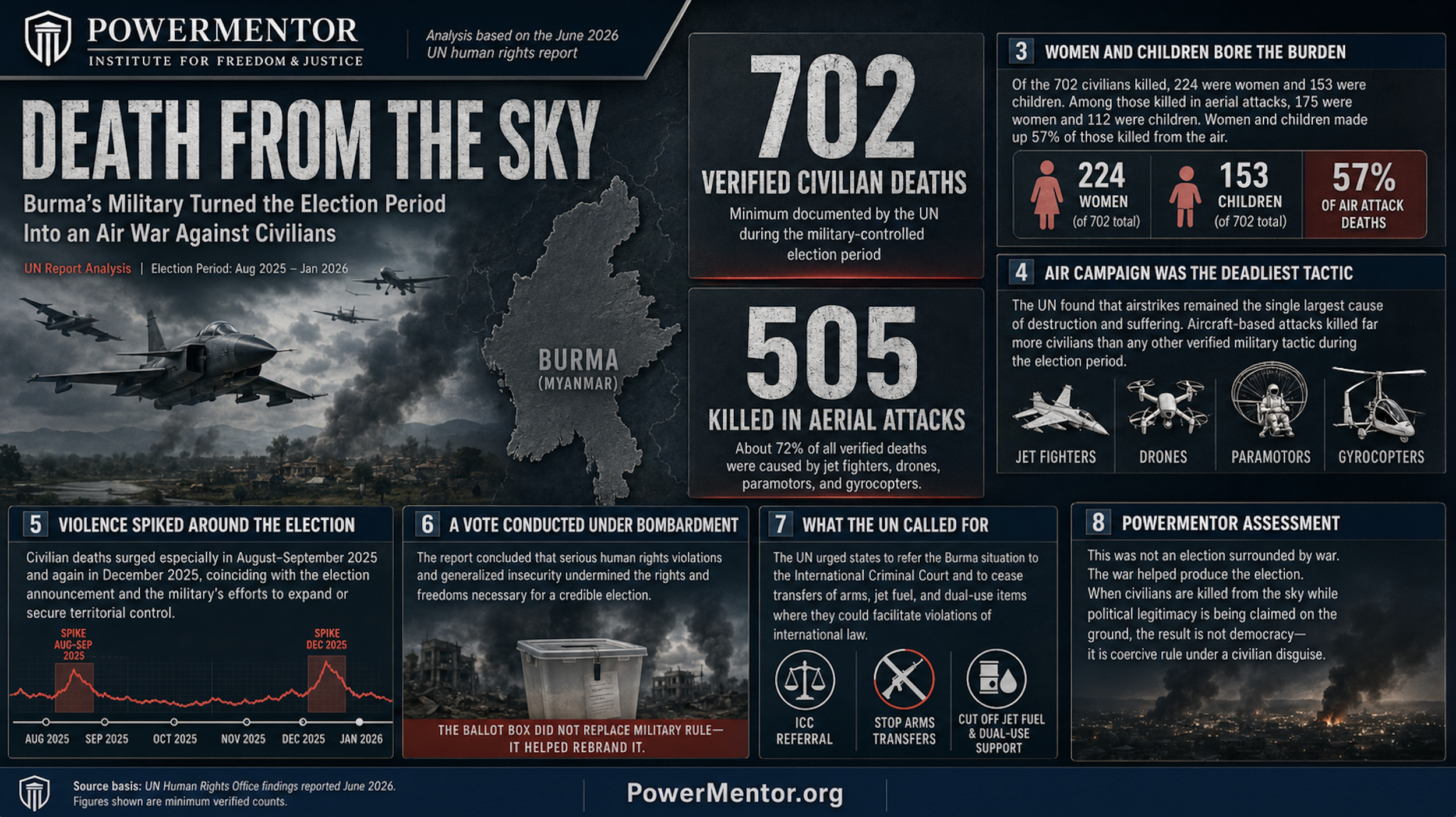
The military-controlled election in Burma was presented as a political transition, but a new United Nations report reveals a far darker reality. During the six months surrounding the election process, the Burma military killed at least 702 civilians, with aircraft responsible for the overwhelming majority of verified deaths. Rather than creating the conditions necessary for citizens to choose their government freely, the military expanded its territorial campaign, attacked communities from the air and conducted voting beneath a climate of violence, displacement and fear.
The report covers the period from August 2025, when the military announced the election process, through the end of voting in January 2026. According to the UN Human Rights Office, the military was responsible for the verified deaths of 224 women and 153 children. These numbers expose the fundamental contradiction behind the election: a government cannot claim democratic legitimacy while its armed forces are bombing the population it supposedly seeks permission to govern.
AIR ATTACKS KILLED MORE CIVILIANS THAN ANY OTHER MILITARY TACTIC
The most significant finding in the report is the central role of the military’s air campaign. At least 505 of the 702 verified civilian deaths—approximately 72 percent—resulted from attacks involving jet fighters, military drones, paramotors and gyrocopters. Air attacks were therefore not a secondary feature of the violence. They were the single largest cause of civilian death, destruction and suffering during the election period.
Among the 505 civilians killed in aerial attacks were 175 women and 112 children. Together, women and children represented approximately 57 percent of those killed from the air. This distinction is important because some news summaries could leave readers with the impression that air attacks caused only 57 percent of the overall deaths. In reality, the air campaign caused nearly three-quarters of all civilian deaths verified by the United Nations.
These figures also demonstrate that the consequences cannot be dismissed as isolated accidents involving combatants. When hundreds of women and children are among the dead, the pattern raises urgent questions concerning target selection, proportionality, distinction and the military’s obligation to protect civilians under international humanitarian law.
THE AIR CAMPAIGN WAS DESIGNED TO EXTEND THE MILITARY’S REACH
The Burma military has increasingly depended upon air power because it cannot consistently control contested territory through ground forces. Resistance organizations and ethnic armed groups have challenged the military across large portions of the country, making conventional occupation costly and difficult. Aircraft allow the military to strike communities beyond the immediate reach of its soldiers, punish populations in resistance-controlled areas and terrorize civilians without maintaining a permanent ground presence.
The UN identified particularly deadly increases during August and September 2025 and again in December 2025. These periods corresponded with the election announcement and military battlefield operations intended to expand or secure territorial control. The timing suggests that the violence was closely connected to the military’s effort to create the appearance of national authority before and during the voting process.
The election was therefore accompanied by a campaign to reshape the battlefield. Where the military lacked political support or effective territorial control, it used air power to intimidate communities, displace residents and weaken resistance. The ballot box existed alongside the bomb crater.
JET FIGHTERS WERE ONLY ONE PART OF THE THREAT
The air campaign was not limited to conventional fighter aircraft. The military also expanded its use of drones, paramotors and gyrocopters, creating a cheaper and increasingly adaptable system of aerial warfare.
Paramotors are lightweight powered paragliders that can carry soldiers and small explosive devices. They can fly at low altitude, approach communities with limited warning and operate without the infrastructure required by military jets. Gyrocopters offer greater speed and range while remaining less expensive and easier to deploy than conventional aircraft. Commercially available components can also make these systems more difficult to stop through traditional arms sanctions.
The growth of these platforms represents a dangerous development. The military is constructing a layered air campaign that combines sophisticated fighter aircraft with inexpensive, improvised systems capable of reaching villages, schools, medical facilities, religious gatherings and displacement sites. Communities that may receive warning of an incoming jet can have far less time to react to a low-flying paramotor or drone.
Reports of aircraft returning after an initial bombing also raise concerns about so-called double-tap attacks, in which a second strike endangers rescuers, medical workers and relatives attempting to help those wounded in the first explosion. Such tactics deepen fear and make even emergency assistance potentially deadly.
AN ELECTION HELD WITHOUT THE CONDITIONS REQUIRED FOR DEMOCRACY
A credible election requires more than printed ballots and polling locations. Citizens must be able to speak, organize, campaign, obtain information and vote without violence or intimidation. The UN concluded that serious human-rights violations and widespread insecurity undermined the fundamental rights and freedoms necessary for a credible electoral process.
The military removed the elected government in the February 2021 coup, arrested political leaders, suppressed peaceful opposition and plunged the country into nationwide war. It then organized a tightly controlled election in which its political allies held decisive advantages and much of the population was excluded, displaced, imprisoned or living in contested territory.
After the election, military-aligned lawmakers selected coup leader Min Aung Hlaing as president. The change in title did not erase the coercive foundation of his authority. Replacing military uniforms with civilian political language does not transform military domination into democratic legitimacy.
The civilian death toll shows that the election was not conducted during a transition away from violence. It was conducted while the military intensified violence against the people.
THE VERIFIED DEATH TOLL IS ALMOST CERTAINLY AN UNDERCOUNT
The UN describes the 702 deaths as a minimum verified figure, not a comprehensive account of everyone killed. Confirming deaths in Burma is extremely difficult because many communities remain inaccessible, communications are restricted, medical systems have been damaged and families may bury victims before independent investigators can document the circumstances.
Some victims die later because they cannot reach hospitals or obtain blood, surgery, medicine or emergency transportation. Others disappear beneath destroyed buildings or are killed in remote areas where no independent organization can investigate. The actual human cost of the election-period campaign is therefore likely higher than the verified total.
The UN also acknowledged that other armed organizations may have caused civilian casualties. However, the 702 verified deaths examined in this report were attributed specifically to the Burma military. Recognizing abuses by any party does not diminish the documented responsibility of the military for the deaths covered by the investigation.
THE INTERNATIONAL SUPPLY CHAIN BEHIND THE AIR WAR
Aircraft cannot continue operating without fuel, replacement parts, navigation equipment, maintenance systems, financial networks and access to dual-use technology. For that reason, the UN called upon governments to stop transfers of arms, aviation fuel and dual-use items where there is a substantial risk that they could facilitate violations of international law.
This recommendation recognizes an uncomfortable truth: Burma’s air campaign is sustained by international supply chains. The bombs may fall inside Burma, but the aircraft components, fuel, technology and financial services enabling the attacks can originate or pass through other countries.
Sanctions that focus only on senior military officials are insufficient when the operational systems responsible for killing civilians remain intact. Effective pressure must address the full network that enables flight operations, including aviation fuel importers, brokers, insurers, banks, shipping companies, aircraft maintenance suppliers and companies providing adaptable commercial technologies.
The increasing use of commercially sourced paramotors and drones makes enforcement more complicated, but not less necessary. Governments must strengthen end-use monitoring and investigate companies or intermediaries whose products are repeatedly converted into weapons against civilians.
THE QUESTION OF WAR CRIMES AND INTERNATIONAL ACCOUNTABILITY
Civilian deaths during an armed conflict are not automatically proof of a war crime. International investigators must examine the intended target, available intelligence, expected civilian harm, weapons used, military necessity and precautions taken before each attack. However, deliberate attacks against civilians, indiscriminate attacks and strikes expected to cause excessive civilian harm in relation to the anticipated military advantage may constitute war crimes.
Repeated attacks affecting homes, schools, hospitals, religious locations and civilian gatherings demand independent investigation. A recurring pattern can also help investigators determine whether particular strikes were isolated failures or part of a broader policy.
The UN report calls upon countries to refer the situation in Burma to the International Criminal Court. Because Burma is not a full party to the Rome Statute, the court’s jurisdiction is limited unless a referral or another recognized jurisdictional basis exists. Continued political paralysis has allowed military leaders to believe that international condemnation will not be followed by meaningful consequences.
Documentation must therefore be preserved now. Satellite imagery, aircraft records, videos, photographs, witness testimony, medical reports, weapons fragments, command structures and supply-chain records may become essential evidence in future international or domestic prosecutions.
POWERMENTOR ASSESSMENT: THIS WAS NOT AN ELECTION SURROUNDED BY WAR—THE WAR HELPED PRODUCE THE ELECTION
The most important conclusion from the UN findings is that the air campaign and the election process should not be treated as unrelated events. The military announced voting while attempting to expand territorial control, intensified attacks during critical stages of the process and then used the resulting election to provide a civilian appearance to continuing military rule.
The violence was not merely background instability. It helped define the political environment in which the election occurred. Bombing communities, displacing populations, imprisoning political opponents and restricting fundamental freedoms ensured that millions of people could not participate in a genuinely free national decision.
The election did not give civilians authority over the military. It gave the military a new mechanism for claiming authority over civilians.
THE WORLD MUST RESPOND TO THE AIR CAMPAIGN, NOT ONLY CONDEMN IT
Statements of concern have not stopped aircraft from taking off. The international response must focus on practical measures that reduce the military’s ability to attack civilians. These include restricting aviation fuel and aircraft components, enforcing targeted financial sanctions, preventing the transfer of dual-use technology, supporting early-warning and civilian-protection systems, funding cross-border humanitarian assistance and preserving evidence for future prosecutions.
Governments should also recognize the political significance of the report. A military-controlled election conducted under aerial bombardment cannot be treated as a legitimate return to civilian government. Diplomatic recognition should not reward an electoral process built upon coercion, exclusion and mass civilian suffering.
CONCLUSION: THE BALLOT COULD NOT HIDE THE BOMBS
The United Nations report removes any remaining illusion that Burma’s election represented a genuine democratic transition. During the six-month election period, the military killed at least 702 civilians, and aerial attacks accounted for approximately 72 percent of those verified deaths. Women and children made up more than half of the people killed from the air.
Behind every number was a person—a child, a mother, an elder, a teacher, a medical worker or a family member whose life ended beneath an aircraft operated by the military claiming the right to govern them.
Burma did not experience democracy from the ballot box. Its civilians experienced death from the sky.
The international community must decide whether it will accept a military dictatorship’s political rebranding or confront the machinery that continues to kill Burma’s people. History will not measure the world’s response by the strength of its statements. It will measure whether governments acted to stop the aircraft, protect civilians and bring those responsible to justice.
