

TWO AMERICANS. TWO AUTHORITARIAN REGIMES. ONE ALARMING MESSAGE: The Detention of Adam Castillo in Burma (Myanmar) and the Arrest of Min Zin in China
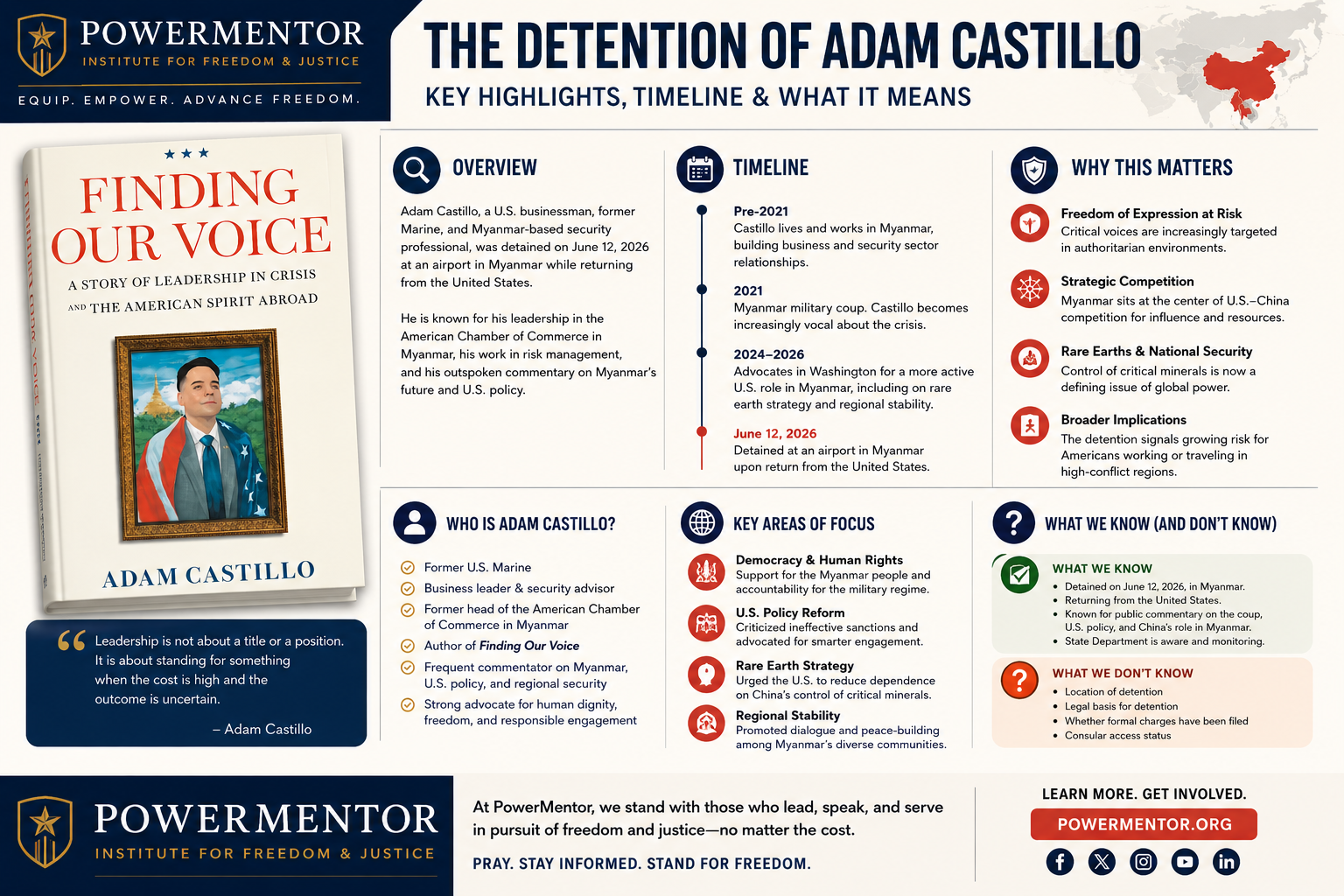
Update: Growing Questions Surround the Official Explanation
As additional reporting has emerged, questions continue to surround the official explanation for Adam Castillo's detention in Burma.
While authorities have reportedly linked the detention to allegations involving a property or organizational dispute, some Burma analysts, democracy advocates, and individuals familiar with the country's political environment have expressed skepticism that the matter can be viewed solely through a commercial or legal lens. Critics of the military regime note that authoritarian governments have historically used allegations involving property rights, financial misconduct, regulatory violations, or breach-of-trust claims as legal mechanisms to detain or pressure individuals who have become politically sensitive or inconvenient.
These concerns are amplified by the broader context surrounding Castillo's work and public profile. Prior to his detention, Castillo had authored Finding Our Voice, a book chronicling his experiences during Burma's 2021 military coup and its aftermath. He had engaged with policymakers, business leaders, and international stakeholders regarding Burma's future and had participated in discussions involving governance, economic development, strategic resources, and regional security. For many observers, the timing of the detention has raised questions that extend beyond the publicly reported allegations.
It is important to distinguish between what is known and what remains uncertain. At present, there is no publicly available evidence proving that the reported allegations were fabricated or that the detention was politically directed. Likewise, there is insufficient information to determine whether the case represents a legitimate legal dispute, a politically influenced prosecution, or a combination of both. The facts remain incomplete.
However, skepticism toward official explanations does not arise in a vacuum. Burma's military government has a documented history of using legal processes against journalists, political opponents, civil society leaders, democracy advocates, and individuals viewed as challenging state interests. Human rights organizations and international observers have repeatedly documented cases in which legal charges were used to justify actions that critics viewed as politically motivated.
For this reason, many analysts caution against drawing premature conclusions. The most responsible approach is to continue examining verified facts as they emerge while advocating for transparency, due process, access to legal representation, and full consular protections. Regardless of the ultimate explanation, the detention of an American citizen under these circumstances warrants close attention from the international community.
As this story continues to develop, the central questions remain unchanged: What is the true basis for the detention? Has due process been afforded? And will the facts ultimately support the official narrative or reveal a more complex reality beneath the surface?
PowerMentor Institute for Freedom & Justice will continue monitoring developments and providing updates as additional verified information becomes available.
_______________________________________________________
In the span of just a few days, two Americans with deep ties to Burma (Myanmar) found themselves detained by two of the most powerful authoritarian governments in Asia. One was arrested in Burma (Myanmar). The other was arrested in China. At first glance, the stories appear unrelated. Yet when viewed through the lens of geopolitics, freedom, and the growing competition between democratic and authoritarian systems, they reveal something much larger than the fate of two individuals.
The detention of Adam Castillo, a former United States Marine, businessman, security professional, and author, and the arrest of Min Zin, a respected scholar, democracy advocate, and policy analyst, have raised serious concerns among diplomats, academics, humanitarian workers, and freedom advocates around the world. While there is currently no evidence that the two cases are directly connected, both men operated in the increasingly dangerous space where truth, influence, national security, and authoritarian power intersect.
What makes these cases significant is not merely that two Americans were detained. It is that both men spent years engaging with one of the most complex geopolitical conflicts in the world: the ongoing struggle for Burma’s (Myanmar) future.
Adam Castillo: Leadership in Crisis
For many people familiar with Burma (Myanmar), Adam Castillo is not an unknown figure. A former Marine who spent years building relationships throughout the country, Castillo became a recognized voice within the international business community and served as a leader within the American Chamber of Commerce in Burma (Myanmar). Unlike many executives who quietly conduct business overseas, Castillo became increasingly involved in conversations about Myanmar's future following the military coup of February 2021.
His recently published book, Finding Our Voice: A Story of Leadership in Crisis and the American Spirit Abroad, chronicles his experiences during one of the most turbulent periods in modern Myanmar history. The title itself reflects a central theme that has defined Castillo's public engagement: the belief that leadership requires moral courage, especially during times of uncertainty.
What makes his detention particularly concerning is that Castillo occupied a unique position within Burma’s (Myanmar) ecosystem. He was neither a politician nor a diplomat. He was a businessman who lived through the collapse of a fragile democratic experiment and chose to speak publicly about what he witnessed. In environments where authoritarian governments increasingly view independent voices with suspicion, that alone can create significant risk.
According to reports, Castillo was detained after returning to Burma (Myanmar) from the United States. As of this writing, many critical questions remain unanswered. Public information regarding his location, legal status, access to legal counsel, and potential charges remains limited. That uncertainty has only intensified concern among those who know him personally and professionally.
The Other American: Min Zin's Arrest in China
While attention has largely focused on Castillo's detention in Burma (Myanmar), another story has unfolded simultaneously in China.
Chinese authorities confirmed the arrest of Min Zin, a United States citizen and one of the most respected Burma (Myanmar) scholars and democracy advocates in the world. Unlike Castillo, whose background is rooted in business and security, Min Zin built his reputation through intellectual leadership, policy research, and democratic activism.
Min Zin first became known during Burma’s (Myanmar) 1988 pro-democracy movement, a historic uprising that challenged military rule and inspired a generation of activists. After spending years in exile, he eventually became a prominent scholar and founded the Institute for Strategy and Policy–Burma (Myanmar), an organization focused on governance, democratic development, and regional affairs.
Chinese authorities have accused Min Zin of espionage and endangering national security. Those accusations are serious. However, observers familiar with authoritarian systems understand that national security laws are often written broadly enough to encompass activities that would be considered normal academic, journalistic, or policy work in democratic societies.
For years, Min Zin studied subjects that sit at the center of China's strategic interests, including Burma’s (Myanmar) political transition, regional security, Chinese influence operations, and the future of democratic governance in Southeast Asia. Whether those activities played a role in his arrest remains unclear, but they undoubtedly placed him in one of the world's most politically sensitive environments.
Burma (Myanmar): The Battleground Few Americans Understand
To understand why these cases matter, one must first understand Burma (Myanmar) itself.
Since the military coup of 2021, Burma (Myanmar) has transformed from a country struggling toward democracy into one of the world's most complex conflict zones. The military junta now faces resistance from ethnic armed organizations, local defense forces, pro-democracy groups, and a wide range of political actors. Entire regions of the country operate outside the effective control of the central government.
The conflict is no longer simply a political crisis. It has evolved into a multi-dimensional struggle involving military power, ethnic identity, resource control, international influence, and competing visions for the future of the nation.
Within this environment, foreign nationals who maintain relationships across multiple sectors often find themselves under heightened scrutiny. Business leaders, researchers, aid workers, journalists, and policy experts frequently operate in a space where information itself becomes politically sensitive.
For authoritarian governments, knowledge can be viewed as influence. Influence can be viewed as interference. And interference can be treated as a security threat.
The China Connection and the New Great Game
Neither of these stories can be fully understood without examining China's role in Burma (Myanmar).
Over the past decade, China has emerged as Burma’s (Myanmar) most influential external actor. Beijing's interests extend far beyond diplomacy. Burma (Myanmar) provides China with strategic access to the Indian Ocean, critical energy infrastructure, transportation corridors, and valuable natural resources. As tensions between China and the United States continue to grow, Burma (Myanmar) has become an increasingly important piece of a much larger geopolitical chessboard.
Perhaps no issue illustrates this reality more clearly than rare earth minerals.
Rare earth elements are essential components in modern technology. They are used in electric vehicles, advanced military systems, missile guidance technologies, satellites, aircraft, and renewable energy infrastructure. While these minerals rarely make headlines, they have become one of the most strategically important resources in the twenty-first century.
Burma (Myanmar) possesses significant rare earth deposits, particularly in regions affected by ongoing conflict. China currently dominates the global processing of rare earth elements, making access to these resources a matter of national security for many nations, including the United States.
Reports indicate that Castillo had advocated for a more active American role in Burma (Myanmar) and had discussed the strategic implications of rare earth supply chains. Whether those activities contributed to his detention remains unknown. What is known is that discussions involving rare earths, Chinese influence, ethnic armed groups, and U.S. strategic interests touch some of the most sensitive issues in the region.
Why Authoritarian Regimes Fear Independent Voices
History provides an important lesson: authoritarian governments rarely fear silence.
They fear people who can communicate effectively.
They fear people who can connect local realities to global audiences.
They fear individuals capable of building networks across political, economic, and cultural boundaries.
Adam Castillo and Min Zin represent two very different kinds of influence. One built his influence through business leadership, operational experience, and personal relationships. The other built his influence through scholarship, policy analysis, and intellectual leadership. Yet both share something important in common: they are independent thinkers whose perspectives carry weight.
Authoritarian systems often struggle to tolerate independent centers of influence because such voices operate outside government control. Whether those voices come from journalists, scholars, business leaders, faith leaders, or civil society advocates, they introduce competing narratives into environments where authorities prefer a monopoly on information.
A Warning for Americans Abroad
The broader lesson from these cases extends far beyond Burma (Myanmar) and China.
For decades, many Americans assumed that carrying a U.S. passport provided a significant measure of protection overseas. While citizenship remains important, the reality of today's geopolitical environment is more complicated. Around the world, governments are increasingly willing to detain foreign nationals, restrict movement, and leverage legal systems in ways that would have been unthinkable a generation ago.
The rise of digital surveillance has further amplified these risks. Social media posts, emails, books, interviews, policy papers, and even private communications can be scrutinized years after they were created. Individuals working internationally must recognize that activities viewed as normal civic engagement in democratic societies may be interpreted very differently elsewhere.
This reality should not discourage engagement. Rather, it should encourage awareness. Effective leadership requires understanding the environment in which one operates.
The Human Cost Behind the Headlines
Beyond the geopolitical analysis lies a more personal reality.
Families are waiting for answers. Friends are searching for information. Colleagues are attempting to understand what happened. Communities connected to both men are experiencing uncertainty and concern.
These human dimensions are often overlooked in discussions about international affairs. Yet they are precisely what make these stories matter. Every detention creates a ripple effect that extends far beyond the individual involved. Fear spreads through professional networks. Questions emerge about safety, advocacy, travel, and public engagement.
That chilling effect may be one of the most significant consequences of all.
A PowerMentor Perspective
At PowerMentor Institute for Freedom & Justice, we believe that leadership requires courage, particularly when freedom is under pressure. While many facts surrounding these cases remain unknown, the broader implications are clear.
The detention of Adam Castillo and the arrest of Min Zin remind us that the struggle between freedom and authoritarianism is not an abstract debate confined to textbooks and policy journals. It is a lived reality affecting real people in real time.
Both men spent years engaging with difficult questions about governance, security, democracy, and the future of Burma (Myanmar). Today, they find themselves at the center of a global conversation about power, influence, and human liberty.
Whether one approaches these stories from the perspective of national security, international business, humanitarian work, diplomacy, or faith, the lesson remains the same: freedom requires vigilance, truth requires courage, and leadership often carries a cost.
As the world awaits further information regarding both cases, one principle should guide our response—never allow uncertainty to become indifference. The pursuit of truth, justice, and human dignity demands our attention now more than ever.
"Freedom is preserved not by comfort, but by courageous men and women willing to stand for truth when the cost is unknown."
References
Rebecca Tan, "China and Myanmar Detain U.S. Citizens in Separate Incidents, Sparking Alarm," The Washington Post, June 12, 2026. The article reported that Adam Castillo was detained in Myanmar while Min Zin was arrested in China, noting that both men were well known among diplomats, journalists, and analysts focused on Myanmar and that the incidents triggered concern throughout business and research communities.
Reuters, "Myanmar Detains U.S. Businessman Who Wrote About Military Coup, Sources Say," June 12, 2026. Reuters reported that Adam Castillo, former head of the American Chamber of Commerce in Myanmar, author of Finding Our Voice, and a longtime Myanmar-based businessman, was detained after returning to Myanmar from the United States. Reuters also reported that U.S. officials were aware of the situation and seeking additional information.
Huizhong Wu, "U.S. Scholar With History of Activism in Myanmar Arrested in China on Suspicion of Espionage," Associated Press, June 12, 2026. The report details the arrest of Min Zin, an American citizen, scholar, and democracy advocate known for his work on Myanmar and Chinese foreign policy. Chinese authorities alleged espionage-related activities, while U.S. officials confirmed awareness of the detention.
"China Arrests American Scholar-Journalist, Adding to Friction With U.S.," The Wall Street Journal, June 12, 2026. The article reported that Chinese authorities placed Min Zin under criminal detention on suspicion of espionage and endangering national security, further complicating U.S.-China relations.
"Not for Sale: Rare Earths Pitch Ignites Debate Over U.S.-Myanmar Engagement," Pulitzer Center, March 9, 2026. The report discusses Adam Castillo's engagement with U.S. policymakers regarding Myanmar's rare earth resources and the strategic implications of China's dominance in critical mineral supply chains.
"Rare Earths Pitch Ignites Debate Over U.S.-Myanmar Engagement," Mekong Eye, March 9, 2026. The article examines proposals involving U.S. access to Myanmar's rare earth resources and the geopolitical competition surrounding critical minerals.
Suggested Author's Note
Author's Note: At the time of publication, many facts regarding the detention of Adam Castillo and the arrest of Min Zin remain incomplete or evolving. This article is based on publicly available reporting from major international news organizations and should be updated as additional verified information becomes available.
PowerMentor Note:PowerMentor uses the name Burma because the country's military regime imposed the name change to Myanmar in 1989 without democratic consent. We recognize Burma as a reminder that political rebranding cannot erase human rights abuses, authoritarian rule, or the ongoing struggle for freedom and self-determination.
