

TREN DE ARAGUA: THE RISE OF A TRANSNATIONAL CRIMINAL EMPIRE AND THE REPORTED ELIMINATION OF NIÑO GUERRERO
When Criminal Organizations Become National Security Threats
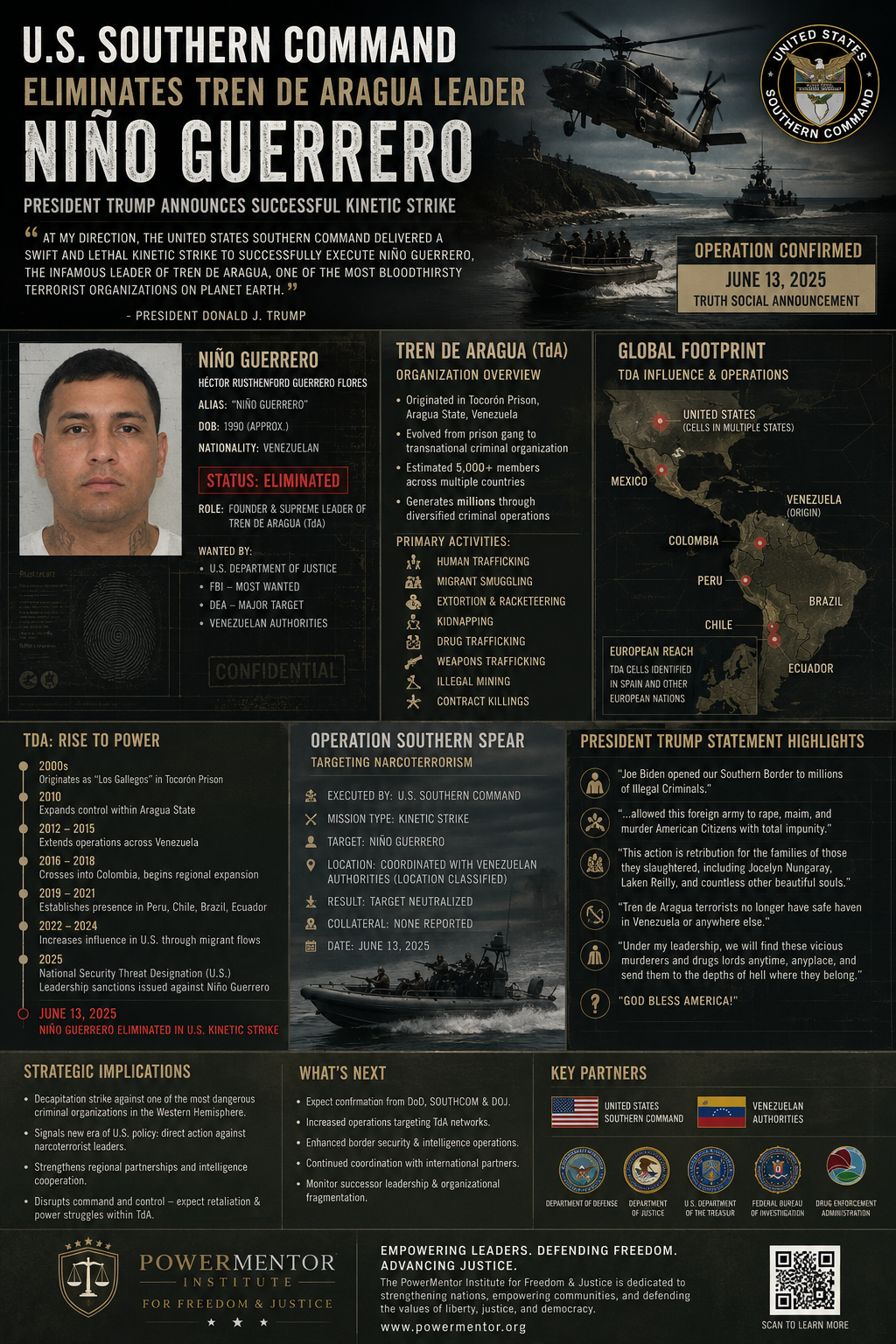
On June 13, 2026, President Donald J. Trump announced that United States Southern Command had conducted a "swift and lethal kinetic strike" resulting in the death of Héctor Rusthenford Guerrero Flores, better known as Niño Guerrero, the alleged founder and supreme leader of Tren de Aragua (TdA).
This operation represents one of the most significant actions ever taken against a transnational criminal organization in the Western Hemisphere.
The significance extends far beyond the death of one criminal leader.
It reflects a growing recognition that certain criminal organizations have evolved beyond traditional gangs and now operate as transnational threats capable of destabilizing governments, corrupting institutions, exploiting migration routes, trafficking human beings, and terrorizing communities across multiple continents.
Who Is Niño Guerrero?
For years, Niño Guerrero was one of the most powerful and elusive criminal figures in Latin America.
Unlike traditional gang leaders who control a neighborhood or city, Guerrero allegedly oversaw a criminal enterprise stretching across multiple nations.
His organization emerged from Venezuela's notorious Tocorón Prison, a facility that became symbolic of state collapse and criminal control.
Reports over the years described Tocorón as less a prison and more a criminal kingdom.
Inside the prison were reportedly:
Swimming pools
Restaurants
Nightclubs
A zoo
Commercial businesses
Armed security
While ordinary citizens struggled with economic collapse, Guerrero allegedly exercised power from inside prison walls while directing criminal operations throughout Venezuela and beyond.
The existence of such an environment represented not merely criminal activity but a profound breakdown of governmental authority.
The Rise of Tren de Aragua
Tren de Aragua began as a regional gang connected to labor disputes involving railroad workers in Venezuela.
Over time it evolved into something much larger.
The organization expanded during a period characterized by:
Political instability
Economic collapse
Hyperinflation
Mass migration
Weak law enforcement institutions
As millions of Venezuelans fled their country, criminal networks discovered opportunities to exploit migration routes.
Tren de Aragua adapted quickly.
The gang reportedly established operations in:
Venezuela
Colombia
Ecuador
Peru
Chile
Brazil
Mexico
United States
Spain and other parts of Europe
Rather than remaining confined to one geographic area, TdA followed migration corridors and built criminal infrastructure wherever vulnerable populations existed.
The Criminal Business Model
Unlike traditional drug cartels that focus primarily on narcotics trafficking, Tren de Aragua diversified its criminal portfolio.
Human Trafficking
One of the most disturbing allegations involves the exploitation of vulnerable migrants.
Criminal networks reportedly preyed upon individuals fleeing economic hardship and political instability.
Victims were often:
Extorted
Kidnapped
Forced into labor
Subjected to sexual exploitation
Threatened with violence against family members
Extortion
Businesses throughout several countries reported systematic extortion demands.
Failure to pay frequently resulted in threats, assaults, property damage, or worse.
Kidnapping
Kidnapping became another revenue source.
Victims included:
Business owners
Migrants
Professionals
Family members of targeted individuals
Drug Trafficking
Although not exclusively a narcotics organization, TdA reportedly generated significant revenue through drug distribution and transportation networks.
Contract Killings
Authorities across South America linked TdA members to numerous murders and targeted assassinations.
Violence was not simply a byproduct of criminal activity; it became a governing tool used to establish fear and maintain control.
Impact on Communities
The greatest victims of organizations like Tren de Aragua are ordinary citizens.
Communities affected by TdA often experience:
Fear
Residents become reluctant to cooperate with authorities.
Witnesses remain silent.
Victims avoid reporting crimes.
Economic Damage
Businesses close.
Investors leave.
Jobs disappear.
Economic growth slows.
Social Breakdown
Families become fragmented.
Neighborhood trust declines.
Public spaces become unsafe.
Government Corruption
Criminal organizations frequently seek influence over public officials, police officers, and local institutions.
When corruption spreads, public confidence erodes.
The result is a cycle in which criminal power expands while legitimate authority weakens.
Why Governments Are Taking a Harder Approach
Historically, criminal organizations were treated primarily as law enforcement problems.
Today, many governments increasingly view groups such as Tren de Aragua as hybrid threats occupying the space between organized crime and terrorism.
Several factors contribute to this shift:
International Reach
The organization operates across multiple countries.
Financial Power
Criminal enterprises generate millions of dollars annually.
Use of Terror
Violence is intentionally used to intimidate populations.
Institutional Corruption
Criminal groups undermine governmental legitimacy.
Cross-Border Operations
Traditional policing alone struggles to address organizations operating internationally.
For these reasons, governments have increasingly adopted counterterrorism-style strategies.
The Reported Southern Command Operation
While operational details remain limited, President Trump's announcement suggests several noteworthy elements.
Precision Targeting
The strike reportedly focused on a specific individual rather than broader military objectives.
International Coordination
Trump stated that the operation was coordinated with Venezuelan authorities.
If accurate, this represents a remarkable development given the historically strained relationship between Washington and Caracas.
Strategic Messaging
The operation sends a message that transnational criminal leaders may no longer enjoy sanctuary based on geography.
Deterrence
The objective is not only to remove a leader but to influence the decision-making of others who may believe they are beyond the reach of law enforcement or military power.
Will Tren de Aragua Survive?
History suggests that organizations rarely disappear overnight.
Several possibilities exist.
Scenario One: Fragmentation
Without a central leader, regional commanders may compete for power.
This can temporarily weaken organizational effectiveness.
Scenario Two: Succession
Another leader quickly assumes control.
This has occurred repeatedly throughout criminal history.
Scenario Three: Organizational Decline
Sustained pressure from multiple governments disrupts finances, communications, recruitment, and operations.
This outcome requires long-term commitment.
The removal of a leader is often the beginning of a campaign rather than the conclusion of one.
Lessons for the Future
The rise of Tren de Aragua offers important lessons.
Weak Institutions Create Opportunity
Criminal organizations flourish where governmental authority is absent or ineffective.
Borders Alone Are Not Enough
Modern criminal networks operate across continents.
Solutions require international cooperation.
Human Trafficking Must Remain a Priority
Some of the most vulnerable people in society become targets for exploitation.
Public Safety and National Security Are Increasingly Linked
Criminal organizations can create consequences that extend far beyond local crime statistics.
Final Thoughts
Whether viewed through the lens of public safety, national security, or human rights, the story of Tren de Aragua illustrates how criminal organizations can evolve into powerful transnational enterprises capable of affecting entire regions.
If reports regarding the death of Niño Guerrero are confirmed, historians may view this event as a significant turning point in the international effort to confront one of the Western Hemisphere's most dangerous criminal organizations.
The challenge moving forward will not simply be removing individual leaders.
The challenge will be dismantling the systems, finances, recruitment networks, corruption structures, and criminal economies that allow organizations like Tren de Aragua to survive.
Lasting victory is achieved not only by eliminating criminal leaders but by restoring security, opportunity, justice, and hope to the communities they have harmed.
PowerMentor Institute for Freedom & Justice
Empowering Leaders. Defending Freedom. Advancing Justice.
