

Iran’s Divided Command: Why Negotiations Will Likely Fail—and Military Action Required
Strategic Assessment
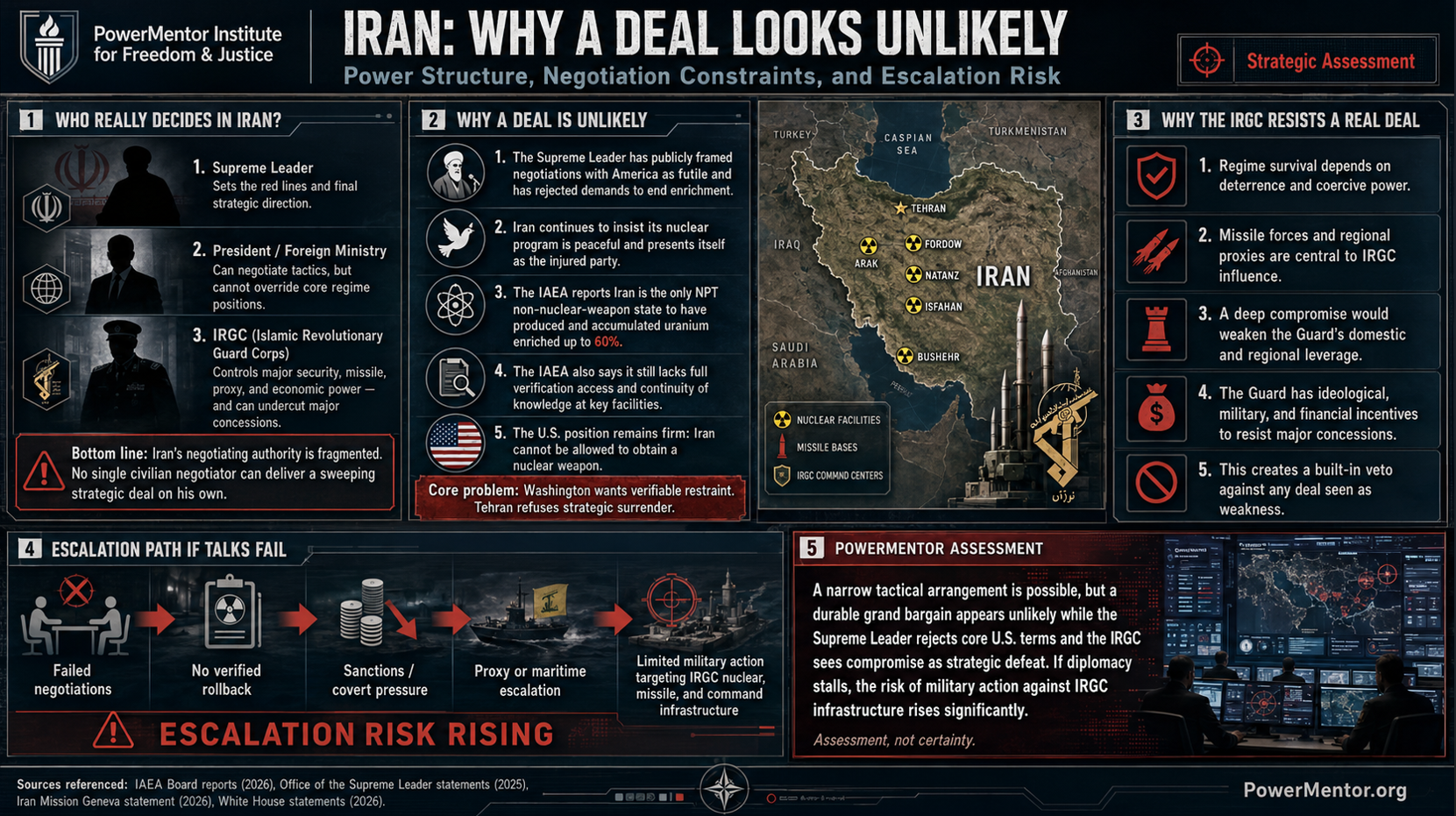
Iran’s present crisis cannot be understood through the familiar image of a single Supreme Leader issuing orders through a unified chain of command. The system confronting the United States and its Middle Eastern partners is increasingly fragmented, militarized, and shaped by competing centers of authority.
That fragmentation makes diplomacy exceptionally difficult. It also creates a serious danger: an Iranian official may negotiate an arrangement without possessing the authority—or the institutional power—to ensure that the Islamic Revolutionary Guard Corps complies with it.
This assessment is not based on partisan ideology. It is based on the observable structure of the Iranian regime, its public positions, the International Atomic Energy Agency’s findings, and the rapidly changing balance of power inside Tehran.
Important update: Military action against Iran is no longer merely a future possibility. The United States and Israel have already conducted extensive strikes during the 2025–2026 conflict. The relevant question now is whether failed negotiations will produce another concentrated phase of military action, particularly against surviving IRGC, missile, naval, command-and-control, and nuclear-related infrastructure.
Iran No Longer Has a Clear, Unified Decision-Maker
Historically, Iran’s Supreme Leader served as the final arbiter among the presidency, clerical establishment, military, intelligence services, and Revolutionary Guard.
That arrangement has been severely disrupted.
Following the death of Ayatollah Ali Khamenei during the opening phase of the 2026 war, Mojtaba Khamenei was elevated into the leadership structure. However, reporting indicates that the IRGC and senior security officials have gained wartime authority while the new Supreme Leader exercises considerably less independent control than his predecessor.
Iran therefore appears to be operating through several overlapping power centers:
The Supreme Leader
The Supreme Leader provides ideological legitimacy and formal authorization. But formal authority does not necessarily equal operational control, particularly when the military-security establishment believes the survival of the regime is at stake.
The President and Foreign Ministry
Iran’s civilian diplomats can conduct negotiations, communicate through intermediaries, and explore ceasefires or sanctions arrangements.
However, they cannot independently dismantle the nuclear program, surrender missile capabilities, abandon regional proxies, reopen strategic waterways, or restructure the Revolutionary Guard.
The Islamic Revolutionary Guard Corps
The IRGC controls or influences:
Ballistic missiles and drones
Strategic naval operations
Regional proxy relationships
Internal security and political enforcement
Large portions of Iran’s economy
Sensitive military and nuclear-related infrastructure
The Guard is not simply one government department. It is a military, intelligence, ideological, political, and economic power structure within the state.
This creates the central negotiating problem:
The people capable of signing an agreement may not be capable of enforcing it, while the people capable of enforcing it may have strong incentives to prevent it.
Iran’s Leadership Is Not Necessarily Paralyzed—But It Is Divided
It would be inaccurate to say that Iran is completely incapable of making decisions. The regime has continued military operations, managed internal succession, negotiated through intermediaries, and coordinated responses to external attacks.
The more precise conclusion is that Iran can still make tactical decisions, but reaching a durable strategic decision is far more difficult.
Iran may be able to agree temporarily to:
Reduce attacks
Extend a ceasefire
Permit limited maritime traffic
Exchange prisoners
Resume indirect negotiations
Offer narrowly defined inspection access
But a permanent agreement would require the regime to resolve questions that affect its fundamental identity and survival:
Will Iran permanently restrict enrichment?
Will it surrender or export enriched uranium?
Will the IAEA receive unrestricted access?
Will Iran limit its ballistic-missile program?
Will the IRGC cease supporting regional armed groups?
Will the Strait of Hormuz remain permanently open?
Will sanctions relief occur before or after compliance?
Those are not technical details. They are questions about whether the Islamic Republic will surrender the instruments it believes keep the regime alive.
The IRGC Has Powerful Reasons to Resist a Comprehensive Deal
A Real Agreement Would Reduce the Guard’s Power
The IRGC’s domestic importance is reinforced by the existence of external enemies, sanctions, military confrontation, and continuing national emergencies.
A comprehensive agreement would weaken the Guard by:
Reducing its control over national-security policy
Limiting missile and drone programs
Restricting illicit commercial networks
Weakening its relationships with regional proxies
Allowing civilian institutions greater influence
Opening Iran to economic and political competition
For many IRGC leaders, therefore, a genuine normalization agreement may represent a greater institutional threat than continued confrontation.
The Guard’s Ideology Rewards Resistance
The Revolutionary Guard was created to defend the Islamic Revolution—not merely Iran’s borders. Its institutional identity is built around resistance to the United States, Israel, and Western political influence.
A settlement that appears to result from American military and economic pressure could be interpreted internally as ideological surrender.
Conflict Preserves the Guard’s Economic Position
Sanctions and isolation injure ordinary Iranians, but they can also strengthen organizations with access to smuggling networks, state contracts, ports, construction companies, energy assets, and protected financial channels.
The more isolated Iran becomes, the more valuable the IRGC’s networks can become.
Iran May Seek a Limited Deal Rather Than Genuine Resolution
Recent reporting suggests that Tehran has explored a limited or interim arrangement designed to ease economic pressure while avoiding irreversible concessions on the nuclear program. Iranian sources described an approach focused on absorbing pressure, keeping diplomacy alive, and preserving core capabilities.
That would fit Iran’s strategic interests.
A limited arrangement could provide:
Partial sanctions relief
Reduced military pressure
Time to rebuild damaged capabilities
Domestic economic breathing room
International recognition of the government
Preservation of enrichment knowledge and infrastructure
The United States, however, is seeking outcomes that can be verified rather than promises that can be reversed. Historically, Iran has never honored agreements such as an MOU.
This creates a fundamental mismatch:
Washington wants measurable disarmament and durable restraint. Tehran wants relief, survival, and strategic flexibility.
The Nuclear Verification Crisis Makes Trust Nearly Impossible
The International Atomic Energy Agency has reported that it cannot establish the current size, composition, or location of significant portions of Iran’s enriched-uranium stockpile.
Before the loss of inspection access, Iran had accumulated approximately 440.9 kilograms of uranium enriched to 60 percent. The IAEA has described Iran as the only non-nuclear-weapon state under the Nuclear Non-Proliferation Treaty to have produced and accumulated uranium at that enrichment level.
The agency has also reported:
Loss of continuity of knowledge over nuclear material
No access to several affected enrichment facilities
Uncertainty regarding the location and status of enriched uranium
Inability to confirm whether enrichment has stopped
Unresolved concerns regarding undeclared material and activities
There is an important distinction:
This does not by itself prove that Iran has assembled a nuclear weapon.
But it does mean that international inspectors cannot reliably verify Iran’s claims. In nuclear diplomacy, verification gaps create strategic danger even when weaponization has not been conclusively demonstrated.
Why Negotiations Are Unlikely to Produce a Grand Bargain
A limited ceasefire or transitional agreement remains possible. A comprehensive settlement is much less likely because of five structural barriers.
1. No Single Iranian Institution Can Deliver Everything
The diplomatic apparatus can negotiate, but the IRGC possesses much of the relevant operational power.
2. The Regime Equates Concessions With Vulnerability
Iranian leaders repeatedly argue that previous agreements produced Iranian concessions without reliable Western compliance. This history reinforces the belief that compromise invites additional pressure.
3. The IRGC Benefits From Strategic Ambiguity
Uncertainty about missiles, drones, uranium, naval capabilities, and proxy forces increases Iran’s deterrent value.
4. The United States Requires Verifiable Results
The current American position remains that Iran cannot obtain a nuclear weapon. A politically sustainable agreement would therefore require intrusive verification and enforceable restrictions—not broad statements of peaceful intent.
5. Events Outside the Negotiating Room Can Destroy the Process
An Israeli strike, Iranian missile launch, Hezbollah attack, maritime incident, militia assault, or assassination could collapse negotiations regardless of progress made by diplomats.
The June 2026 exchanges between Iran and Israel demonstrated how quickly regional fighting can threaten broader negotiations.
What a Renewed Military Strike Could Look Like
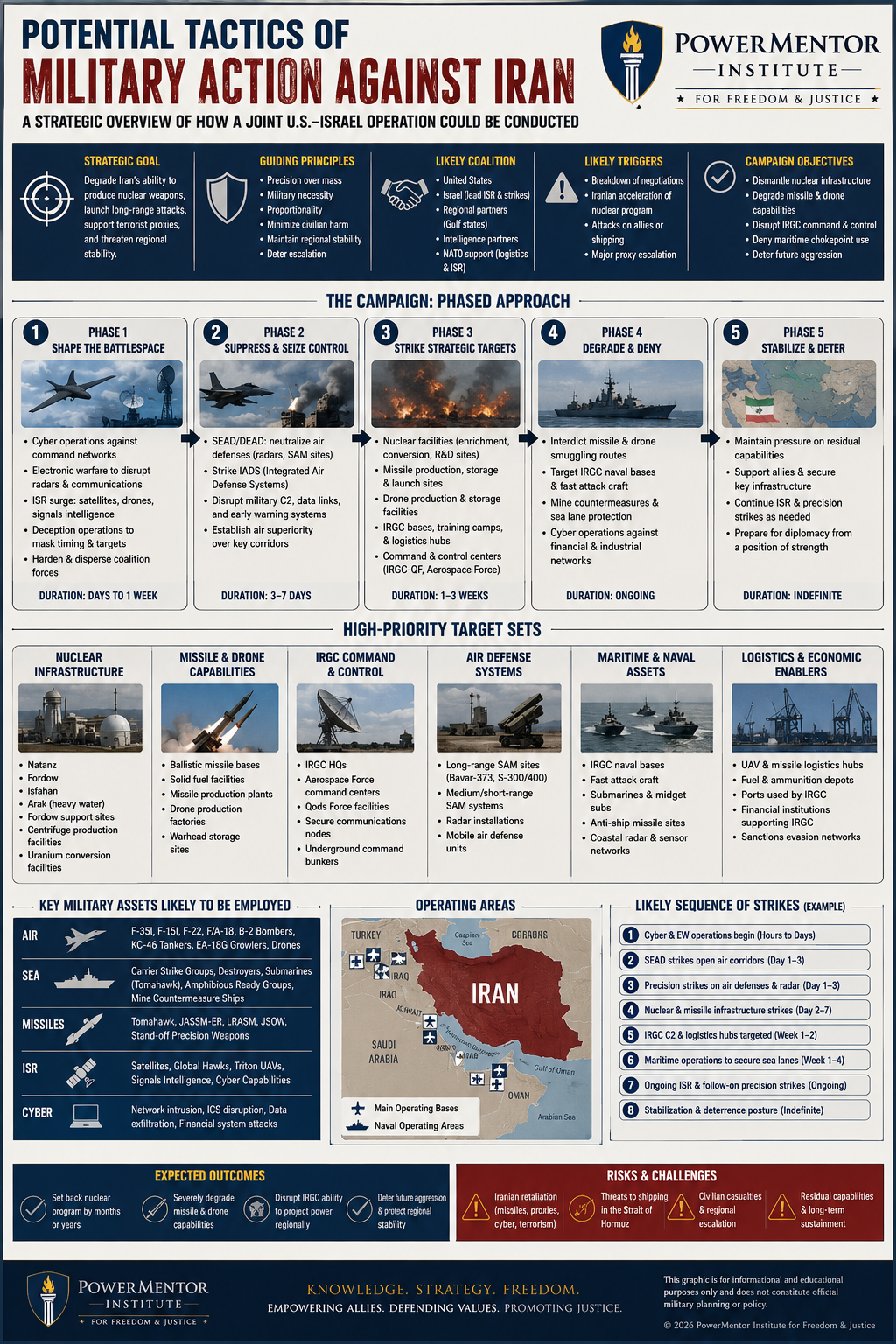
Should negotiations collapse, the next military phase would likely be designed not as a symbolic warning but as a concentrated effort to reduce the IRGC’s ability to regenerate military power, threaten Gulf shipping, retaliate against American partners, and conceal nuclear activity. A military strike to take out or diminish the IRGC is becoming more and more likely, and the only sure method nuetralize the threat from Iran.
This is a strategic assessment, not a prediction or endorsement of war.
Phase One: Intelligence, Surveillance, and Force Protection
Before visible strikes, the United States and its allies would likely increase:
Satellite and airborne surveillance
Monitoring of mobile missile units
Tracking of IRGC commanders and communications
Protection of American bases and embassies
Naval defenses around the Persian Gulf
Air- and missile-defense deployments
Warnings to commercial shipping
The immediate purpose would be to identify Iranian retaliation options and reduce the vulnerability of U.S. personnel and regional partners.
Phase Two: Suppression of Iranian Air and Missile Defenses
An opening strike package would likely focus on Iran’s ability to contest the airspace and launch rapid retaliation.
Likely target categories could include:
Air-defense radar
Surface-to-air missile systems
Military communications
Command-and-control centers
Ballistic-missile launch sites
Drone storage and launch infrastructure
The goal would be to reduce Iran’s defensive awareness and disrupt coordinated retaliation.
Phase Three: Strikes on IRGC Operational Infrastructure
The central military focus would probably be the Guard’s surviving capacity rather than Iran’s civilian population.
Potential target categories could include:
IRGC Aerospace Force installations
Missile-production and storage facilities
Drone-manufacturing infrastructure
Naval bases supporting operations in the Persian Gulf
Command bunkers and communications nodes
Facilities supporting regional proxy operations
Military logistics and weapons-transfer networks
The objective would be to sever the connections between commanders, weapons, transportation systems, and field units.
Phase Four: Nuclear-Related Targets
Where intelligence indicated continuing enrichment or concealed nuclear activity, strikes could be directed against:
Enrichment infrastructure
Centrifuge-support facilities
Uranium-conversion capabilities
Underground access points
Electrical systems supporting nuclear facilities
Storage or transportation infrastructure associated with enriched material
Underground facilities would present the greatest challenge. Military action can damage buildings, entrances, power systems, ventilation, and equipment, but it may not establish where all nuclear material is located.
That is why military action can delay a nuclear program without necessarily eliminating the knowledge, personnel, or political intention behind it.
Phase Five: Maritime Operations
Iran’s strongest leverage may remain its ability to threaten shipping through the Strait of Hormuz.
A renewed campaign could therefore include efforts to:
Protect commercial vessels
Clear or deter naval mines
Neutralize missile and drone threats near shipping lanes
Restrict movement from IRGC-controlled ports
Interdict weapons shipments
Target small-boat and unmanned naval capabilities
Iran has used pressure on the Strait as deterrence, economic leverage, and a way of raising the international cost of military action.
What Iran’s Retaliation Could Look Like
Iran would be unlikely to respond solely through conventional military action.
A broader retaliation strategy could include:
Ballistic-missile and drone attacks
Attempts to disrupt the Strait of Hormuz
Attacks against Gulf energy infrastructure
Cyberattacks against government or commercial systems
Proxy attacks against American or allied interests
Pressure against Israel through multiple regional fronts
Detention of foreign nationals or maritime crews
Domestic repression framed as wartime security
Iran’s strategy would likely be to expand the political and economic cost of the conflict, rather than defeat the United States through conventional combat.
A Strike Would Not Necessarily End the Regime
Military superiority does not automatically produce political control.
A renewed campaign could destroy substantial IRGC infrastructure while still failing to:
Locate all enriched uranium
Eliminate Iran’s nuclear expertise
Prevent future clandestine rebuilding
Create a stable successor government
Stop all proxy attacks
Guarantee that the Strait remains open
Prevent civilian casualties and regional economic disruption
It could also strengthen the most militant factions by allowing them to portray the conflict as a struggle for national survival.
The United States and its allies can severely damage Iranian capabilities. That does not mean they can easily determine what political order follows.
The Most Likely Outcome: Coercive Diplomacy, Not Clean Victory
The most probable path is not uninterrupted peace or unlimited war.
It is a cycle of:
Negotiations → limited agreement → alleged violation → economic pressure → military escalation → temporary ceasefire → renewed negotiations
That cycle may continue because neither side can easily obtain everything it wants.
Iran cannot defeat the United States militarily. But it can create substantial economic, political, and regional costs.
The United States and Israel can destroy military infrastructure. But airstrikes alone cannot erase nuclear knowledge, guarantee compliance, or manufacture a unified Iranian negotiating authority.
PowerMentor Assessment
A narrow tactical agreement remains possible. A durable grand bargain remains unlikely.
Iran’s civilian diplomats may be capable of negotiating temporary arrangements, but the IRGC controls many of the capabilities that would have to be surrendered, restricted, or verified.
The absence of a universally dominant decision-maker increases the possibility that:
Iranian negotiators promise more than they can deliver
The IRGC obstructs or circumvents implementation
Regional actors trigger escalation independently
The United States concludes that diplomacy is being used to buy time
Should negotiations collapse, the next military phase would likely focus on surviving IRGC missile, drone, naval, nuclear-support, and command infrastructure.
Yet military action would carry a serious warning:
Destroying capabilities is easier than producing political stability. Delaying a nuclear program is easier than eliminating the knowledge behind it. Beginning a military operation is easier than controlling everything that follows.
Peace requires credible diplomacy. Credible diplomacy requires unified authority, enforceable commitments, unrestricted verification, and consequences for noncompliance. Iran presently appears unable—or unwilling—to provide all four.
